
The annual Royal Society Awards recognise outstanding contributions to scientific discovery, public engagement and research culture. Of the 27 awards for 2025-26, announced today, four honour Oxford University researchers.

Sir Paul Nurse, President of the Royal Society, said: 'The recipients of this year's medals and awards have made exceptional contributions to science and research culture. Their work has helped further our understanding of the world around us and will inspire generations of scientists to come. Celebrating excellence in science is core to the Society's mission. I offer my congratulations to all the 2026 recipients.'
About the Oxford winners:
Professor Laura Herz (Department of Physics) has been awarded the Rumford Medal , which recognises outstanding contributions in the field of physics.
Professor Herz's research explores how light interacts with novel semiconductor materials and has helped establish the physical principles that underpin the development of highly efficient next-generation solar cells.
Her group studies how light creates mobile electrical charges, how these charges move through a semiconductor and why they are sometimes lost before they can be used. By uncovering these fundamental physical processes, this enables scientists and engineers to design materials that convert sunlight into electricity more efficiently. Much of her current work focuses on metal-halide perovskites, a new class of semiconductors that has transformed solar-cell research over the past decade because they can be made inexpensively while achieving exceptionally high efficiencies.
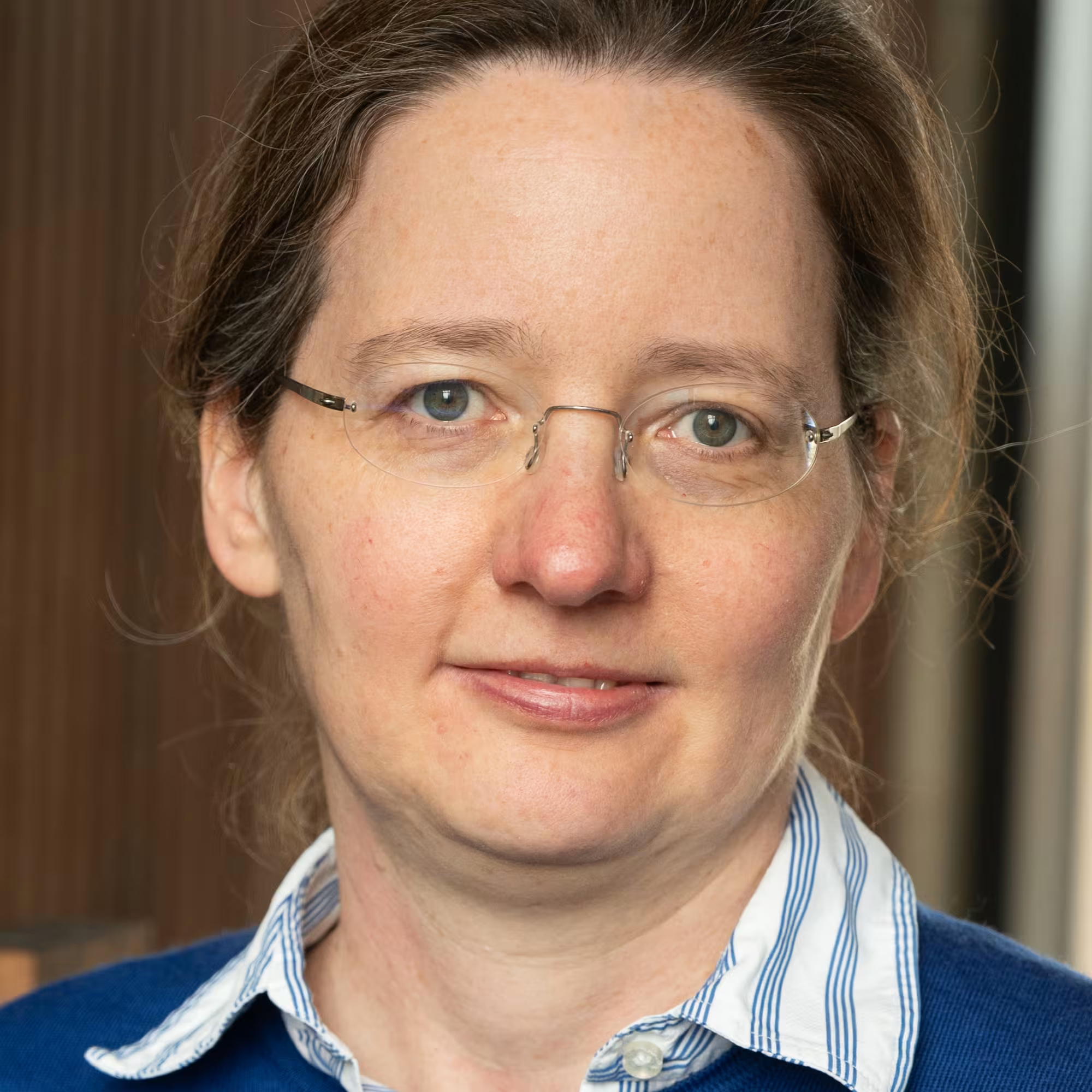
"I am deeply honoured to receive the Rumford Medal. The award highlights how curiosity-driven physics can make important contributions towards solving one of society's greatest challenges: the development of affordable and sustainable energy technologies. This work would not have been possible without the creativity, dedication and generosity of the many outstanding students, postdoctoral researchers and collaborators with whom I have had the privilege to work over the years. I am sincerely grateful to them, and to the Royal Society, for this recognition."
Professor Iain McCulloch (Department of Chemistry) has been awarded the Hughes Medal , which recognises outstanding contributions in the field of energy.
Professor McCulloch researches chemistry-based solutions that can help address global warming. One promising approach is using hydrogen as both replacement for fossil fuels and as a chemical reagent, generated from water rather than from fossil fuels.
Professor McCulloch's group focusses on designing and synthesizing organic semiconducting polymers, to efficiently absorb solar irradiation and convert this into electrical charges which can be used to drive chemical reactions as well as provide electrical power. This includes fabricating organic semiconducting nanoparticle photocatalysts to split water into molecular hydrogen and oxygen. Additionally, his group are pursuing other related technologies including organic photovoltaics for electricity generation.

"It is a huge honour to be awarded the Royal Society Hughes Prize. Clean energy provision is one of the most important global challenges of today, requiring innovative technologies across sectors currently using fossil fuels. My research relies on having excellent, and patient, collaborators and colleagues, as well as having group members who are comfortable to extend their expertise into areas beyond their educational background and comfort zones. This award is testimony to their endeavours."
Professor Ketan Patel , Director of the MRC Weatherall Institute of Molecular Medicine (MRC WIMM), has been awarded the Buchanan Medal , which recognises distinguished contributions to the biomedical sciences.
Professor Patel's research has revealed how aldehydes, simple chemicals produced naturally within our bodies and when we consume alcohol, can damage our DNA - the blueprint of life. His work discovered the mechanism that protects our genomes from this threat, and showed that when this mechanism fails, the consequences are profound: blood production ceases, tissues age prematurely and the risk of cancer is greatly increased.
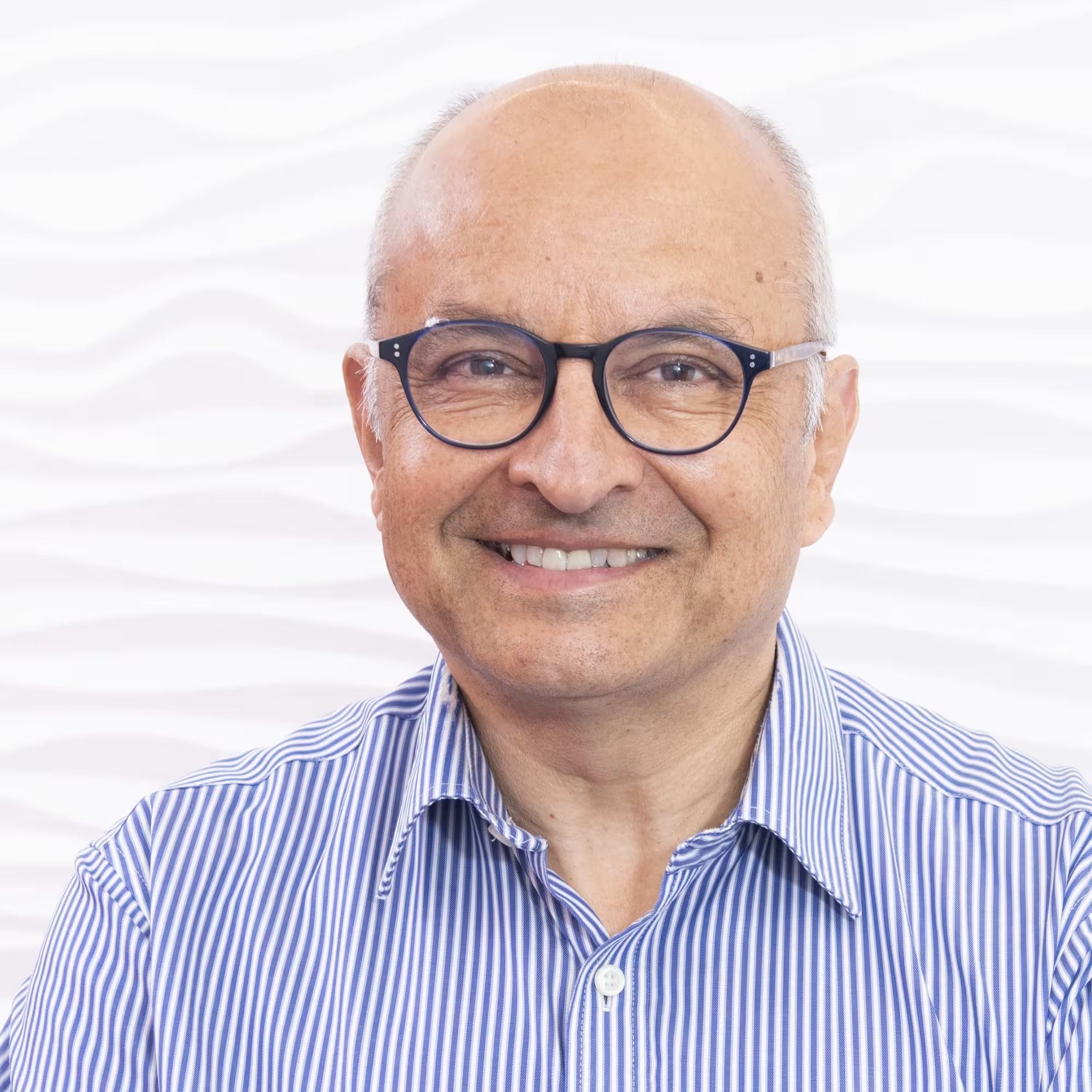
"I am deeply honoured to receive the Buchanan Medal from the Royal Society, particularly given the distinguished Oxford scientists who have received it in the past. This award also belongs to the many exceptional students, postdoctoral fellows and collaborators I have had the privilege of working with over the years. Their dedication, creativity and perseverance made these discoveries possible, and I am enormously grateful to them."
Professor Charlotte Williams (Department of Chemistry) has been awarded the Armourers & Brasiers' Company Prize which is awarded for excellent use-inspired basic research in functional or structural materials.
Professor Williams's research focusses on using innovative catalysis and polymer chemistry to try to reduce environmental pollution.
Her discoveries have enabled the efficient production of high-performance plastics, elastics, electrolytes for batteries and even water-soluble polymers for use in beauty and cleaning products. Recent research highlights include her discovery of innovative catalysts that transform waste carbon dioxide into polymers. All her materials are designed from the outset with their end-of-life in mind, so that they are reusable, fully recyclable or fully biodegradable. She leads a research team in the Department of Chemistry and works with a range of business partners. She is also the founder and a director of econic technologies , which sells catalysts and technologies for carbon dioxide transformation into polymers.

"I am honoured by the recognition for my work in catalysis and polymer materials. Since this award recognises science with real-world impact, I really want to acknowledge the value of academic-industry teamwork. I've thoroughly enjoyed working with scientists, engineers and leaders in many companies and especially want to acknowledge all my colleagues at econic technologies. It's been an incredible journey to see my science transformed from discoveries in the university laboratories into large-scale commercial processes and products."
Further information about the 2026 awards can be found on the Royal Society website .


