
In May 2025, fourth-grader Emily Roberts was camping near Cottonwood, California when she awoke one morning completely paralyzed from her left waist down to her left foot. She couldn't walk.
"I felt very scared," Emily said. "I had to leave our trip to go to the hospital again."
Emily's mother, Cecille Roberts, is haunted by the memory of their drive to the emergency department. "It's the worst experience, to hear your child screaming in pain, saying she wishes her life would be over, so she won't hurt anymore," Cecille said.
A year of frightening symptoms
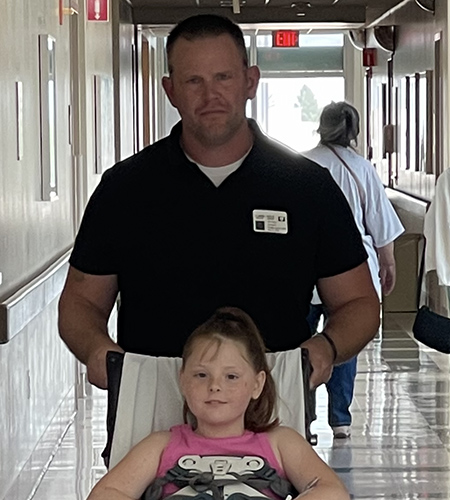
Emily had already endured a year of worsening, unexplained symptoms. Usually an active kid playing softball, hiking and camping, she began to experience back pain that progressed to leg weakness and incontinence.
"Emily just screamed and cried at home," Cecille said. "She'd have bathroom accidents at school because she didn't have the sensations to tell her to go. She was so embarrassed."
She was repeatedly misdiagnosed and sent home from hospitals and clinics with pain medication that didn't help.
Paralysis leads to emergency spine surgery and discovery of aggressive bone cyst
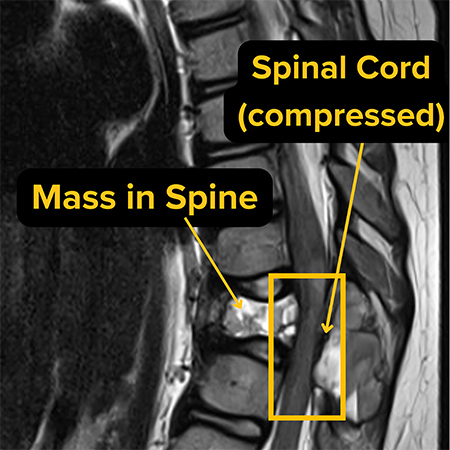
Everything changed when UC Davis Children's Hospital pediatric neurosurgeon Cameron Sadegh received a transfer request. "Based on her symptoms, I knew something was compressing her spinal cord," he said. "When a person starts losing sensation, doctors have 24-48 hours to intervene before effects may become permanent."
Sadegh arranged for Emily to take an air ambulance to UC Davis Children's Hospital, where he met her and her mother on the helipad late one Saturday night. Within 30 minutes of arrival, she was in surgery with Sadegh and UC Davis Spine Center neurosurgeon Rick Price.

The emergency procedure removed enough of the lesion and affected vertebra to restore movement to her leg. It also confirmed the cause of her symptoms: an a rare, aggressive lesion weakening her spine and several ribs. Emily needed more surgery.
Further imaging showed the cyst had grown into her chest cavity. The team brought in pediatric cardiothoracic surgery expert Gary Raff to help protect Emily's left In addition, vascular neurosurgeon Branden Cord prepared Emily for safer spine reconstruction surgery. To reduce blood loss, he carefully injected material into blood vessels feeding the cyst to block them, a procedure called embolization.
When a person starts losing sensation, doctors have 24-48 hours to intervene before effects may become permanent." -UC Davis Children's Hospital pediatric neurosurgeon Cameron Sadegh

Virtual and augmented reality can enhance surgical accuracy
Price brought a special area of expertise to the team: the development and use of advanced virtual and augmented reality tools. He used these tools to create an immersive 3D visualization of the tumor, allowing the team to "walk through" Emily's anatomy. This helped them prepare the safest approach and then achieve maximum accuracy during surgery. "These tools help us better protect the spinal cord and stabilize the spine," Price said.
Their planning paid off: Emily's final surgery was a success.

After several weeks of physical and occupational therapy in the hospital, she went home with nine carbon fiber screws and one "cage" that reconstructs the vertebral body her surgeons removed. Price chose carbon fiber components to ensure Emily's best care going forward. While other available metals can cause visual interference, Emily's carbon fiber components are radiolucent, which means X-rays pass through them easily. They ensure clear medical images as her spinal reconstruction is monitored while she grows.
The hardware also kept her spinal column and spinal cord safe as she healed. Emily has regained strength and her incontinence resolved as well.
By August, she was cleared just in time for fifth grade — and cheer tryouts. Emily cheered for her first school sports event in January. She loves her black, green and white uniform and the energy of the team.
"I can't stunt and I can't tumble, but all the other things I can do," Emily said. "My coach told me the other kids will support me."
"I can be a kid again"
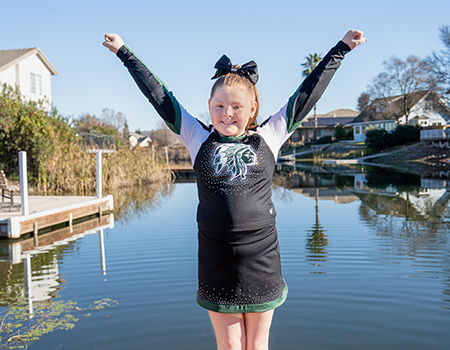
This week, Emily and her care team will mark the first anniversary of her successful surgeries as she finishes her school year strong and smiling.
"Emily has been a huge partner in this by telling us how she feels as she heals," Sadegh said. "When kids and their families keep the dialogue open with all of us, they facilitate our team giving them the very best care."
Her message to her care team: "Thank you for getting me to where I am today, so I can be a kid again!"


