
Mathematical models have necessarily reduced distant exoplanets to idealized circles - until now.
Leveraging observations by NASA's James Webb Space Telescope (JWST) and a new mapping method called "transmission strings," a Cornell-led international research team has for the first time resolved an exoplanet's uneven contours. The resulting shape - circle-like, of course, but slightly egg-shaped, with one more extended side - details how intense heat and whipping winds influence the atmosphere of the "hot Jupiter" WASP-17b, orbiting a star more than 1,000 light years from Earth.
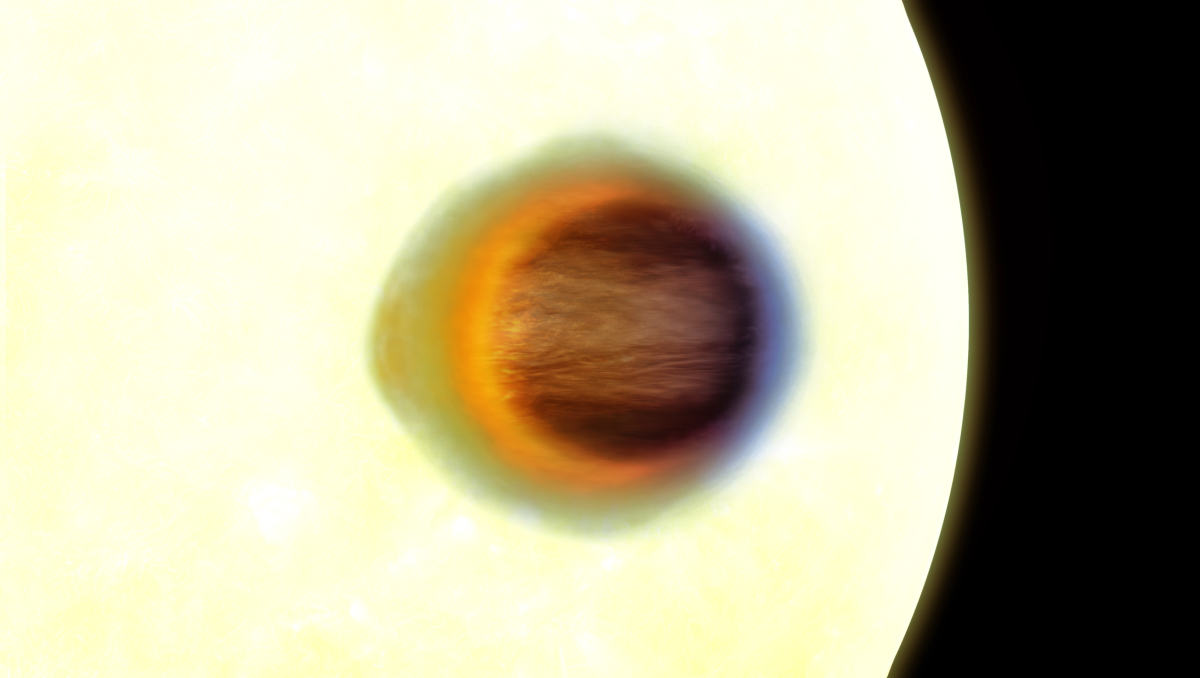
WASP-17b transiting in front of its star revealing the shape of its absorbing atmosphere through James Webb Space Telescope observations.
The team says its findings about the planet's chemical composition and temperature shifts - from equator to poles, and between permanent day and night sides - are consistent with theoretical predictions and other modeling techniques. Together, they create one of the most comprehensive, three-dimensional views of an exoplanet's atmosphere among the more than 6,000 exoplanets confirmed to date, making WASP-17b a benchmark for comparisons with others.
"This is proof of concept that planets are in fact 3D objects, and that consistently, as they go around their star, what we predict should be happening is happening," said Lili Alderson, a Klarman Postdoctoral Fellow in the College of Arts and Sciences. "To move beyond computational exercises and see it for real is a different matter."
Alderson is the first author of "A Spatial Map of the Atmospheric Limb of a Hot Jupiter," published Oct. 14 in Nature Astronomy. Twenty co-authors include Nikole Lewis, associate professor in the Department of Astronomy (A&S) and Alderson's fellowship adviser, and doctoral students Maura Lally and Elijah Mullens; and from the University of Bristol, U.K., where Alderson earned her doctoral degree and began the work, second author Hannah Wakeford, associate professor of astrophysics, and Senior Postdoctoral Associate David Grant and doctoral student Daniel Valentine.
"Planets are temperamental, their atmospheres complex and chaotic," Wakeford said. "The fact that all of these numbers came together and showed us this very structured, dynamical picture of this giant world over 1,000 light years away was just really exciting."
Cornell-led research previously has used JWST's game-changing sensitivity to pioneer a technique called eclipse mapping, which measures changes in light as an exoplanet swings behind its host star. The new transmission strings method - also called transit mapping - tracks the planet as it crosses in front of the star, capturing the composition of light around the edge of the planet's atmosphere, or limb, from different angles. Traditional modeling, in contrast, extracts a spectrum only as an average across the entire limb.
"Rather than assuming your planet is a circle with the same radius all the way around, our technique allows you to pull out different distances from the center to the edge of the planet," Alderson said. "We're able to go around the edge. So, we've gone from a ring to understanding where on the ring the gemstones are, so to speak."
The team revealed a "gem" where theory and prior modeling suggested one should be on WASP-17b, on the "evening" side of its equator. There, jets of wind transport heat from the planet's permanently illuminated day side around toward the permanently shadowed night side, inflating the atmosphere relative to the equator's cooler "morning" side. Transit mapping verified other characteristics of WASP-17b.
"Theory predicts that the morning and the evening sides should have a strong temperature difference, and WASP 17b fits really nicely in that trend - pretty much bang-on what we thought it would be," Alderson said. "It was also nice to confirm that important molecules like water and carbon dioxide are pretty consistent all the way around the limb."
Alderson and Wakeford said the successful demonstration of transmission strings on WASP-17b paves the way for mapping many more candidates. The process is beginning to differentiate conditions across exoplanet latitudes - not just between day and night sides - and a first step toward mapping weather-scale patterns in exoplanet climates.
"Having this very robust mathematical model that we can apply to this state-of-the-art data is incredibly exciting," Wakeford said. "The results are a really beautiful demonstration of the dynamics that are going on in these multidimensional and multifaceted worlds."
In addition to her ongoing collaboration with Wakeford, Alderson said her work with Lewis, as well as the time and computational resources afforded by the Klarman Fellowship, had accelerated this first-of-its-kind transit mapping.
"The first-ever use of this new technique shows us that our understanding of these planets is correct, that our different methods all agree with each other," she said. "And that the future is very bright for being able to use these techniques to get deep dives on many different planets in the coming years."
The research analyzed data collected by the JWST Telescope Scientist Team Deep Reconnaissance of Exoplanet Atmospheres through Multi-instrument Spectroscopy (TST DREAMS) Guaranteed Time Observations program, for which Lewis served as principal investigator. Funding support came from NASA, the U.K. Research and Innovation Science and Technology Facilities Council, and the Klarman Fellowship.


