
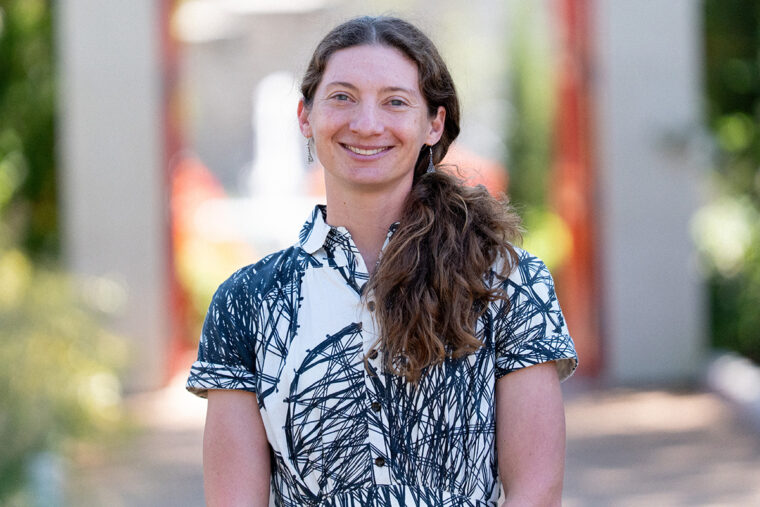
Rachel Penczykowski knew early on that she was drawn to science. Over time, her interest narrowed - first to biology, then ecology. One upper-level parasitology course changed her trajectory.
A guest lecture on environmental conditions shaping host-parasite interactions was, as she describes it, a "life-changing light bulb moment." In that lecture, she realized the intersection of ecology and disease was "exactly what I was most excited about," she recalls. From then on, disease ecology became her focus.
Today, Penczykowski is an associate professor of biology in WashU Arts & Sciences.
She pursued a PhD in aquatic disease ecology from the Georgia Institute of Technology. When a faculty position opened in the biology department at WashU, it felt like a natural next step. The ecology and evolutionary biology community is highly regarded, but the potential for collaboration at WashU was just as important.
She values being at a university large enough for ambitious research across schools, yet small enough that collaboration feels accessible.
Penczykowski's research builds on and extends her postdoctoral work. Her lab investigates plant-pathogen interactions across geographic regions and climatic zones, asking how environmental variation shapes infection risk, transmission and evolutionary change. She explains her work by drawing parallels to human disease. Just as scientists track different strains of influenza, her lab studies the genetic diversity of fungal plant pathogens and how that diversity shifts across landscapes and climates.


