
By Anna Mayor, University Communications and Marketing and USF Health
As Hillsborough County faces its largest dengue outbreak on record, with more than 350 locally-acquired cases reported this year, University of South Florida faculty and students are helping public health officials respond through predictive mapping, mosquito control training, neighborhood outreach and multilingual public education campaigns.
Dengue, also known as break-bone fever, is a viral infection transmitted through the bites of infected mosquitoes, primarily Aedes aegypti and Aedes albopictus. Symptoms can include high fever, headache, eye pain, joint pain, nausea, vomiting and skin rash. Symptoms typically appear four to 10 days after an infected mosquito bite, and severe dengue can develop after the initial fever subsides.
USF's response brings together geographic artificial intelligence, environmental research, public health expertise and community engagement to help officials identify potential mosquito breeding habitats, target prevention efforts and give residents practical information to reduce their risk.
Mapping mosquito hotspots with Geo-AI
After local officials declared a state of emergency in early October, Hillsborough County went on to account for roughly 84% of Florida's dengue cases. The outbreak has heightened the need to move mosquito control beyond reacting to reported cases toward predicting where mosquito habitats are likely to emerge.
Benjamin Jacob, associate professor of biostatistics and data science, is leading a team using geographic artificial intelligence, or Geo-AI, to help identify mosquito breeding hotspots and guide targeted intervention.
The team's "Seek and Destroy" approach uses mapping and remote-sensing tools to narrow the search, helping public health teams focus their efforts rather than canvass large areas without geographic guidance.
"By analyzing relationships between environmental factors and known mosquito collection locations, they can help predict where mosquito populations may emerge in the future," Jacob said. "At the same time, they're gaining hands-on experience with advanced analytical tools while contributing to research that supports public health and disease prevention."
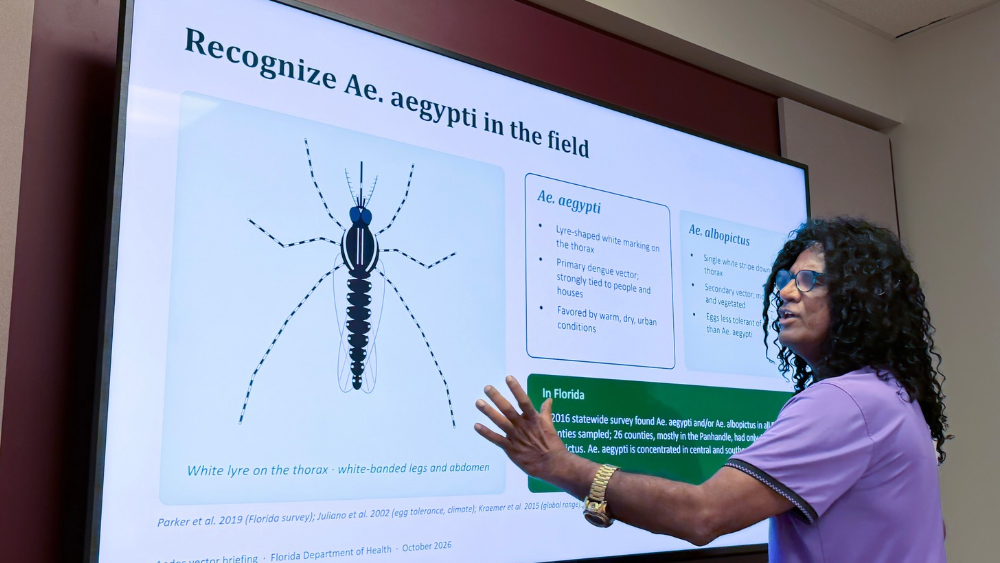
Jacob leads a training session with Florida Department of Health and Hillsborough County personnel on identifying Aedes aegypti and Aedes albopictus mosquitoes. (Photo by Anna Mayor)
Jacob and his students analyze satellite-derived imagery and environmental data to identify conditions associated with mosquito breeding. Their models incorporate weather patterns, rainfall, temperature and other environmental factors to help identify areas at elevated risk for mosquito proliferation and dengue transmission.
"When we can identify high-risk locations early, public health agencies can focus mosquito control efforts, public education and disease surveillance where they're needed most," Jacob explained. "In the future, these models could support real-time decision-making and be adapted to address other mosquito-borne diseases such as West Nile virus, Zika virus and chikungunya."
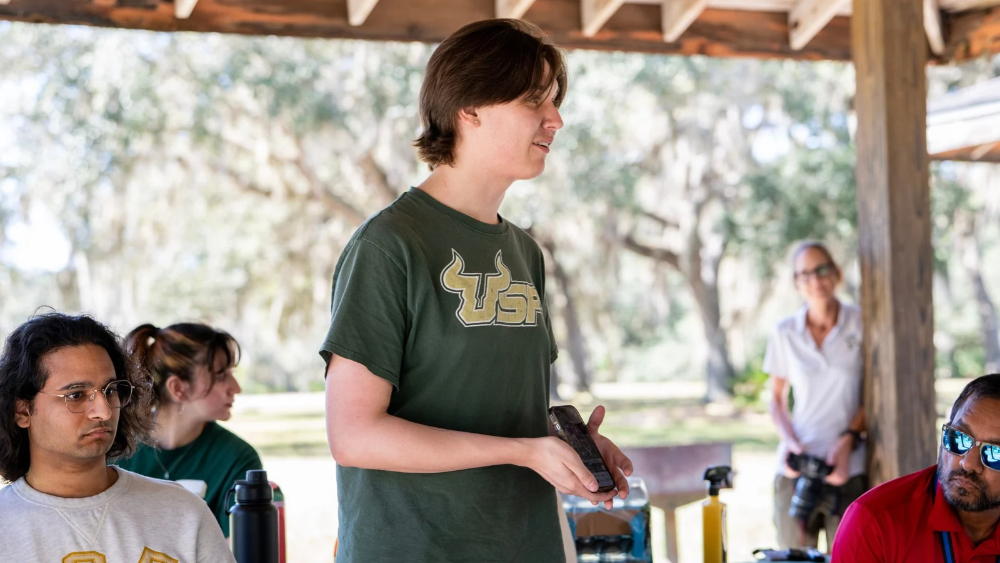
Undergraduate student Payton Jachec explains how to use GIS during a demonstration of mapping mosquito habitats using pins Jacob and his lab identified as potential areas of concern. (Photo by Fredrick Coleman)
At USF Riverfront Park, the students helped train Florida Department of Health and Hillsborough County personnel to use geographic information systems, GPS and satellite imagery to recognize potential mosquito habitats, record their precise coordinates and translate mapped locations into street-level information that field teams can use to find and address those sites.
The training included field exercises in which participants identified environmental conditions that support mosquito breeding and learned how those observations could inform future mapping and surveillance efforts.
Jacob's lab brings together students from a variety of disciplines, including public health, geoscience and computer science, giving them opportunities to apply their classroom training to a public health challenge unfolding in their own community.
Namit Choudhari, a doctoral candidate in the School of Geosciences, studies the impacts of climate, drought and flooding. Through this project, he is examining how changing environmental conditions across Hillsborough County influence where mosquitoes are likely to breed and how dengue risk shifts over time.
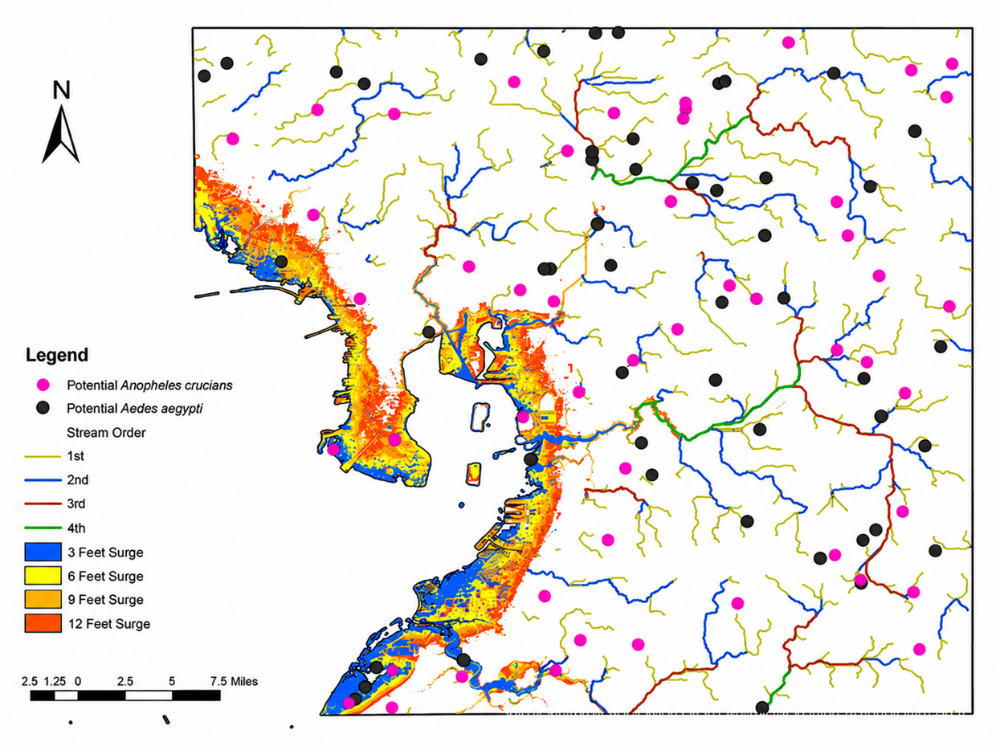
Researchers are examining how environmental factors such as flooding, waterways and coastal conditions influence mosquito habitat suitability. The work helps inform Geo-AI models used to identify areas at elevated risk for dengue transmission. (Photo courtesy of Namit Choudhari)
Choudhari is helping develop Geo-AI models that account for factors such as rainfall, temperature and other environmental conditions to identify where mosquito populations and dengue transmission may pose a greater risk.
"As a doctoral student in geography, it gives me an opportunity to connect GIS and climate change impact research with real-world public health challenges affecting the local community," Choudhari said.
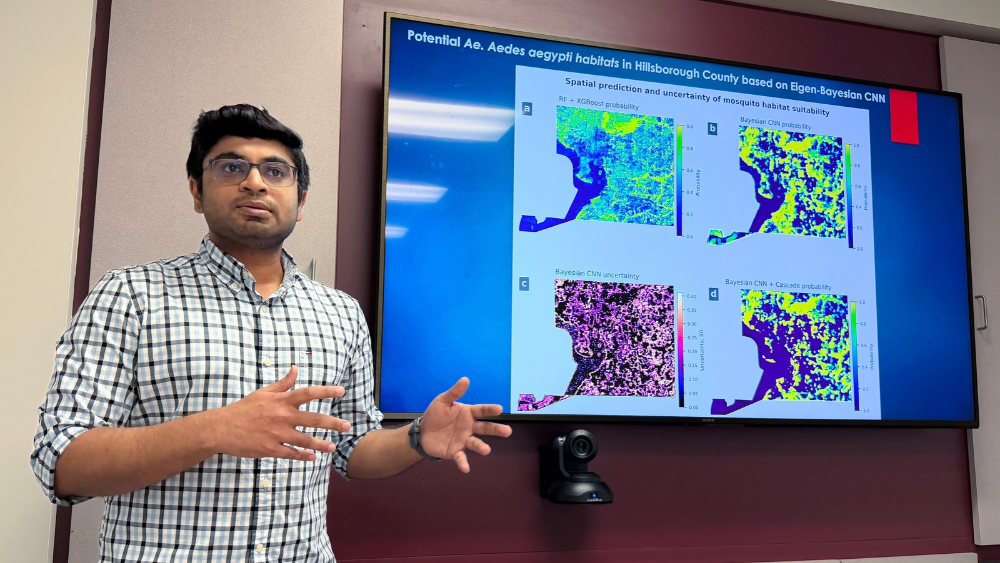
Namit Choudhari, a doctoral candidate in the School of Geosciences. (Photo by Anna Mayor)
Caleb Jaramillo, a master of public health student, is applying spatial analysis skills developed through his work in Jacob's lab to help identify vulnerable areas and support surveillance.
"This opportunity provides me with a chance to directly make a positive contribution to an ongoing and current public health emergency impacting my home," Jaramillo said. "It gives me the opportunity to connect my work in GIS research with a pressing real-world challenge."
Jaramillo said geographic information systems can help pinpoint vulnerable areas and better direct resources to communities most at risk. The analysis can also examine where mosquito risk overlaps with demographic factors, helping public health officials identify communities that may face greater exposure or barriers to prevention information and services.
Undergraduate student Payton Jachec works with GPS data collected at mosquito breeding sites and integrates it with Google Earth, satellite imagery and GIS software to create detailed maps of mosquito habitats. By assigning precise geographic coordinates to potential breeding sites, the team helps field personnel investigate locations identified through satellite imagery and analyze them alongside rainfall, vegetation and land-use patterns.
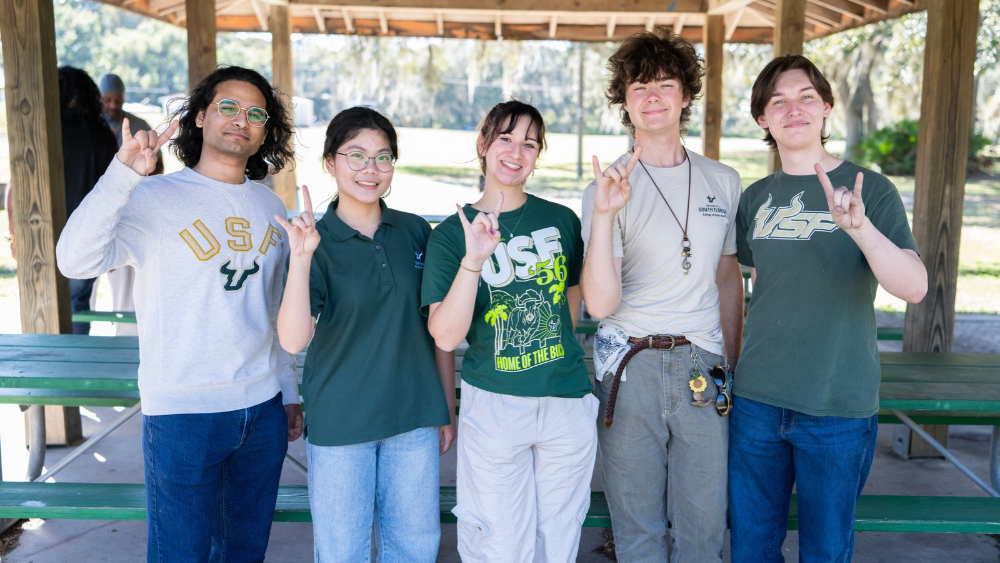
Students in Jacob's Geo-AI lab who conducted the field training (from left) Caleb Jaramillo, Quynh-Anh Nguyen, Sasha Mosich, James Jedrzejczyk and Payton Jachec. (Photo by Fredrick Coleman, USF Health)
"This effort has enhanced my student experience in myriad ways," Jachec said. "I have gained a deeper understanding of the relationships between populations and vectors, advanced skills in epidemiological modeling, and stronger connections with county and state departments of health."
From prediction to prevention
While Jacob's team uses Geo-AI to help identify where mosquito-control efforts may be needed, other USF faculty, students and volunteers are turning that information into community action through neighborhood outreach and dengue education.
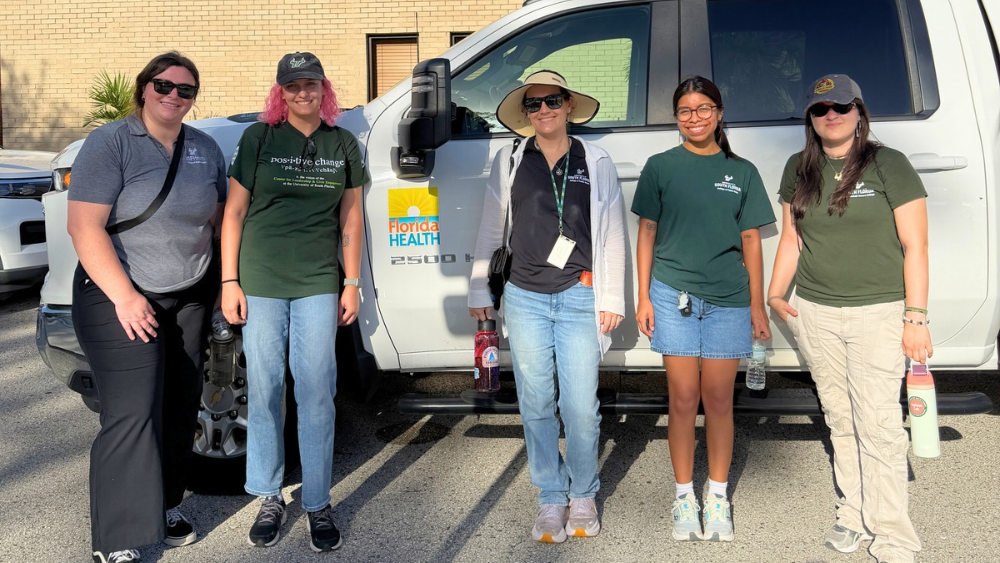
USF team (from left) Katherine Walde, Alexis Dunnick, Caitlin Wolfe, Angelica Rios and Lorelei Herman canvassed neighborhoods in Hillsborough County experiencing dengue transmission to share educational resources on preventing mosquito breeding grounds. (Photo courtesy of Caitlin Wolfe)
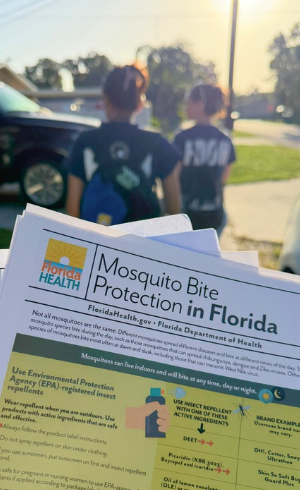
USF team (from left) Katherine Walde, Alexis Dunnick, Caitlin Wolfe, Angelica Rios and Lorelei Herman canvassed neighborhoods in Hillsborough County experiencing dengue transmission to share educational resources on preventing mosquito breeding grounds. (Photo courtesy of Caitlin Wolfe)
"One of the main messages we shared was simple: spray, drain and cover," said Caitlin Wolfe, director of COPH Bull Professional Engagement Network (BullPEN). "If we can reduce standing water, we reduce mosquito breeding areas, which reduces the number of mosquitoes and ultimately lowers the risk of dengue transmission."
Wolfe said the outreach emphasized that dengue prevention requires community participation.
"This is a group effort. We all need to do our part," Wolfe said. "It was also a great opportunity for public health students to put their passion into practice while supporting local outbreak response efforts."
Together, the mapping, field training and community outreach connect predictive technology with prevention. Geo-AI models help identify where mosquito risks may emerge, GIS and GPS tools help locate and document potential breeding sites and neighborhood outreach gives residents steps they can take to reduce mosquito habitats around their homes.
Making dengue prevention information accessible
Alongside mosquito mapping and neighborhood outreach, USF faculty and students are developing multilingual publication education materials to answer residents' questions about dengue, mosquito control and the county's response.
To understand what residents most wanted to know, Janelle Applequist, associate professor in the Zimmerman School of Advertising & Mass Communications, examined local social media conversations and Google search activity. The analysis identified concerns about aerial spraying and a need for straightforward information about mosquito control and steps residents could take to protect themselves.
Claudia Parvanta, professor of health policy and systems management and director of the USF Center for Social Marketing, led the effort to develop the materials. Her team identified public questions, drafted answers using information from the Florida Department of Health, the Centers for Disease Control and Prevention and the Environmental Protection Agency, simplified the language and consulted USF environmental health and vector-borne disease experts to review the materials for scientific accuracy.
"When providing health information to the public, the goal is to make it as easy as possible for people to follow the advice," Parvanta said. "People are also more likely to follow advice that seems to be speaking directly to them."
Bilingual USF students translated the dengue fact sheet into Spanish, Haitian Creole, Farsi, Arabic and Portuguese. After the initial materials were shared with the Tampa Bay Refugee Task Force, the organization requested additional languages based on the needs of families served by its network. A volunteer through the Largo Library ESL program then translated the materials into Russian, bringing the project to seven language versions, including English.
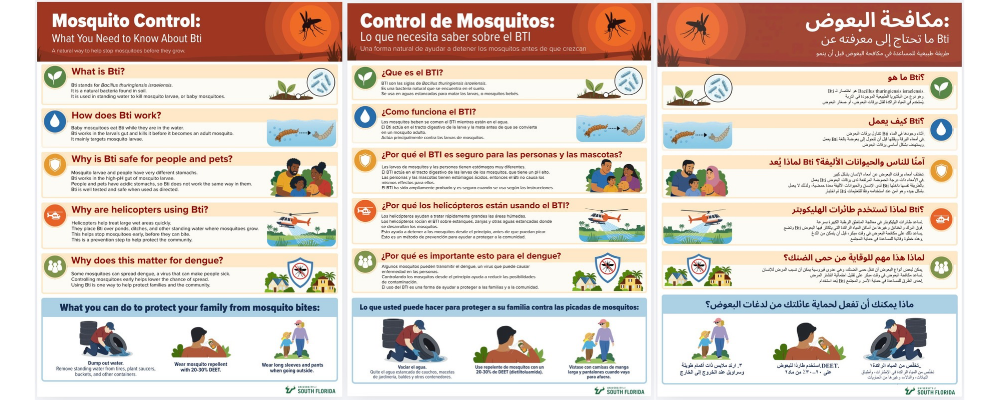
Christine McCarty, assistant professor of instruction in the Zimmerman School of Advertising & Mass Communications, helped transform the information into accessible, visually engaging educational resources.
"Public health materials need to communicate quickly and effectively," McCarty said. "I focused on ensuring that the illustrations were straightforward, that there is a clear visual hierarchy, and that the key messages were easy to understand at a glance.
"Projects like this demonstrate how design can help bridge the gap between specialized knowledge and everyday understanding," McCarty said. "The public health expertise, student contributions and visual communication all played a part in making the information more useful and accessible to the community."
For decades, the USF College of Public Health has worked alongside state and local partners, including the Florida Department of Health, combining student training and faculty expertise to help communities respond to emerging public health challenges.
The college's collaboration with public health and mosquito control officials extends beyond the immediate outbreak. Juan-David Ramírez, professor of global, environmental and genomic health sciences, and his team are also assisting with diagnosis and viral sequencing, while Kristi Miley, research associate at the USF Center for Global Health and Inter-Disciplinary Research, is contributing expertise in arbovirology.
"It's an exceedingly valuable opportunity for our students and faculty to embed themselves at this time of emergency response," said Sten Vermund, dean of the USF Health College of Public Health. "We will learn and we will also contribute, also engaging the Global Virus Network that is headquartered at USF."
What began as a response to a growing dengue outbreak has evolved into a broader university effort connecting research, technology, public health training and community education. The work is helping support the current response while building tools and partnerships that could strengthen efforts against future mosquito-borne disease threats.
"You can't really inform people too much, or too early," Parvanta said. "Treat them like partners who can help solve public health problems."


