
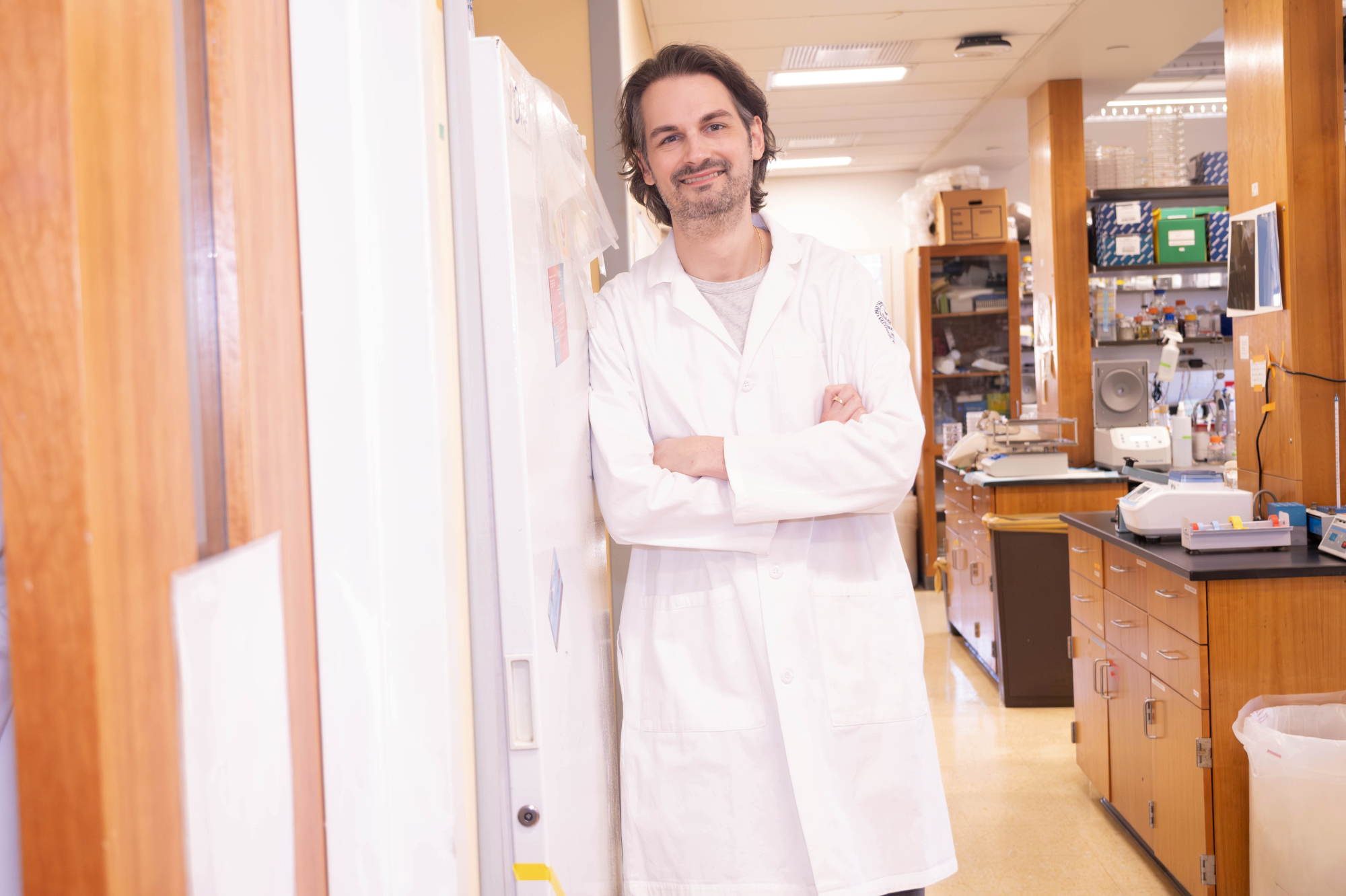
Postdoc Alexander Lercher is uncovering immune pathways that let our bodies adapt to viral threats over time. (Credit: Lori Chertoff)
Riding the subway, rushing through errands, rendezvousing with friends-for the human immune system, daily life means running a gauntlet of germs.
Most researchers study these pathogens-be they COVID-19, RSV, norovirus, countless common colds or any of the growing list of viruses making the rounds-one at a time and in isolation, so as to get a handle on how the immune system responds to each. But Alexander Lercher, a postdoctoral fellow in Rockefeller's Laboratory of Virology and Infectious Disease, thinks that approach misses something fundamental.
"The immune system isn't just warding off one virus at any given moment," Lercher says. "It's constantly encountering microbes and adapting in response. The more you think about it, the more complex you realize it is. There is a dynamic interplay that's impacting the whole system."
Scientists already know how antibodies let the immune system remember one specific virus in order to respond quickly when it encounters that virus again. Lercher is studying a different kind of immune memory: how fighting off one virus changes the way the immune system responds to a totally unrelated one. In 2024, he demonstrated that mice infected with COVID-19 were later less susceptible to influenza, in a project partly supported by Rockefeller's SNF Institute for Global Infectious Disease Research. His work, which continues to probe the molecular nuances of how this happens, could lead to new ways to treat or prevent viral infections by co-opting the immune system's natural ability to shift into a more defensive mode than usual. But doing that will first require new ways of studying and thinking about the immune system.
The scientist: Alex Lercher
Lercher grew up in Austria and became fascinated by microbiology as a teenager at a science-focused high school. While an undergrad in Vienna, he developed a particular interest in not only the microbes that infect people, but also in how the immune system responds to these pathogens. After all, immune molecules aren't just designed to attack invaders; many are also involved in preventing overblown inflammation.
"What the immune system really wants to do is maintain the status quo," he explains. "It's always scanning your tissues and organs for any indication something's going awry. In a way, it's always in response mode, constantly trying to keep your body functioning at the best possible level."
During graduate school at Vienna's Research Center for Molecular Medicine, he zeroed in on viruses, investigating how antiviral immune responses change the metabolism of hepatocytes, a type of liver cell. Then he arrived at Rockefeller in November 2020 to join Nobel laureate Charles Rice's lab, at a moment when the SARS-CoV-2 pandemic exposed how urgently we need to better understand our own immune systems. What Lercher wanted to understand was: could an infection with this new virus change the immune systems in a lasting way? In other words, does recovery from SARS-CoV-2 affect how the immune system responds to other, future threats?
The challenge: virus after virus
Most studies of the immune system use mice raised in carefully controlled laboratory environments. They are purposefully exposed to one virus and then that response is studied. It's a complicated enough question that can take years to untangle. But the real world is far more complex.
"In between the times we actually get sick, we probably encounter millions of microbes that don't sicken us," Lercher says. "But they might still leave an imprint on us."
As to what kind of imprint, that's still not fully understood. But emerging evidence suggests there are subtler, broader types of immune memory beyond antibodies.
For instance, individuals, and in particular children, that received the BCG tuberculosis vaccine become less susceptible to unrelated infectious diseases in the months after the shot. Researchers call this phenomenon "trained immunity"-the idea that the innate immune system, the body's first line of defense, can form memories. But unlike the antibodies of the adaptive system, innate memories are not specific to a certain pathogen.
"I really wanted to get a handle on what it means for the innate immune system to possess memories-and how it generates those memories," Lercher says. "There are potentially so many applications for that kind of knowledge."
The approach: mapping molecular pathways
Understanding this type of memory requires probing immune cells to understand which pathways become more or less active than usual after a viral infection. Lercher tracks immune responses by naïve or recovered immune cells in the wake of a second viral pathogen encounter and measures how, for example, levels of immune signaling molecules change.
He also tracks how the DNA within innate immune cells is reorganized post-infection. In every cell, DNA is normally wound tightly around proteins, keeping genes that are currently not needed packed away and inaccessible. But after a viral infection, the packaging around certain immune genes becomes looser, making them easier for cellular machinery to access and activate. This kind of molecular memory-like putting a viral response gene on speed dial-could make innate immune cells respond more quickly or effectively to a new threat.
But studying these cellular and molecular effects still only scratches the surface of human immune complexity. Lercher also wants to model what happens when immune cells encounter multiple pathogens in quick succession. How long does each memory last? Do they build on each other? And does a bacterial infection after a viral one reprogram the previous viral memory?
"It very quickly starts to get very complicated," Lercher says. "Imagine taking only three immune cell types, exposing them to dozens of different combinations of pathogens and trying to track hundreds of molecules that those cells are producing in response every day for ten days. This is why people have studied one pathogen at a time."
Lercher envisions artificial intelligence will be a significant help in parsing out such complex scenerios. Scientists worldwide are working to build virtual cell models-computational simulations that can predict cellular behavior. Lercher is pondering how AI-powered frameworks can help scientists to sift through complex data on immune molecules, find patterns, and simulate how innate immune cells establish and retain memories across multiple infections.
"Technology has brought us to a moment when we can start thinking about modeling a more real-world context of exposing animals or cells to multiple pathogens and start to really understand what's happening," he says.
The progress: from COVID to influenza
Working with Rice's lab and collaborators at Weill Cornell Medicine and Mt. Sinai, Lercher laid some compelling groundwork with his 2024 study. The group determined not only that antiviral genes known to help the immune system to respond to viruses were more loosely packaged after a COVID-19 infection, but also that there were significant benefits conferred to the mice; when they were later exposed to influenza, they displayed fewer symptoms and lower mortality.
"It was very potent protection," says Lercher. "It highlights the potential of this kind of immune memory to provide broad protection against infectious diseases."
And his approach has already opened up intriguing possibilities for human health. In the same study, Lercher and his collaborators also examined the blood of humans who had recovered from mild COVID-19 and found similar changes to how their DNA was packaged inside immune cells. "That suggests their immune systems might be quicker to respond to the next virus they encounter and that this phenomenon is not something that is only happening in mice," says Lercher.
The promise: broad viral protection
Lercher knows it's still early days with his findings, but he also knows that basic virology can pay off. Fundamental research on the hepatitis C virus by Lercher's mentor Rice led to antivirals that can now cure hepatitis C in most patients. Similar progress toward understanding how immune memory works could one day yield therapies that offer broad protection against multiple infectious diseases.
"If there were a new emerging pathogen on the horizon, it would be nice one day to have a therapy that boosted your general antiviral immunity for the next month or so," he says.
Some scientists even speculate that inducing trained immunity in certain innate immune cells could help them ward off cancers.
But for now, Lercher has more big questions to ask. Among the most important: Could trained immunity ever have downsides, causing chronic inflammation or autoimmune diseases alongside viral protection?
Later this year, Lercher will move to Germany, where he will set up his own lab at the Center for Integrative Infectious Disease Research at Heidelberg University. Among the next steps in his research will be to study how cells integrate simultaneous or sequential immune signals and how these affect memory formation.
"We need to understand those fundamental mechanisms well enough to actually start thinking about therapeutic applications," he says. "This is how science advances, one step at a time."


