Predicting material properties remains a major challenge in materials science, as it often requires complex and computationally intensive calculations. In particular, understanding how materials respond to electric fields is essential for the development of next-generation electronic devices.
To address this challenge, a research group at Tohoku University, led by graduate student Atsushi Takigawa (Graduate School of Engineering), in collaboration with Lecturer Shin Kiyohara and Professor Yu Kumagai, has developed a new AI-based method that enables the rapid screening of thousands of materials, accelerating the identification of promising material candidates.
A key feature of this approach is the integration of AI with physics-based modeling, resulting in significantly higher accuracy than conventional methods. Rather than directly predicting complex properties such as the dielectric constant, the model first evaluates more basic ones. For example, these include Born effective charges, which describe how atoms respond to electric fields, and phonon properties, which capture atomic vibrations within a material. The model then combines these components to reconstruct the overall material property.
"By teaching AI the underlying physics and letting it uncover how the material behaves, we can make predictions that are not only faster but also more reliable, thereby enabling the rapid screening of superior materials" said Atsushi Takigawa.
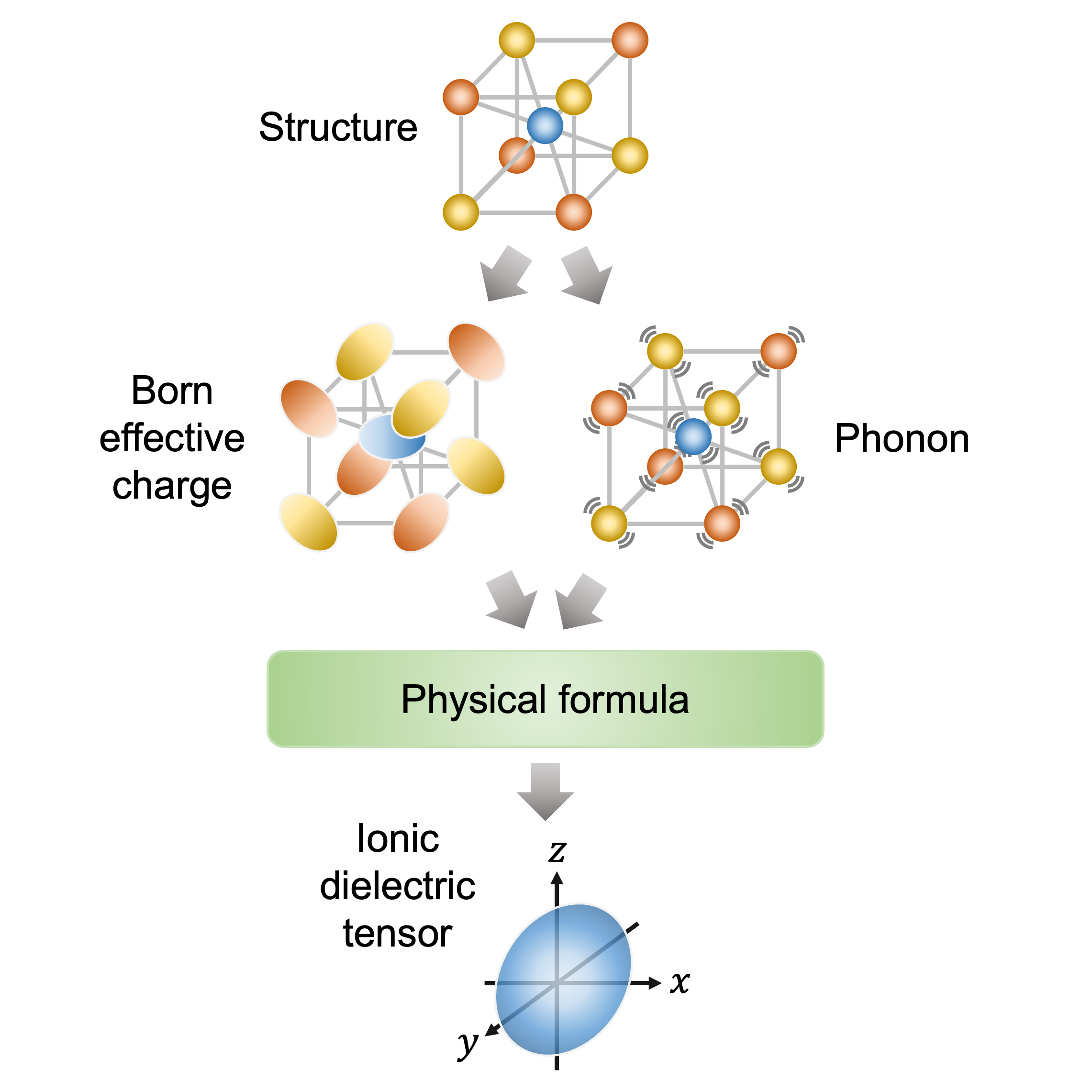
Using this model, the researchers conducted a large-scale screening of more than 8,000 oxide materials, ultimately narrowing down the suspects to uncover 31 previously unknown high-dielectric oxide materials.
This is a significant advancement, as dielectric materials are widely used in everyday electronic technologies, including smartphones and computers. The dielectric constant describes how well a material responds to an electric field: the higher it is, the more effectively the material can store and manage electric energy; the lower it is, the weaker its response. Materials with a high dielectric constant enable smaller, more efficient, and more powerful electronic components, such as capacitors.
In practical terms, this can improve how devices process signals while reducing energy consumption. As a result, improving this property could lead to better-performing electronics and support the development of more energy-efficient and sustainable technologies.
- Publication Details:
Title: Physics-Based Factorized Machine Learning for Predicting Ionic Dielectric Tensors
Authors: Atsushi Takigawa, Shin Kiyohara, and Yu Kumagai
Journal: Physical Review X
DOI: 10.1103/28wr-w896