
Angolan authorities should carry out an independent and credible investigation into the Cavaco River dike collapse and ensure that internally displaced communities receive immediate, adequate, and transparent assistance, Human Rights Watch said today.
Official figures indicate that heavy rainfall and the collapse of the Cavaco River dike on April 12, 2026, triggered devastating floods in Angola's western Benguela province, killing at least 19 people, leaving 31 missing, and affecting more than 8,000 families. At least 3,624 people were rescued, 1,540 homes were destroyed, 3,871 were damaged, and 2,586 remained flooded in the weeks following the disaster.
"The scale of destruction of the Cavaco River dike collapse in Angola raises serious concerns about the authorities' ability to prevent and respond to foreseeable risks," said Sheila Nhancale, Africa researcher at Human Rights Watch. "Families affected need immediate humanitarian aid and answers to how the dike collapsed."
In May 2026, Human Rights Watch interviewed eight people in Benguela province, including residents of affected communities, a journalist, two lawyers assisting displaced families, a volunteer supporting flood victims, and a local activist. Human Rights Watch also reviewed official government statements, media reports, and satellite imagery documenting the aftermath of the floods.
The floods affected several urban and semi-urban neighborhoods in Benguela province, including Calomanga, Massangarala, Seta Antiga, Santa Teresa, Cotel, Calomburaco, and Tchipiandalo, as well as areas in Lobito and Catumbela municipalities, residents said.
Many of these areas already faced structural vulnerabilities due to the authorities' long-standing neglect of residents' economic, social, and cultural rights, including poor housing conditions and inadequate drainage systems, Human Rights Watch found.
One resident said that ruptures began to appear in the Seta Antiga area on April 12, 2026, and during heavy rainfall the river would overflow into surrounding homes.
A number of people said that the Cavaco River dike had been deteriorating but had not undergone maintenance for many years.
A local journalist monitoring the impact of the floods said prolonged degradation of the infrastructure may have contributed to its collapse. "The dike protecting the city had not been maintained since 2002, that's more than 20 years of deterioration," said Dino Calei, the journalist. "In Tchipiandalo, a significant part of the neighborhood has practically ceased to exist due to the recent floods."
A 35-year-old resident of Calomanga said that the dike had been damaged for a long time. He said that residents had warned authorities during public consultations with the local administrator, but that no action had been taken. Residents also said they made public complaints through the local radio station, but nothing was done.
"It was a tragedy," said the resident. "Around 8 a.m., water from the Cavaco River entered the neighborhood without any warning. We tried to save children and older people, but many died." He said that he saw 13 bodies and helped recover 8 of them.
When interviewed on May 3, the resident said that more than 300 people were still sleeping in the open in parts of Calomanga, with limited access to assistance. He said aid was largely limited to occasional distributions of items such as mattresses, while displacement centers remained overcrowded and lacked adequate sanitation, food, and privacy.
The Benguela provincial government said that temporary accommodation centers had been established in old Campismo, new Campismo, the Ombaka National Stadium, and in other public and religious facilities.
But residents and volunteers described inadequate conditions in these centers.
"Conditions in the centers are inhumane," said Maria do Carmo, who provides support to victims at the old Campismo. "The bathrooms have no privacy or cleanliness, which puts people's health at risk, especially women. People are forced to relieve themselves in the open out of fear of infections, On May 1, we even ran out of charcoal for cooking and had to organize ourselves using our own means, and the food was not enough for everyone."
Estrela Francisco, a lawyer assisting affected families, said conditions in the camps were not suitable for prolonged stays. "Conditions in the centers are inadequate and incompatible with basic standards of dignity," she said. "People in vulnerable situations, including pregnant women, remain in makeshift tents, while the distribution of aid lacks transparency."
A local activist, Tiago Ngana, said assistance has not been distributed equitably. "Aid has come from various parts of the country, but it is not reaching those who need it," he said. "Some people lost everything and received only a bag of cement, while others have access to more support."
The floods also damaged critical infrastructure, including the destruction of one bridge and significant damage to another along National Road 260, limiting access to affected areas.
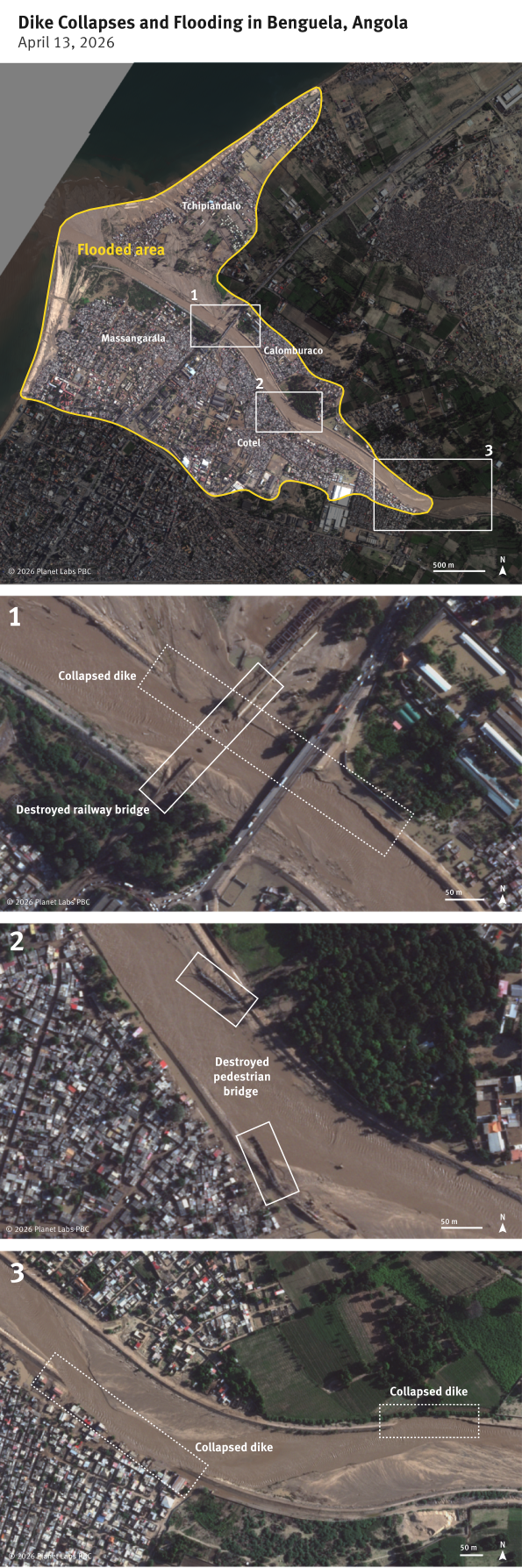
Satellite imagery from April 13, the day after the dike collapsed, and analyzed by Human Rights Watch shows entire neighborhoods in Benguela flooded. The Cavaco River dike has visibly collapsed in at least three locations in the town, and two bridges on the river, one for pedestrians and one a railway bridge, have been destroyed.
The floods in Benguela came weeks after heavy rains also caused significant flooding in Angola's capital, Luanda, where at least a dozen people were reported killed and thousands of homes were affected. These successive incidents underscore the recurrent nature of flooding in Angola and the persistence of structural vulnerabilities, Human Rights Watch said. Disaster preparedness, prevention, and response have been inadequate, including drainage systems, and officials appear to have limited capacity to mitigate risks in densely populated urban areas.
Angola is party to the International Covenant on Economic, Social and Cultural Rights, the African Charter on Human and Peoples' Rights, and the African Union Convention for the Protection and Assistance of Internally Displaced Persons in Africa (Kampala Convention), which builds on the UN Guiding Principles on Internal Displacement.
These treaties obligate governments to ensure due diligence to prevent foreseeable risks, mitigate their impact, and protect the rights to life, physical integrity, adequate housing, health, and safety. These obligations include adopting reasonable preventive measures, establishing effective early warning and response systems, and ensuring adequate, sufficient, and nondiscriminatory assistance to affected populations.
The Kampala Convention, a regional treaty to prevent internal displacement, obligates governments to ensure adequate food, shelter, medical care, and education for internally displaced people; to provide effective remedies for displacement and damages; and to seek lasting or durable solutions for displacement.
"Governments have an obligation not only to respond in an emergency but also to uphold their populations' human rights," Nhancale said. "The Angolan authorities should ensure immediate assistance, as well as to provide transparency and accountability for what went wrong."


