No needles required
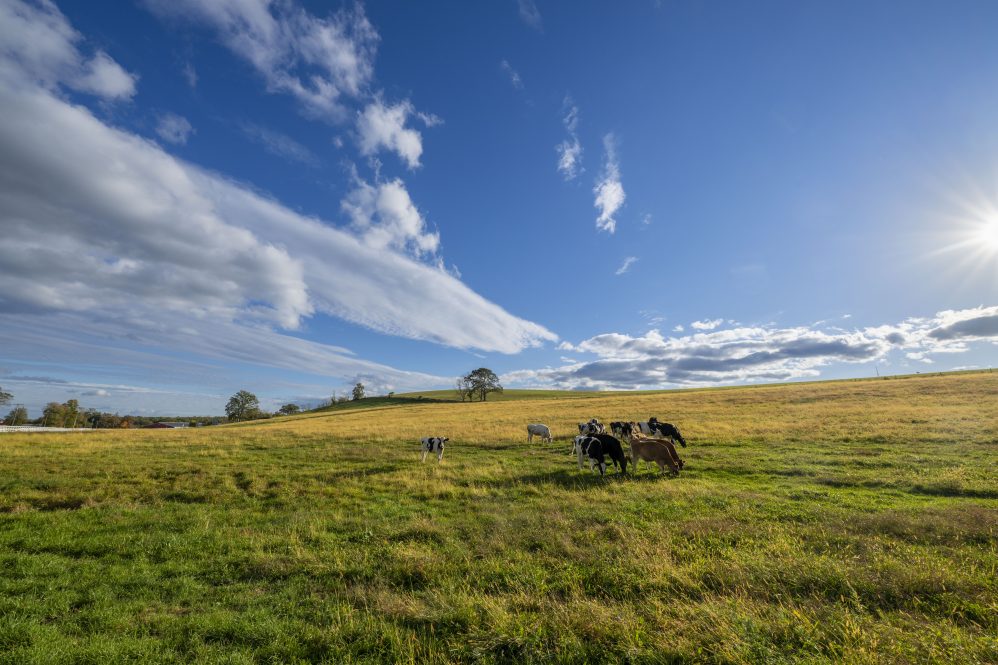
(Sean Flynn/UConn Photo)
on Oct. 8, 2025. (Sean Flynn/UConn Photo)
Sticking needles into arms-or rather, haunches-is often the hardest part of distributing an effective agricultural vaccine. Now, University of Connecticut researchers show in the April 15 issue of Advanced Healthcare Materials that a patch can deliver a safe, temperature-stabilized vaccine against foot and mouth disease, no needles required.
Foot and mouth disease is an economically devastating viral infection of cattle, sheep, and goats that kills young animals and weakens older ones. Even a small US outbreak could shut down meat and livestock exports. A large one could require culling of 30% of the national livestock, with economic damages as high as $228 billion, according to a 2013 analysis published in the Journal of Bioterrorism and Biodefense.
An effective vaccine against foot and mouth disease exists, but has significant disadvantages. It's made with an adenovirus that carries it into the animal's body. Adenovirus vaccines need to be kept cold, so they require refrigerated distribution. It's possible to stabilize the vaccine in a gel, but then the gel must be carefully dosed and dissolved before being injected into the animal, which is cumbersome for farmers and adds contamination risks. And the injections themselves degrade the quality of the animal's meat, leading to lower prices when it is sold.
UConn biomedical engineer Thanh Nguyen and Parbeen Singh, a postdoc in the Nguyen lab, worked with colleagues at the US Department of Agriculture's National Bio and Agro-Defense Facility in Manhattan, Kansas to develop a foot and mouth microneedle patch vaccine. Nguyen's lab had already developed a drug-delivery patch that uses tiny needles to make channels through the outer layer of the skin.
The researchers then used a sugar gel to stabilize the adenovirus foot and mouth vaccine. They tried multiple sugars, and found sucrose was most effective at replacing water molecules around the vaccine, holding the virus in shape even at room temperature. The researchers put that stable vaccine gel into the microneedle patches, and tested it in mice. The patches induced the same antibodies in the mice as the old, injectible vaccine had. And the patches were much easier to apply.
"Just take it out of the package, peel off the backing, and stick it on," says Nguyen.
The sugar gel stabilized the vaccine so well that the patches could be kept at room temperature for weeks. The researchers held them at 45 C (113 F) for a month without losing any potency. And the microneedle patches didn't cause the swelling, inflammation, or scarring that injections had. That means farmers can vaccinate their animals without worrying about damaging their value at market.
The next step for the researchers will be to test the vaccine in large animals such as pigs, and assess other aspects of the animal's immune response.
This project was funded by USDA grant numbers 5694000, 58-3022-4-037, 58-3022-3-012.