
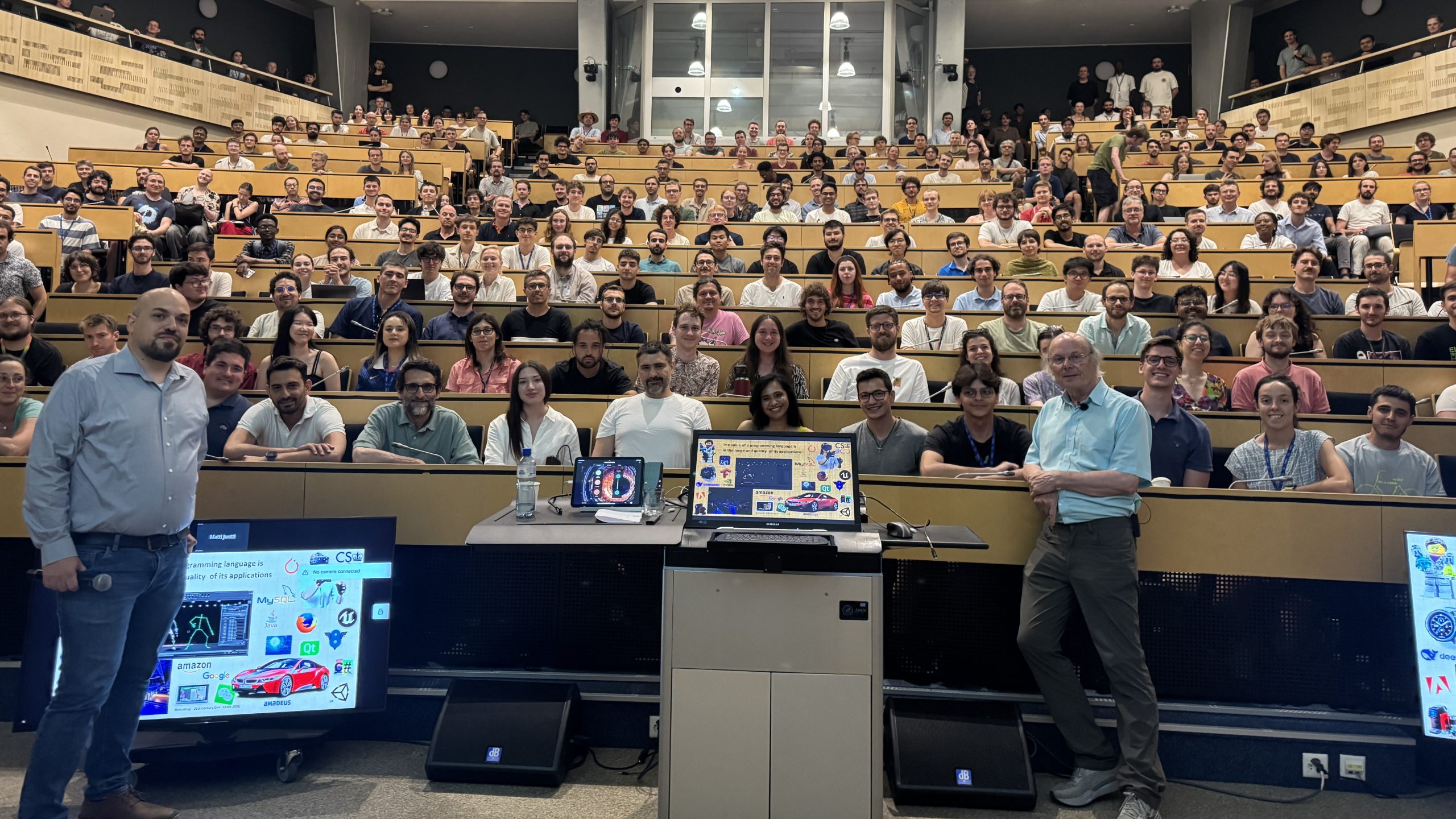
The CERN Main Auditorium during Bjarne Stroustrup's 21st Century C++ seminar. (Image: Alex Lasa Lamarca/CERN)
Behind the scenes of CERN's accelerators and detectors, millions of lines of code help turn particle collisions into scientific knowledge. One of the programming languages behind that work is C++, used to control detectors, process data and simulate particle interactions.
On 14 July, its creator, Bjarne Stroustrup, filled CERN's Main Auditorium for his seminar 21st Century C++, part of the first CERN STEAM Academy. With an additional viewing space opened in the Council Chamber and hundreds following online, the event reached an estimated audience of around 900 people.
"Good software is often invisible," Stroustrup observed. His message was that improving software does not necessarily mean making it more complicated. Clearer, simpler code can be faster, more reliable and easier for others to understand, a principle which is particularly important at CERN, where international teams develop software that may remain in use for decades.
In a conversation with CERN physicist Andrea Bocci the following morning, Stroustrup explored how C++ continues to evolve, from making programming safer to supporting new computing technologies. He also discussed how this programming language underpins familiar tools such as Python, as well as artificial intelligence applications, which often depend on C++ for performance.
For scientific software, adopting new ideas means balancing innovation with reliability. Developers need room to experiment, while protecting the systems and expertise built up over many years. Asked whether C++ would still be a good choice in 15 years, Stroustrup remained confident: "It's a language, an ecosystem and a community that's meant to evolve."
Preparing people to navigate that evolution is central to the CERN STEAM Academy. Developed within the Next Generation Triggers project, the ten-week programme combines lectures, practical sessions and collaborative learning in software, edge computing and machine learning. Participants learn from experts from CERN, universities, research laboratories and industry.
As CERN prepares for the computing demands of the HiLumi LHC, these skills will help researchers and engineers develop and maintain the tools that future experiments will need. Stroustrup's visit offered a chance to discuss those responsibilities directly with the creator of a language already woven into CERN's daily work.
Read the full story in the EP newsletter.
Watch the full conversation with Bjarne Stroustrup:


