
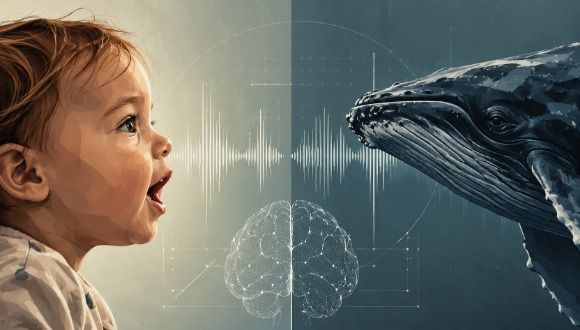
• Researchers examined a fundamental challenge in using artificial intelligence to decipher the communication of bats, whales, birds, and other animals.
• To test AI's ability to distinguish meaning from sound, they used vocalizations made by toddlers, whose intended messages humans can understand at least partially.
• Even advanced neural networks sometimes grouped together vocalizations with different meanings while separating sounds intended to convey the same message.
• The researchers argue that decoding animal communication will require more than AI and acoustic analysis—it must also consider how animals perceive and respond to sounds.
In recent years, numerous attempts have been made to use artificial intelligence to decipher the communication of bats, whales, birds, and other animals. However, a new study led by a team of researchers from Tel Aviv University points to a fundamental problem with this approach: AI models focus on the physical properties of a sound, but this does not mean that they understand the meaning attributed to it by animal listening.
According to the researchers, sounds that are acoustically similar do not necessarily carry similar meanings, while sounds that appear different may convey the same information to the receiver. Therefore, classifying sounds according to their acoustic similarity, as is done in most studies, may create a misleading picture of the communication system and the meaning of the messages it conveys.
The study, published in the scientific journal Current Biology, was conducted by Mor Taub, Inbal Arnon, Amiyaal Ilany, Mirjam Knörnschild, Yoav Ram, and Prof. Yossi Yovel. The research team included scientists from Tel Aviv University, the Hebrew University of Jerusalem, the University of Edinburgh, the Museum für Naturkunde - Leibniz Institute for Evolution and Biodiversity Science, and Humboldt-Universität zu Berlin.
To investigate the problem, the researchers used a unique communication system: the vocalizations of human toddlers who have not yet fully developed speech. Unlike animal vocalizations, in this case the researchers can determine, at least to some extent, how the humans to whom the vocalizations are directed interpret them. The recordings included vocalizations made in three contexts: distress, calling to a specific person, the mother or the father and requesting food.
The researchers analyzed the recordings using a classical acoustic method and two deep state-of-the-art neural networks: one trained on animal vocalizations and another trained on adult human speech. The models were asked to group the vocalizations according to their characteristics.
The results showed that the deep neural networks performed better than the classical acoustic method, but even they failed to classify the toddlers' vocalizations according to their meaning. In some cases, they grouped together vocalizations carrying different messages; in others, they separated different vocalizations intended to convey the same message. The models also failed to identify how a sequence of vocalizations expressed increasing urgency, a distinction that the human ear perceives naturally.
According to the researchers, reliably deciphering animal communication will require combining AI tools with behavioral observations, playback experiments, and sometimes measurements of brain activity. Every species has its own unique perceptual world, and understanding what animals are "saying" therefore requires more than analyzing sound alone: it also requires examining how they hear the sound and respond to it.
Prof. Yossi Yovel concludes: "In recent years, there has been growing excitement about the possibility of using artificial intelligence to decode animal communication, but our study shows that these promises should be treated with caution. Identifying acoustic patterns is not necessarily the same as deciphering meaning: to understand what an animal is 'saying,' we need to know how the animal receiving the message perceives it and responds to it. The path toward truly deciphering animal communication will require a combination of AI, behavioral observations, experiments, and research into the nervous system. Artificial intelligence is a powerful tool, but it is no substitute for the perspective of the animal itself."


