Acid-filled pitchers complete with fangs. Labyrinthine chambers decorated with bristles. Leaves that snap shut in less than a second. Employing strategies like these, carnivorous plants have a reputation as fearsome predators, but a new study published in the journal Ecology suggests they may do more to help their insect neighbors than previously thought.
Researchers at the Okinawa Institute of Science and Technology (OIST) have found that the nectar of pitcher plants - carnivorous plants named for their specialized pitcher-shaped leaves that trap and digest prey - constitutes an important part of the diet for their most abundant prey, vespid wasps. While this interaction was previously thought to represent a clear-cut predator-prey relationship, this study provides evidence that it may be more accurately described as a form of mutualism, where both sides benefit. Far from being a burden on local insects, these plants may be integral to the stability of their local ecosystems.
"Generally, we ecologists like to categorize relationships as just being one fixed, discrete type of interaction, such as predator-prey or competitive," says the study's senior author Professor David Armitage, from OIST's Integrative Community Ecology Unit. "But what we're becoming more aware of is that these ecological interactions are much more context-dependent and fluid."
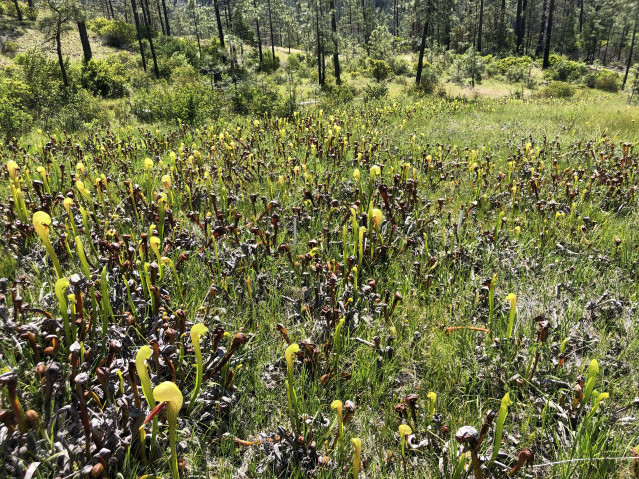
Armitage and colleagues were inspired to explore this relationship after observing just how often would-be prey escapes unscathed with a belly full of nectar. "If you hang out with pitcher plants enough, you'll always see insects landing on them, feeding, or doing something, and then flying off. The capture rate is so low," says Armitage. According to a study by Philip Dixon and colleagues in 2005 that involved watching Darlingtonia californica pitcher plants found in California fens for several hundred hours, less than 2% of wasps that visited the plants fell prey to their trap. Other plant scientists, for example, Daniel Joel in 1988, have suggested that these interactions might hew more towards mutualism, but it remained unclear how this could be further explored.
And so, armed with curiosity about how such an inefficient strategy can be feasible, some wasp traps, and an incredible amount of patience, Armitage and his collaborators trekked out to these California fens to collect samples of wasps, pitcher leaves, and other local flora. Upon returning, they used mass spectrometry to quantify the type and amount of nitrogen in the wasps, comparing the levels in wasps collected near the pitcher plants to wasps far away from them.
Nitrogen atoms are captured from the atmosphere by bacteria, including some that live inside plant roots. Once incorporated - or fixed - into organic molecules, the nitrogen passes through the ecosystem's food web: first into plants, then into herbivores, and eventually into predators, and so on. At each step, the lighter forms - or isotopes - of nitrogen are excreted, while the heavier isotopes build up within the organism. As a result of this preferential excretion, these heavier isotopes serve as a measure of the organism's trophic level, or how and where it fits into the local food web.
Carnivorous plants are quite special in that their consumption of insects and other high-trophic-level organisms gives them higher levels of heavy nitrogen isotopes compared to neighboring non-carnivorous plants. This is reflected in the nectar they produce as well, and so when wasps or any other insects consume this nectar, they also get a measurable boost in their heavy nitrogen levels.
The researchers found that wasps collected near pitcher plants had elevated quantities of heavy nitrogen, meaning the heavy nitrogen-rich nectar composed an important part of their diet.
This study stands at the forefront of a growing perspective that the "inefficiency" of these plants isn't actually such a bad thing: the pitcher plants get a boost in nitrogen by consuming a wasp every now and again, and the wasps get a stable - and all things considered, relatively safe - food source in the form of nutrient-rich nectar.
By forgoing the immediate reward of capturing many insects, these plants may be ensuring a stable population of prey for the future. "It is kind of cool to think about a plant cultivating an insect to eat," says Armitage.
This improved understanding of how these species interact will also aid future research into how carnivorous plants like Darlingtonia shape their local environments. "The role of pitcher plants in some of these really dry, otherwise less-productive regions of the California mountains might be underestimated," concludes Armitage. "Rare and unique plants like Darlingtonia may even be considered foundation species, forming the basis for complex ecosystems akin to coral reefs or mangrove forests."