Getting muddy to discover more about a species older than dinosaurs
Getting muddy to discover more about a species older than dinosaurs ()
There's already a UConn student shirtless and up to his waist in Long Island Sound when we tag our first horseshoe crab. The water is only 64 degrees Fahrenheit on this breezy June morning. Not everyone is so keen to get wet.
UConn's Genome Ambassador Program and Sacred Heart University's Project Limulus teamed up to tag horseshoe crabs crawling onto the beach in Stratford on June 16. Fortunately, the crabs are all over, scrabbling along the pebbled bank near the edge of the seagrass as well as four feet deep in the rising tide. Jo-Marie Kasinak, director of Project Limulus, describes finding horseshoe crabs as a "Choose Your Own Adventure" experience, in which you can get as wet and muddy as you (don't) want. Some students start peeking into the large concrete reef balls high and dry on the beach, looking for horseshoe crabs that waited too long to swim out and got stuck inside during the last high tide.
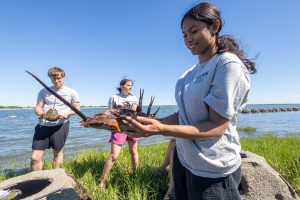
"The males are smaller. They use their boxing gloves to latch onto the females to swim to shore for mating," says Kasinak, referring to the specially shaped claws male horseshoe crabs have. She mentions that horseshoe crabs are not monogamous, and that in Delaware Bay one female was found with 19 males hanging onto her. It's not quite that crazy out here in this salt marsh now managed by the Audubon Society. But we've already found one mating pair, and we're looking for more.
Horseshoe crabs have scooted around Earth's coastal waters for the last 450 million years. They existed before the dinosaurs, before any land animals at all. Which probably explains why they crawl onto beaches to mate and lay eggs; land predators weren't a thing back then. Multiple epochs later, they still spend late spring and summer in and around the beaches and salt marches from Maine to Florida, then head out into deeper water for the colder months. Scientists don't know too much about what they do out there.
Which is why we're out here tagging them. Crabs tagged here in Stratford are most commonly reported along nearby beaches within a five-kilometer radius, although some have traveled as far south as Florida. The actual tagging process involves picking up a crab, driving an awl into its shell far enough from the edge to avoid it sticking off the side but close enough to the edge to avoid the brain, and then shoving a tag into the hole. It's like an earring, or at least that's how the researchers describe it.
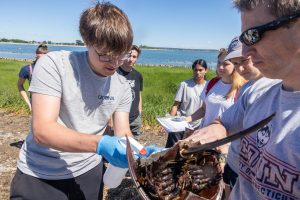
When the awl goes in, most crabs bleed a little. Their blood is pale blue, and goes for more than $60,000 per gallon in the pharmaceutical industry. It's used to test the cleanliness and sterility of vaccines and certain medical equipment, clotting immediately upon encountering the slightest contamination.
The crabs are picked up on mid-Atlantic beaches during mating season, bled, and then returned to the beaches weakened. Some of them manage to mate and lay eggs and survive, but some don't, and the blood harvest is contributing to the decline in horseshoe crab numbers.
"There is a synthetic product made in yeast" to replace horseshoe crab blood, "but a lot of companies don't trust it," says Jay Podziewski '27 (CLAS). The undergraduate molecular biology major is doing a Summer Undergraduate Research Fund (SURF) project this summer experimenting with how to grow horseshoe crab amoebocytes-the cells in the blood that clot to reveal bacterial contamination-in the lab. If scientists can figure out how to grow them in the lab instead of in a crab, they might be able to produce a product much closer to real horseshoe crab blood than the current yeast synthetic. "If we're successful, it should have an easier time getting approved," Podziewski says. And fewer crabs would need to be bled.
UConn marine genomicist Kate Castellano is Podziewski's advisor on the project. She was on the team at UConn's Institute for Systems Genomics that sequenced the horseshoe crab's genetic code, publishing it in 2025.
"There are multiple factors in the horseshoe crab's blood that cause the clotting," Castellano says. Since the synthetic product produced by yeast was using only a single gene to produce a single clotting factor, "maybe it wasn't working as well as it could because it was missing factors," she says. Podziewski's project will create a tool to better understand the biology of the cells, and see whether these other factors are required to make the test more sensitive.
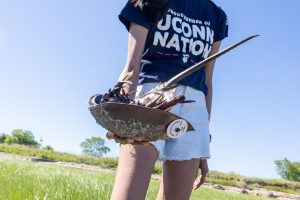
One of the students manages to dig a small male horseshoe crab out of a reef pot, where he had buried himself to keep his gills moist during the last low tide. He is promptly tagged and released. Then two students walk over with a mating pair. The female is large. She has a hole in her shell, and is missing a few claws, but she's carrying loads of eggs and has very light-colored eyes, a sign of relative health and youth. The researchers try to figure out if the hole in her shell is from a previous tagging or not.
"This seemed like a super cool way to experience field work in a different field," says Jillian Taormina, taking a break from crab hunting. Taormina is doing a stint of post baccalaureate research on human genomics in Deborah Bolnick's lab at UConn before moving on to graduate study at the University of Maine Farmington this fall. "It's fascinating to see how different fields interact; I can definitely take some of this with me," Taormina says.
The salt marsh we're standing on was formerly owned by Remington Arms, which used it as a shooting range at one point. Later Dupont bought Remington, and tried to environmentally remediate the property, but reminders of the past still emerge from the muck on a regular basis. This writer found a piece of a clay pigeon, still painted safety orange. UConn multimedia specialist Syd Herdle picked up some shot casings as well as a discarded drone, a decidedly more modern piece of garbage.
It's reassuring that even in this imperfectly repaired environment, the crabs still come and breed. All in all, the students tag 17 horseshoe crabs in two hours, and numerous other breeding pairs are spied but elude the researchers.
Other creatures come, too. A birder stopping by to catch glimpses of shorebirds walks over and asks what we're doing, and whether she can help. Anyone can volunteer. The interested can check out Project Limulus or join in other UConn Genome Ambassador projects to learn more about horseshoe crabs, genetics and the scientific process.