
More than 26.5 million people in the Democratic Republic of the Congo are facing acute hunger, according to a new analysis from UN-backed food security experts published Tuesday.
Ongoing conflict in the country's east is driving mass displacement and pushing millions into crisis or emergency levels of hunger. Nearly 3.6 million people are at emergency levels of food security - one step from famine - while a further 22.9 million are in crisis .
The situation is most severe in eastern provinces, where fighting between Congolese forces, and Rwanda-backed M23 rebels and other armed groups has displaced tens of thousands of people since the start of 2026.
Insecurity and funding shortfalls
Around 3.59 million people are internally displaced in eastern DRC, with South Kivu and North Kivu provinces the hardest hit. The closure of Goma airport following the city's fall last year further disrupted humanitarian access and supply chains across the region.
Despite the scale of the crisis, food assistance reached only about 1.1 million people in the four worst-affected eastern provinces in January and February - just 23 per cent of those targeted under the 2026 humanitarian response plan - leaving an estimated 3.8 million without support.
Funding shortfalls have forced some partners to suspend operations entirely, while insecurity, deteriorating roads and rising food prices continue to worsen the crisis.
Taliban carries out mass 'corporal punishment'
The Taliban carried out judicial corporal punishment against at least 312 people - including 39 women and four boys - in just three months, according to a new UN human rights report on Afghanistan
The report says a sweeping new decree also expanded the scope of the death penalty and criminalised dissent.
The "Decree No. 12 on Criminal Rules of Courts," circulated to all de facto courts in January, broadened capital punishment to offences including blasphemy, heresy and "persisting in corruption." It also made criticism of Taliban authorities and their interpretation of Islamic law a criminal offence.
Penalties range from lashings to years in prison for insulting Taliban leaders or failing to report its opponents.
The UN Assistance Mission in Afghanistan ( UNAMA ) also documented at least 336 arbitrary arrests by the so called "vice police" and the suspension of two media outlets during the period.
Women barred from work and education
The de facto authorities removed women from the civil service payroll entirely in January, with many discovering their dismissal only when their monthly salary failed to arrive.
The last day of March also marked the 205th consecutive day that Afghan women were barred from UN premises nationwide.
Meanwhile, as the new academic year began that month, the ban on girls attending school beyond grade six entered its fifth consecutive year, leaving 2.2 million girls and women without access to secondary or higher education, according to the UN education agency, UNESCO .
A world without sand? UN partners push for alternatives amid shortages
Sand is not an endless resource and humanity is extracting sand and gravel faster than nature can replinish it, and according to a new report launched by the UN Environment Programme ( UNEP ) on Tuesday.
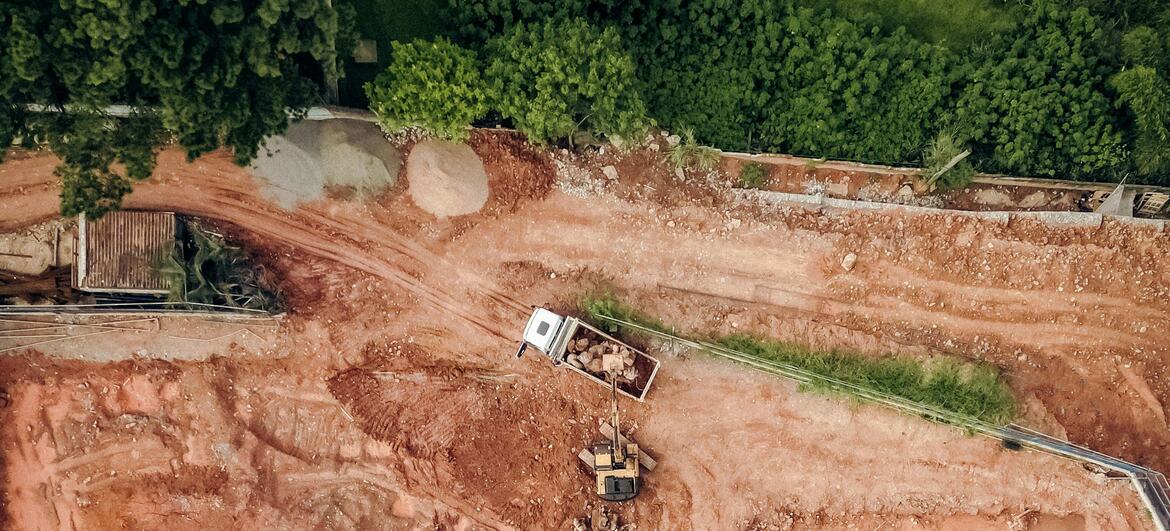
The world currently uses about 50 billion tonnes of sand every year, while extraction is increasing taking place in fragile rivers, lakes, coastal zones and protected marine areas.
Climate change is one of the main drivers of rising demand, as more sand is needed to build infrastructure such as sea walls to protect against rising oceans. Population growth and urbanisation are also fuelling demand.
Population growth increasing demand
"We have seen that particularly in Asia and Southeast Asia where the economy was booming. But we will see it now in Africa because the population is going to double from now to 2050," said Pascal Peduzzi, a senior UNEP official.
"That's plus 1.27 billion people. All of them will need homes and schools and infrastructures," he added.
UNEP warns that whiles and is essential for economic development, it is equally vital for ecosystems, livelihoods and water security.
Searching for alternatives
The report argues that many governments still treat sand as a cheap construction material rather than a strategic resource linked to biodiversity, water security and climate resilience.
But some countries are beginning to rethink that approach. Colombia has formally recognised the importance of sand and gravel as strategic resources, while in Brazil, companies are expanding the use of "ore-sand" - a by-product of mineral processing - which could reduce pressure on rivers and coastal ecosystems traditionally targeted for extraction.
UNEP calls for stronger environmental oversight, greater transparency around extraction permits and a shift away from lowest-cost sourcing practices that often overlook long-term environmental damage.
The agency is urging governments and industry to adopt more sustainable approaches to extraction and highlighted alternatives such as compressed straw, which can be used as a durable and energy-efficient building material.


