
Just in time for this year's Earth Day (22 April), we have a reminder of how the world looks. The most recent photo of Earth's full disk, Hello, World, was taken earlier this month by Reid Wiseman, commander of NASA's Artemis II lunar flyby mission. Not since 1972's Apollo 17 mission have human eyes seen the planet whole from a vantage point in space. Thanks to an image like this, all of us stuck on terra firma have a pretty good sense of what our planet looks like. If we can't all go up into space to see it for ourselves, we can at least be vicarious 'Earth gazers', to borrow the author Christopher Potter's term.
Of course, only a privileged few – 28 people, including Wiseman – have been able to see Earth in the round with their own eyes. And the experience is profound. To glimpse Earth whole can precipitate a 'cognitive shift' that author Frank White has termed the 'overview effect'. The sight of Earth in overview inspires a sense of 'wonder' and 'meaning'. For example, recalling his 1961 project Mercury mission, Alan Shepard, the first American to go into space, writes of not having been 'briefed well enough not to be astonished at the view I got from 100 miles up' – and he wasn't even far enough above the surface to see the entire planet. Russell Schweickart remembers feeling 'changed' by seeing Earth- 'that small spot, that little blue and white thing' – on his 1969 Apollo 9 mission. As White notes, seeing Earth in overview helps us make sense of things: we appreciate 'how everything is related', how 'what appears to be "the world" to people on Earth is merely a small planet in space'.
For those of us down on the ground, to see the planet at a glance in photos like Hello, World can foster a 'planetary consciousness'. Maybe it's no coincidence that the modern environmental movement emerged when it did. My Exeter colleague Tim Lenton has even suggested that the ability to see 'Earth from space' was in part responsible for the germination of his field of study: Earth system science.
The first Earth Day, in 1970, was only three years after the first colour image of Earth whole was captured by NASA's ATS-3 weather and communications satellite. John McConnell, designer of the Earth Day Flag, which features the Blue Marble photo of Earth on a dark background, claims to have been inspired by seeing a picture of the planet on the cover of Life magazine.
As it happens, looking at Earth from space predates these amazing photographs and even the advent of human space flight. In 1957, the year the Soviet Union launched the first artificial space satellite, Sputnik 1, a Dutch educator named Kees Boeke published Cosmic View: The Universe in 40 Jumps. It provides 'a series of drawings' that simulate 'imaginary jump[s]' into space. In just eight images, the reader moves from a shot of a child holding a cat to an illustration of the 'whole' Earth depicted 'as a limited dwelling place in the surrounding blackness of space'.
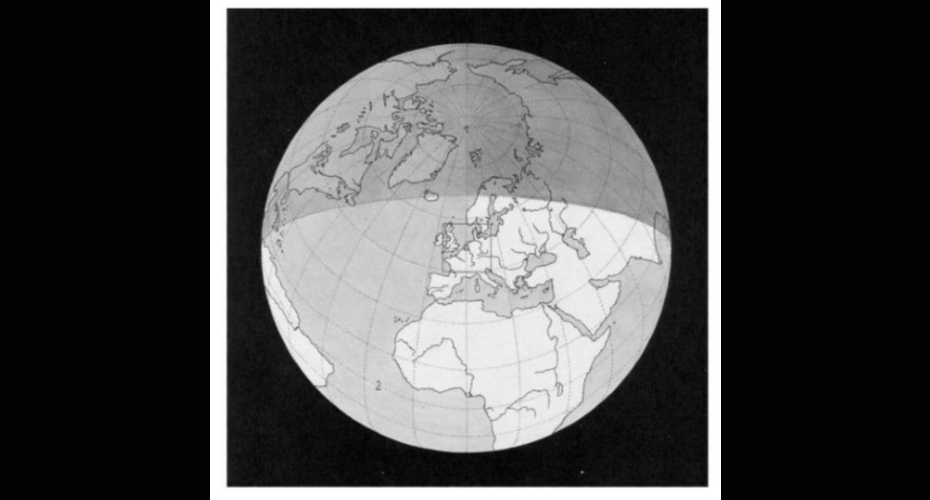
Boeke's hand-drawn Earth view is one of many 'imaginary and fantastic journ[ies]' that, in the days before seeing the planet whole was a physical possibility, provided readers with a hypothetical overview. Particularly in the century or so leading up to the space age, writers of scientific and literary works used imaginary overviews to communicate geographical and astronomical facts beyond the reach of human eyes and scientific instruments. Boldly going where empirical methods could not, these 'views from nowhere', as the philosopher Thomas Nagel has called them, replaced the ordinary 'creaturely point of view' with a commanding God-like perspective.
In 1879, the celebrated English astronomer Joseph Norman Lockyer, co-discoverer of helium, used the imaginary Earth overview to introduce children to fundamental scientific concepts. His primer Astronomy starts with familiar, local sights – what pupils can see around them and what they know from experience – before encouraging them to zoom out into spaces where direct, first-hand experience no longer applies: 'just as men by travelling, can find out lands on the earth, far away from your school, and tell us all about them, so are the shape, size, and position of the earth itself, among all the bodies in the skies, known, and its relation to them can be made clear to you'.
The whole of the book, in fact, is designed on the principle of moving from the local to the distant, from the terrestrial to the cosmic. A first chapter on 'Earth and Its Motions' is followed by 'The Moon and Its Motions', 'The Solar System', 'The Sun – The Nearest Star', 'The Stars and Nebulæ'. Such reverse telescoping fosters a particular kind of spatial awareness and encourages an at first disorientating but potentially liberating sense of one's place in the scheme of things.
But it wasn't only scientists who made use of imaginary Earth overviews from a 'nowhere' perspective. Fiction writers and poets of the nineteenth and early twentieth centuries embraced them as well. In his 1916 novel A Portrait of the Artist as a Young Man, for instance, Irish modernist James Joyce includes a passage where his protagonist – at this point a late-Victorian schoolboy like those for whom Lockyer intended his book – performs his own imaginative flight. Intrigued by an illustration in his geography primer of Earth as 'a big ball in the middle of clouds' (an echo of the distinctive masthead of another Lockyer publication, the journal Nature, the young Stephen Dedalus transcribes his coordinates on the book's flyleaf:
Stephen Dedalus
Class of Elements
Clongowes Wood College
Sallins
County Kildare
Ireland
Europe
The World
The Universe
As Stephen matures, this early overview exercise – an instance of what German philosopher Peter Sloterdijk has termed 'globing', or seeing in overview with a kind of 'sight not based in natural human eyes' – becomes not only a way to understand planetary mechanics (that Christmas would eventually arrive 'because the Earth moved round always') but also an artistic strategy. Like his high-flying namesake, the mythical artificer Daedalus, Stephen can detach himself from his parochial surroundings, winging his mind above his contemporary Ireland and into the placeless heavens, surveying 'the earth beneath him'. In his mind's eye, he hovers like an astronaut in space, capable of witnessing the 'the vast cyclic movement of the earth'.
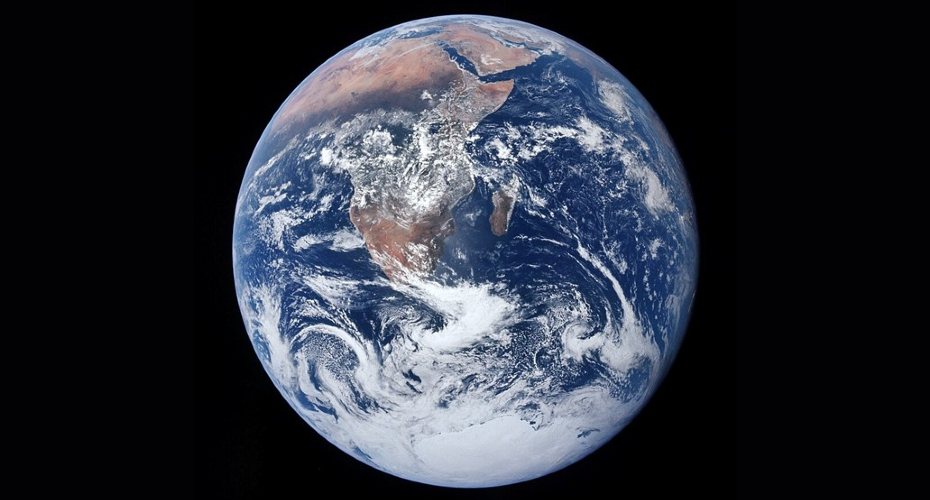
Nineteenth-century literature, too, is full of overview fantasies. Writers such as Jules Verne, Camille Flammarion and H. G. Wells portrayed fictional space sojourns, anticipating the Apollo and Artemis missions and offering templates for what Earth might look like from space. Sometimes, as in Wells's The First Men in the Moon (1901), it resembles a perfectly legible school globe. Likewise, for the voyagers in John Jacob Astor's A Journey in Other Worlds (1894), Earth looks 'like a map':
All its peninsulas and islands, enclosed blue seas, and bays came out in clear relief. Gradually Russia, Germany, France, the British Isles, and Spain moved towards the horizon, as in grand procession, and at the same time the Western Hemisphere appeared.
In George Griffith's A Honeymoon in Space (1901), the cloudless Earth in overview provides '[n]ot a bad way of studying geography': 'If we stopped here long enough', one character suggests, 'we should see the whole earth spin right round under us'.
Often, however, as the anonymous 1858 story Journey to the Moon reveals, '[c]loudy belts' obscure extraterrestrial viewers' ability to see Earth's geography clearly. The story's author imagines lunar onlookers trying to 'obtain at once an entire view of either of our hemispheres'. Despite our atmosphere's 'flickering drapery', moon-based geographers are 'nevertheless [able to] construct an accurate map by noting down the details of various countries as they presented themselves from time to time, and then combining the fragments into a whole'.
The resulting 'full view' image of Earth is a 'puzzle map' or mosaic of pieces that uncannily foreshadows much more recent processes of representing Earth. For example, the 2005 image Blue Marble: Next Generation, a successor of the famous 1972 Blue Marble photograph, combines data from different sources taken over a one-year period: 'one Blue Marble image for each month of the year 2004'. Like the fantasy depicted in 'Journey to the Moon', this high-tech NASA overview eliminates cloud 'noise' to prioritise 'how Earth would look to a human in space if our world had no clouds and no atmosphere'.
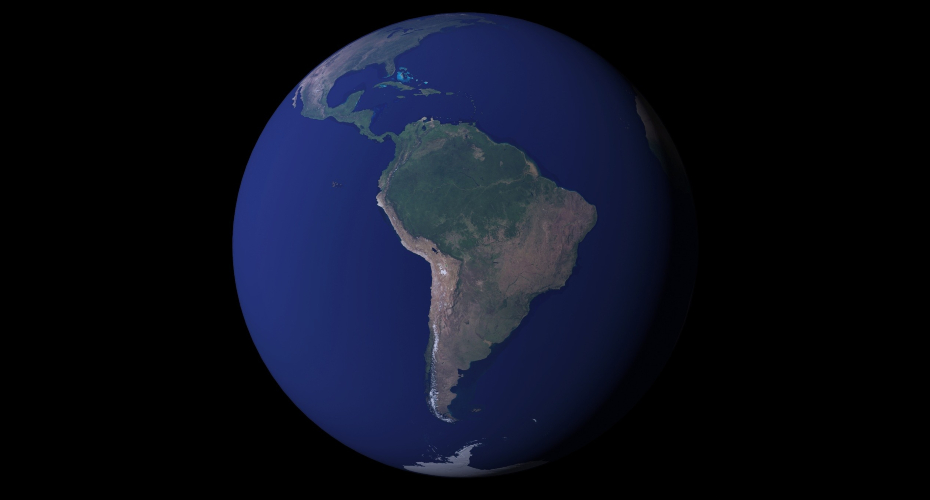
By examining the pre-history of Earth overviews, specifically the ubiquitous array of imagined Earths from the hundred or so years immediately preceding actual space travel, what becomes clear is a powerful overview imaginary – a set of tropes, generic conventions and narrative techniques – that was well established by the time whole-Earth photographs arrived in the 1960s, forever lodging themselves in our collective consciousness. Long before it was camera-ready, the full-disk perspective that we now take for granted was being incrementally refined and curated.
Across scientific and fictional works, we see how our eyes have been trained to see Earth – to the extent that the renowned British astronomer Fred Hoyle, in his 1955 book The Nature of the Universe, would write about what we should 'expect' an overview photograph to look like when it eventually arrives.
Imaginary representations of our planet from the period before space travel also allow us to question some assumptions about what it really means to 'see' Earth in overview. Are fictional overviews only 'fantastic', as Boeke characterised his illustration? Are satellite or human photographs more objective?
The contrast between these two forms of 'seeing' is not always as clear as one might think. For one thing, both kinds of overview are fantasies insofar as they depict Earth from a vantage point impossible for almost all humans. Blue Marble: Next Generation, stripped of atmosphere, is obviously a fiction in another sense: the real Earth, with its swirling cloud 'data', can be tweaked for optimal terrestrial viewing, a technical sleight of hand that fiction writers had exploited over a century earlier.
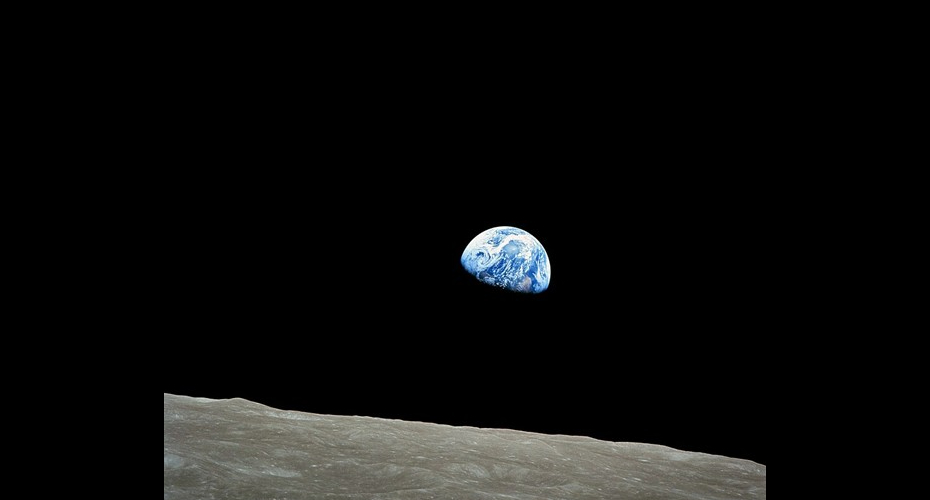
Even less 'datafied' Earth photographs – for example, 1968's Earthrise and the original Blue Marble – have been manipulated to make them conform to what researcher Max Liljefors has called 'a particular kind of "view"'. The original Apollo 8 Earthrise photograph, for instance, was reoriented to give the viewer the impression of viewing the planet from the perspective of a person standing on the lunar surface. Blue Marble was colour enhanced and rotated so that we see Earth as we are accustomed to, with the North Pole on 'top'. To an extent, we might argue, Earth as we see it in overview is always more or less a fiction.
Professor Jason Hall is based in the Department of English and Creative Writing and is a STEM-facing literary and cultural historian whose research and teaching engage with science and technology across the nineteenth and twentieth centuries. He has published several books and articles that explore poetry, fiction and material culture, particularly in relation to areas such as physiology, psychology, industrial manufacturing, astronomy and the Earth sciences.


