
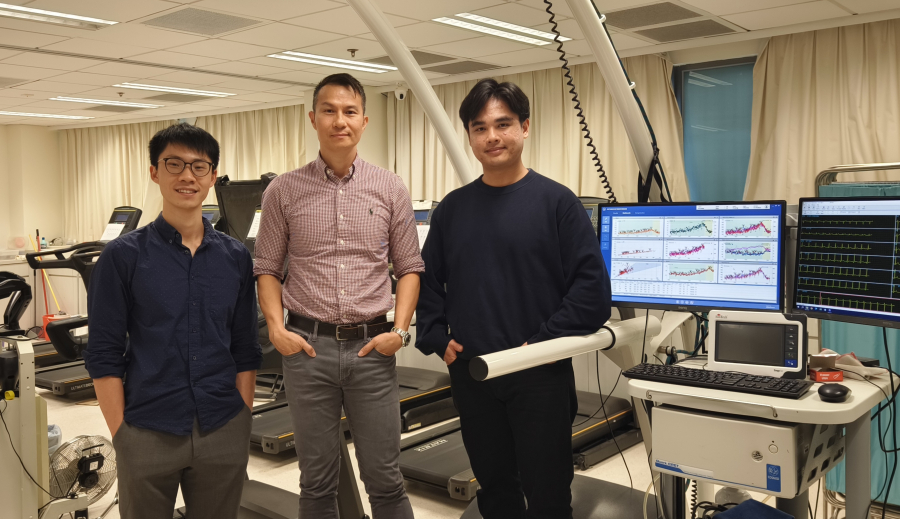
Professor Parco Siu Ming-fai (centre) said that while thrice-weekly interval training is a commonly recommended approach for treating obesity, the study shows that once-weekly interval training with the same total workout time offers similar benefits and is an effective alternative for busy people.
A research team from the School of Public Health at the LKS Faculty of Medicine, the University of Hong Kong (HKUMed), has found that brisk interval walking performed once a week can significantly improve body fat reduction and cardiorespiratory fitness in adults with central obesity, comparable to exercising three times a week – the traditional recommendation for exercise frequency. The study provides strong scientific evidence supporting the therapeutic use of once-weekly brisk interval walking as a convenient exercise approach for adults with central obesity, particularly for those with time constraints. The findings were published in Nature Communications [link to the publication].
A practical, evidence-based exercise approach to combat excess adiposity
Obesity is a common chronic condition characterised by excessive fat accumulation that impairs health. Excess adiposity, particularly when deposited centrally around the abdomen, is linked to negative health outcomes, including cardiovascular disease, metabolic disorders, and increased mortality risk. While regular exercise provides comprehensive health benefits and is integral to obesity management, sustained physical activity remains insufficient, especially for individuals with obesity.
Interval training involves alternating periods of vigorous exercise with lower-intensity active-recovery exercise. It is an effective, time-efficient approach for reducing total body and visceral adiposity compared to traditional continuous moderate-intensity training. However, standard exercise guidelines typically recommend interval training three days per week, which may not be practical for individuals with time constraints and limited access to exercise facilities. While previous studies found that the 'weekend warrior' exercise pattern, which condenses weekly exercise into one to two days, to have positive effects, there has been limited scientific evidence on the efficacy of interval training performed in this pattern.
Professor Parco Siu Ming-fai, Professor and Head of Division of Kinesiology at the School of Public Health, HKUMed, emphasised the importance of validating whether once-weekly interval training can be as effective as the traditional thrice-weekly regimen, thus offering a practical, evidence-based alternative.
Less frequent, similar efficacy
Between September 2021 and September 2024, HKUMed researchers conducted a rigorous trial in Hong Kong involving 315 Chinese adults aged 18 or older who were overweight and had central obesity. The participants were randomly assigned to one of three groups: a once-weekly interval training group, a thrice-weekly interval training group or a control group.
The control group attended a 2.5-hour health education session every two weeks over a four-month period. The interval training groups performed a total of 75 minutes of interval training per week, either in a single session or divided into three sessions. The participants' body fat mass was measured using dual-energy X-ray absorptiometry at three assessment points: before the intervention (baseline), at 16 weeks (post-intervention), and at 32 weeks (four-month post-intervention follow-up).
The trial results revealed that at the 16-week assessment, both the once-weekly and thrice-weekly interval training programmes similarly reduced excess adiposity, as measured by total body fat mass, fat percentage and waist circumference, and improved cardiorespiratory fitness compared to the control group.
'While thrice-weekly interval training remains a commonly recommended approach for the therapeutic management of excess adiposity, our findings show that once-weekly interval training offers similar benefits and represents a practical exercise strategy,' said Professor Siu. 'For many adults with central obesity who struggle to balance work, study, family and other commitments, time constraints are a primary barrier to exercising multiple days per week.'
'Instead of relying solely on high‑frequency exercise prescriptions, once‑weekly interval training can be considered a feasible and effective alternative,' added Professor Siu.
About the research team
The research was led by Professor Parco Siu Ming-fai, Professor and Head of Division of Kinesiology at the School of Public Health, HKUMed. The co-first authors are Dr Leung Chit-kay and Mr Joshua Bernal from the same School.
Acknowledgements
The research was supported by the General Research Fund of the Research Grants Council, the University Grants Committee of Hong Kong, China, and the Seed Fund for Basic Research, HKU.


