
A recent article by the Universities of Würzburg and Halle uses the example of the Federal Republic of Germany to show how important it is to examine changes in the geography of parties and political mobilisation more closely.
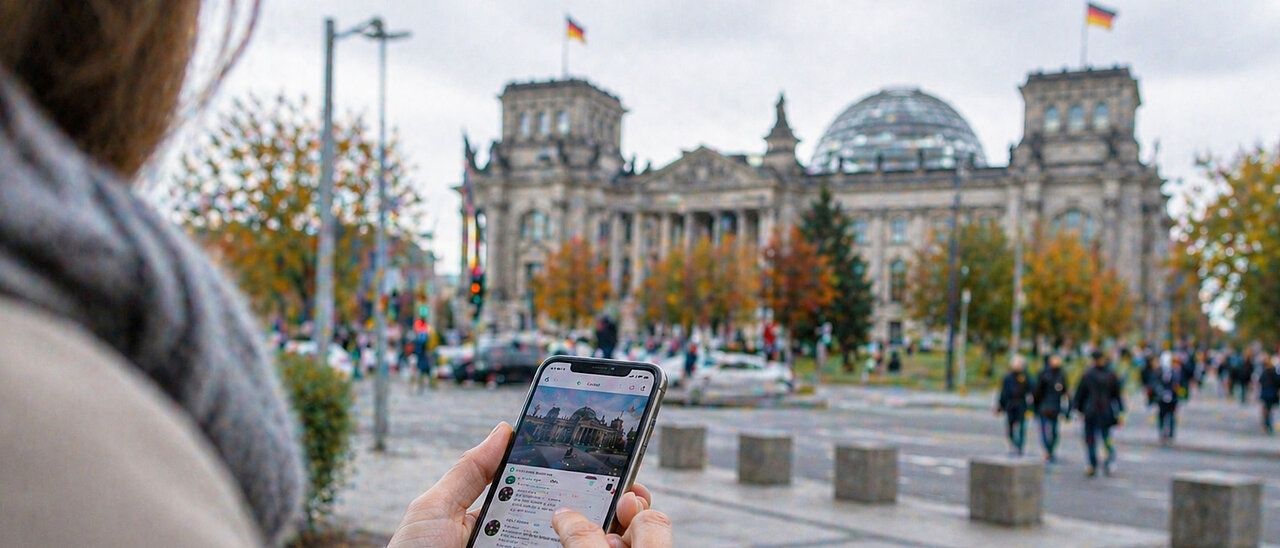
What are the consequences for our democracy when parties increasingly communicate and mobilise supporters via social media and apps? Geographers from The University of Würzburg and Martin Luther University Halle-Wittenberg raise this question in a recently published study.
Digital change reaches party headquarters
With the term "platformisation", the researchers apply an analytical approach to the transformation of political work: while parties and other political groups used to focus on face-to-face meetings, for example in local associations or at information stands, they are now increasingly relying on online platforms and digital strategies. They now mobilise their supporters directly via their own apps or online channels.
"Our study shows: Digital platforms are changing how political actors emerge and organise themselves," explains Matthias Naumann from the Chair of Human Geography at the University of Würzburg, one of the authors of the studies. "Political groups and parties are increasingly using social networks to reach supporters and organise election campaigns."
For their analysis, the researchers examined the political science debate on election events in 2024 and 2025: the European elections, the state elections in Thuringia, Saxony and Brandenburg and the federal elections.
Digital strategies have different effects in different regions
Another finding: the digitalisation of party work is not proceeding in the same way everywhere. Depending on the context - e.g. country-city - the importance of digital platforms differs alongside other communication channels.
How parties use digital platforms also depends heavily on their strategic orientation. The authors demonstrate this using electoral research on the 2024 state elections in eastern Germany, in which the investments in online advertising and the strategic success achieved differed greatly. The article thus shows that geography needs to focus more on the importance of digital platforms for parties, even beyond the Alternative für Deutschland (AfD).
Other parties are pursuing a hybrid approach. Die Linke, for example, uses digital applications to organise traditional door-to-door campaigning: Volunteers are coordinated via an app and deployed to specific neighbourhoods to hold face-to-face conversations with citizens.
Outlook: How digital party structures are evolving
In future studies, the researchers now want to investigate in more detail how digital platforms develop in different regions. The focus will be on how stable new digital party structures are in the long term and what consequences they have for political dynamics in Germany.
Original publication
Towards a platformization of politics? Fragmentation, digitalization, and new geographies of the political party. Yannick Ecker and Matthias Naumann. April 2026. Environment and Planning C: Politics and Space. DOI: https://journals.sagepub.com/doi/10.1177/23996544261443900


