
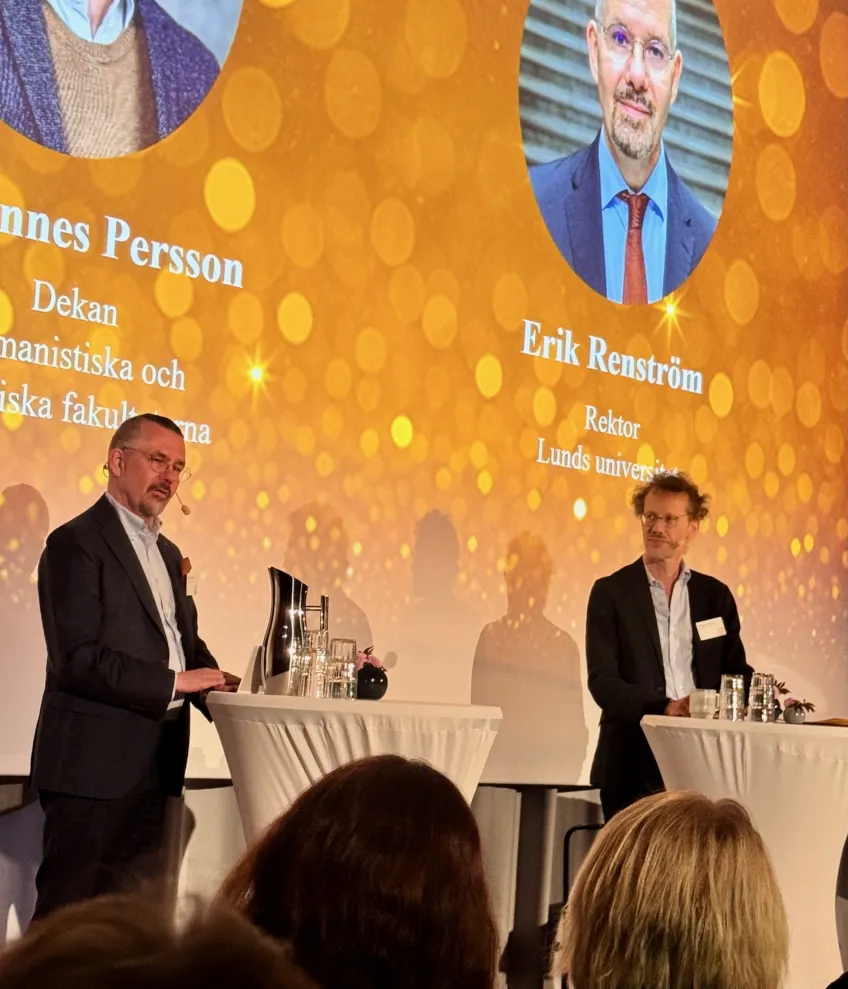
A new hub for the humanities, innovation and society is taking shape in Lund. On 8 May, Lund University and partners from the business sector and civil society launched Lund Humanities Village, which is set to become a new platform for knowledge and innovation where the humanities and theology are linked more closely to today's societal challenges.
Having a Humanities Village as part of an innovation district is quite unique. Lund has a fantastic opportunity here
The Lund Humanities Village initiative brings together students, researchers, the business community, the cultural sector, the public sector and the general public. The aim is to create new collaborations, job opportunities, innovations and pathways for the future within the most pressing issues of our time.

"We want to encourage encounters between students and their future employers. Between researchers from different faculties. Between academia, the business sector, cultural and creative industries, public authorities and the general public. Because the humanities are needed in all these contexts," says Johannes Persson, Dean of the Faculties of Humanities and Theology.
"These meetings will lead to new futures for individuals, new research projects and innovations, and a whole new ecosystem for the Humanities and Theology faculties," says Johannes Persson.
The humanities more necessary than ever
At many universities, both internationally and in Sweden, research and education in the humanities and theology are often conducted against the odds. At the same time, Lund University is choosing to lead the way with a long-term and clear initiative that links humanistic knowledge more closely to society's major challenges.
"Sweden is a technology-oriented country, and that is fundamentally a good thing. But many contemporary problems are not merely technical, but human. Solutions are often found within the humanities and theology," says Johannes Persson.
In an age of AI, automation and changing labour markets, skills such as communication, argumentation, understanding of human decision-making, ethics, culture and meaning are becoming increasingly important.
"AI will change our view of knowledge and the value in knowing things for oneself. Much of that which will become increasingly important is the very stuff the humanities train us in. The question of what knowledge is, and what value it will have in the future is something humanists and philosophers must help answer - who else could do it?"
A physical space - and a structure for the future
Lund Humanities Village is a meeting place in two senses. Firstly, it is a physical location: the area around the LUX and SOL buildings and the two squares in between. But just as important is the structure the initiative creates for long-term collaboration.
For students, the initiative means, among other things, access to mentors, new networks and a clearer picture of the opportunities available after graduation. For researchers, new interdisciplinary contexts and collaborations are opening up.
"It is difficult for individuals to create these contexts on their own. Lund Humanities Village offers a very important framework for our students and researchers," says Johannes Persson.
There is already considerable interest from stakeholders outside the university, and several mentors have expressed an interest in getting involved in the initiative.
Systematically linking the humanities to innovation and societal development is still unusual, both nationally and internationally.
"Having a Humanities Village as part of an innovation district is quite unique. More generally, it is probably also the case, at least in Sweden, that people usually think about finding ways to link art and technology, art and medicine, art and economics, and so on. The links between the natural sciences and the humanities are actually much more obvious than is often thought - but initiatives of this kind are far too rare. Lund has a fantastic opportunity here," concludes Johannes Persson.


