
"Noninvasive Analysis of Skin Emanations during Cupping Therapy by Thin-Film Solid-Phase Microextraction and Dielectric Barrier Discharge Ionization Mass Spectrometry" Analytical Chemistry
Cupping therapy is a traditional Chinese medicine (TCM) technique used to treat chronic pain, expedite muscle recovery, and other conditions. It increases blood flow by creating suction on the skin. But what is released from the skin during treatment? Researchers reporting in ACS' Analytical Chemistry developed a noninvasive approach to analyze compounds pulled in the cup. In a pilot study with healthy volunteers, they detected changes in 13 volatile compounds before and after treatment.
"I have a longstanding interest in analyzing volatiles related to human metabolites, for example, in the breath," says Renato Zenobi, a corresponding author of the study. "It is always best to capture these volatiles directly at the source - for example, have a patient blow into an analytical instrument or, as in the present study, collect directly in the cupping jars."
Despite its widespread use, scientists have rarely studied cupping's effects on a person's physiology. And previous studies have examined metabolites in blood or urine rather than what is released directly from the skin's surface. To address this gap, Zenobi, Xiaowen Yan, and colleagues developed a noninvasive method to capture and analyze skin-derived molecules inside cupping jars.
The researchers identified a two polymer-coated membrane that adsorbs and concentrates airborne molecules. Captured compounds were released by heating the membrane, then identified and quantified by mass spectrometry. The team first demonstrated the approach using a vacuum-suctioned cup on pig skin treated with five compounds found on human skin. All five were captured by the membrane and detected in the sample.
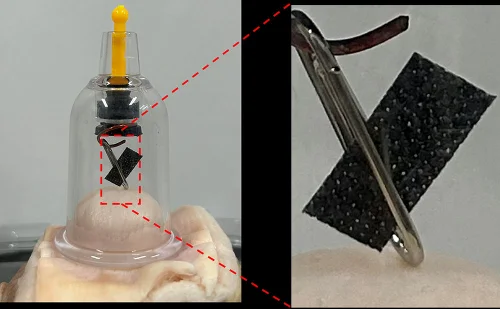
Adapted from Analytical Chemistry 2026, DOI: 10.1021/acs.analchem.6c02559
Then the researchers conducted a proof-of-concept study with 12 healthy volunteers. They placed cups with the coated membranes on participants' backs and waists for 10 minutes, consistent with typical treatment duration. The team compared the air inside cups either with or without vacuum suction, representing conditions during and before cupping, respectively, and observed substantial differences in 13 metabolites and compounds commonly found in the skin surface. These compounds included aldehydes, ketones, alcohols, terpenes, and organic acids, some of which increased in concentration after cupping while others decreased.
Zenobi says these results show that "the metabolic effects of TCM therapies can be studied with modern analytical techniques, which is something that has largely been lacking." However, he cautions that the data are preliminary. "Firm conclusions that are statistically significant should only be drawn when many more patients and controls have been analyzed."
Next, the researchers will plan clinical studies with a local hospital focusing on TCM, comparing people with conditions such as chronic pain to those without, to better understand the impact of cupping therapy on the body.
The study was approved by the Ethics Committee of Xiamen University.
The authors acknowledge funding from the National Natural Science Foundation of China, the National Key Research and Development Program of China, and the Fujian Provincial Natural Science Foundation of China.


