
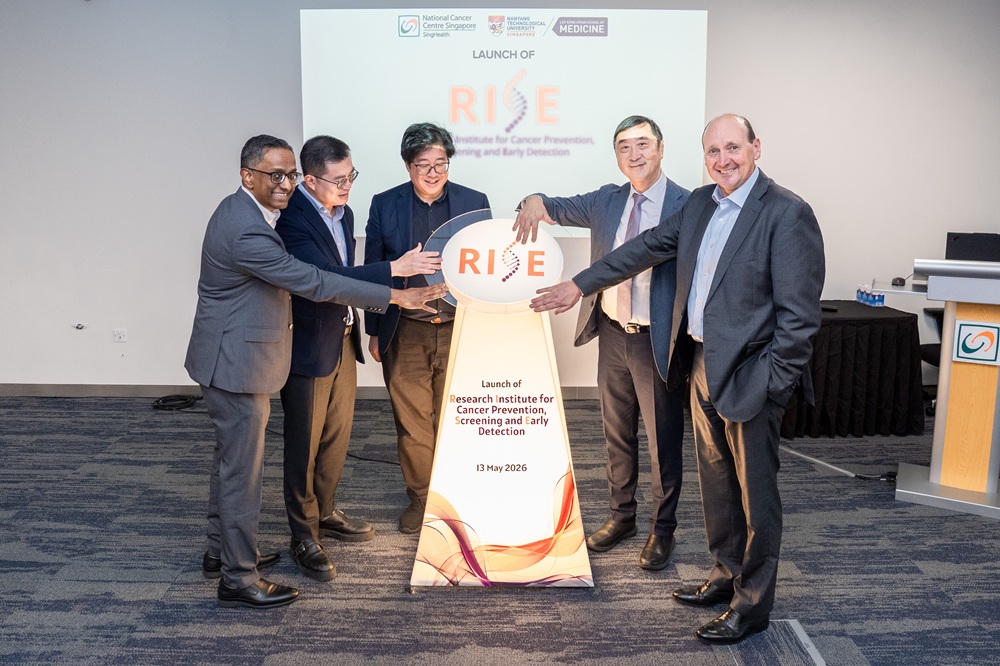
 The Research Institute for Cancer Prevention, Screening and Early Detection (RISE), jointly led by the National Cancer Centre Singapore (NCCS) and NTU Singapore, has announced the launch of two studies; one led by NCCS to evaluate multi-cancer early detection (MCED) tests and another led by the Lee Kong Chian School of Medicine (LKCMedicine) at NTU Singapore to develop targeted screening and prevention for metabolic dysfunction-linked cancers in Singapore.
MCED tests are an emerging cancer screening technology worldwide but there is limited evidence currently to show that they improve population health outcomes. The NCCS team will conduct a clinical trial to comprehensively evaluate the use of MCED tests to identify early-stage cancers in individuals with elevated risk due to pre-malignant conditions or hereditary cancer syndromes, and use the evidence-based insights to assess the feasibility for integration into cancer screening for at risk populations.
The LKCMedicine study focuses on individuals with metabolic risk factors, such as diabetes, excess body fat, high cholesterol or high blood pressure. These conditions increase the risk of developing several cancers, including colorectal, lung and breast cancer. Known as the Cancer Risk Assessments and Early detection (CRAnE) study, it aims to test multi-cancer risk assessment methods in primary care to tailor screening and prevention advice, so that individuals complete the screening tests most relevant to their risks.
Why Cancer Prevention and Early Detection Matter More Than Ever
Global analysis by the World Health Organisation and its International Agency for Research on Cancer found that up to 4 in 10 of all new cancer cases in 2022 were linked to preventable causes such as tobacco use, alcohol consumption, high body mass index, physical inactivity and cancer-causing infections [1].
Locally, the latest statistics from the Singapore Cancer Registry show that cancer incidence rates are steadily rising [2], yet local cancer screening participation rates remain significantly behind global counterparts and international benchmarks. The 2024 National Population Health Survey revealed low cancer screening participation rates among the eligible population here, with breast cancer screening participation at just 35.2%, while cervical and colorectal cancer screening rates are at 44.9% each [3] . International benchmarks for cancer screening participation aim for 70% or higher, to ensure population-level reduction in mortality and incidence.
This data, coupled with the established fact that early cancer detection enables timely treatment that is more effective, less complex and less costly, underscores the urgent need to explore more innovative screening approaches to detect and prevent more cancer types early.
"The next major leap in cancer control will not only come from better, more innovative treatments, but also from improving the ability to prevent and detect cancers earlier when the chances of cure are highest. RISE was established to generate robust evidence that Singapore can use to shape and design screening and prevention strategies that are effective, accessible and tailored to the needs of our Asian population," said Professor Ravindran Kanesvaran, Co-Director of RISE; Chairman & Senior Consultant, Division of Medical Oncology, NCCS.
"There are currently no centres in Asia that conduct clinical translational research, shape policy and deliver education focused on cancer prevention and early detection. RISE fills this critical gap in the region. It also recognises the important role of primary care across the cancer continuum, spanning prevention, screening, early diagnosis, survivorship and health service integration. Through RISE, LKCMedicine and NCCS have an opportunity to build on Singapore's healthcare policies and improve the delivery of cancer screening services in primary care and hospitals," said Professor Jon Emery, Co-Director of RISE; Professor of Family Medicine, LKCMedicine, NTU.
Evaluating the Potential of Multi-Cancer Early Detection (MCED) Tests
MCED tests, which are minimally invasive and require only a blood draw, are gaining interest as an approach to address screening challenges such as psychological and cultural barriers.
MCED tests are currently not part of Singapore's national cancer screening programme due to limited evidence demonstrating their cost-effectiveness and benefit at a population level. While they hold potential, MCED tests are not a replacement for recommended cancer screening tests, including screening at population level using mammogram (for breast cancer), Pap smear and Human Papillomavirus Test (for cervical cancer), and Fecal Immunochemical Test and colonoscopy (for colorectal cancer).
Global research on MCED technology is limited in scope, lacking long-term studies and focusing heavily on Western populations in the US and UK. This highlights the need to conduct research in Singapore to better understand the utility and relevance of MCED testing for our local population.
To address this, NCCS will conduct a clinical trial to assess the ability of MCED tests to detect early-stage cancers in individuals with elevated risk, and generate real-world evidence on whether the tests improve cancer diagnosis, staging, and survival. The clinical trial, which will start in the second half of 2026, aims to recruit 1,000 individuals in Singapore who have higher cancer risk due to pre-malignant conditions and/or hereditary cancer syndromes. Based on their MCED test results, participants will receive follow-up care and be monitored at NCCS for up to 5 years (See Annex A for more info):
"MCED tests hold promise in the fight against cancer, but promise alone is not enough to justify population-wide screening. We need rigorous evidence to understand how these tests perform in our population, what diagnostic follow-up and care is needed after a positive test result, and how individuals experience the screening and care pathway. With this NCCS-led clinical trial, we aim to assess the ability of MCED testing to help detect cancers earlier, reduce the burden of advanced disease and improve patient outcomes at a population level," said Professor Ravindran Kanesvaran.
Addressing Metabolic Dysfunction-linked Cancers, a Growing Concern
Globally, advances in cardiovascular management have helped reduce the overall disease burden attributable to metabolic risk factors. However, the burden from metabolic dysfunction linked cancers is on the rise. Metabolic dysfunction is associated with increased risk of several cancers, including liver, colorectal, pancreatic, endometrial, breast, oesophageal and lung cancer.
Often diagnosed at a late stage, these cancers account for a significant share of cancer deaths in Singapore. It is therefore crucial to increase screening participation among individuals with metabolic dysfunction and develop targeted approaches to multi-cancer screening and prevention.
Through the CRAnE study, LKCMedicine aims to improve early detection and intervention for metabolic dysfunction-linked cancers. Researchers from LKCMedicine will partner with NHG Polyclinics and private general practitioners to identify patients with metabolic dysfunction in primary care settings, and to test advanced multi-cancer risk prediction assessment models that will generate tailored reports outlining patients' cancer risks and the screening tests they should complete. Cancer risk assessment will include polygenic risk scores which estimate how multiple variations in DNA may increase or decrease a person's risk for specific diseases.
The initial study, involving 200 people with metabolic risk factors, will begin in the second half of 2026. Its results will be used to design a larger randomised controlled trial to evaluate the cost-effectiveness of multi-cancer screening and prevention for patients with metabolic dysfunction. (See Annex B for more info)
"By combining advances in cancer risk prediction with primary care-based prevention and early detection efforts, the study seeks to encourage doctors and patients to act fast, improve early diagnosis and reduce the burden of cancer. We hope to improve long-term health outcomes for Singaporeans at risk of multiple cancers," said Professor Jon Emery.
The Role of RISE to Boost Preventive Health Efforts
RISE was established in 2025 with the support of a generous gift of $2.5 million in memory of Mr Murdaya Widyawimarta Po to the NCCS Cancer Fund and $1 million in seed funding from LKCMedicine. The two new studies also benefit from these funding.
In line with the national Healthier SG initiative to boost preventive health, RISE works with all three public healthcare clusters in Singapore and other partners, to drive evidence-based policy recommendations and implementation strategies in primary care that improve cancer screening and early detection. The research institute combines NCCS' clinical care expertise and research capabilities with LKCMedicine's multidisciplinary primary care research and academic strengths, creating a platform to address critical challenges in cancer prevention and early detection in Asia. (See Annex C for more info on RISE)
[1] https://www.who.int/news/item/03-02-2026-four-in-ten-cancer-cases-could-be-prevented-globally
[2] https://www.nrdo.gov.sg/docs/librariesprovider3/default-document-library/singapore-cancer-registry-infographic-2023.pdf?sfvrsn=3e72976a_1
[3] https://www.hpb.gov.sg/community/national-population-health-survey/survey-findings


