Key Takeaways
- For the first time, researchers simultaneously used ultrafast X-rays and electrons to image a shockwave in water, a "multi-messenger" view that reveals details previous experiments couldn't see.
- Researchers found an unexpected layer of water vapor made the shockwave symmetric, a feature similar to what happens in certain targets used for inertial confinement fusion.
- The work shows how researchers can use small-but-mighty systems called laser-plasma accelerators to explore the microphysics of plasmas, advancing fusion energy research.
At the heart of our sun, fusion is unfolding. As hydrogen atoms merge to form helium, they emit energy, producing the heat and light that reach us here on Earth. Inspired by our nearby star, researchers want to create fusion closer to home. If they can crack the engineering challenges underlying the process, they would create an abundant new source of power to eclipse all others.
One of those challenges is understanding what happens at the smallest scales during fusion reactions so that researchers can better control the process. In one of the two main kinds of fusion, inertial confinement fusion (ICF), researchers bombard a fuel-filled capsule with lasers to create shockwaves and heat and compress the target, kicking off fusion. That means lots of complex interactions that scientists haven't been able to get a good look at - until now.
A team of researchers used a new approach at the Department of Energy's Lawrence Berkeley National Laboratory (Berkeley Lab) to watch how a shockwave moved through water in extreme detail, making a never-before-seen movie of how the material compressed and how the electric and magnetic fields evolved. They were intrigued to discover that water provided a good analog for what happens when a laser strikes an ICF target. Scientists captured the process using both X-rays and an electron beam, a unique dual view known as "multi-messenger" imaging.
It's the first time the multi-messenger technique has been used to study the physics underlying fusion, and opens the door for future small- and mid-scale experiments that will improve our models and help design better fusion systems.
The research was led by the University of Michigan through DOE's LaserNetUS (which provides access to high-power laser facilities across the United States), with collaborators from Berkeley Lab's Accelerator Technology & Applied Physics (ATAP) Division and four other institutions. The study was published Dec. 16, 2025, in the journal Nature Communications.
"It was a challenging experiment, but with very fruitful results," said Hai-En Tsai, a research scientist in ATAP. Tsai and the Berkeley Lab Laser Accelerator (BELLA) Center team led the design, construction, and operation of the laser and beam sources for the experiment. "We watched the interaction in picosecond [one trillionth of a second] steps, frame by frame, with micrometer imaging precision. These are unprecedented precision levels in inertial fusion energy, where scientists and engineers have a lot of questions. These results can actually help verify the simulation models used for ICF."
Making movie magic with lasers and water
The idea for the experiment began in 2019, when Mario Balcazar - then a graduate student in Alec Thomas's group at the University of Michigan and now a researcher at SLAC National Accelerator Laboratory - brought the proposal to the BELLA Center.
"We wanted to demonstrate that the X-rays produced by extremely intense lasers have unique properties that allow us to capture a 'movie' of the extremely fast motion of plasma," Thomas said. "There's a lot of excitement surrounding recent breakthroughs in laser-driven fusion. Making further progress requires accurate diagnostics to capture the dynamics of hot plasma, especially unstable behavior that can prevent fusion plasmas from burning properly."
The experiment used an unusual target: a flowing jet of water the size of a human hair. The target required months of engineering work to keep the thin stream of water from freezing in the experiment's vacuum. Once completed, researchers could fire the laser at the water target once per second, far faster than traditional solid targets that have to be replaced after every interaction. (The constantly flowing stream of water automatically replaces itself, and the laser only needs to be aligned once.)
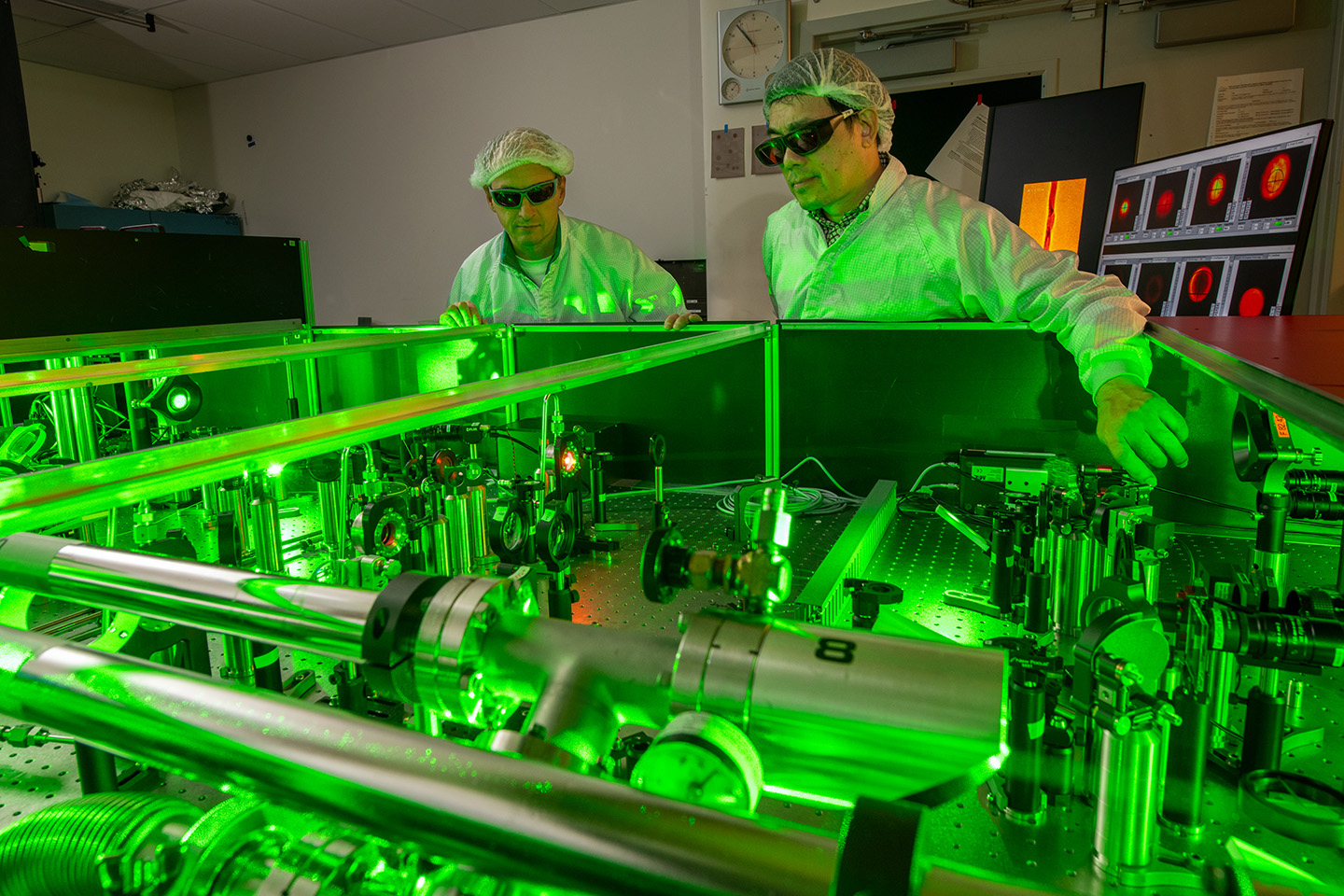
To capture the shockwave moving through the jet, experimenters turned to a laser-plasma accelerator (LPA), a compact device that generates ultrafast X-rays and high-energy electron beams over just a few millimeters. A second, synchronized laser delivered the shockwave to the water. Adjusting the timing between the two pulses let researchers stitch together a high-speed movie that revealed the shockwave's evolution.
The team's first experiment observed the shockwave using only X-rays. "Every time we looked at the X-ray image, it surprised us," Tsai said. "The simulations were very different from what we actually saw in the experiment, and that puzzled us for a while."
To understand the discrepancy, the team conducted follow-up experiments in 2020 and 2023. They added an electron probe to the experiment, combining it with the X-ray view of the shockwave for the first time.
That dual perspective showed what X-rays alone had missed: a thin layer of water vapor surrounding the jet. The vapor acted like a cushion, helping the shock compress the water symmetrically. This is similar to what happens in certain types of targets for inertial confinement fusion, where a thin, low-density layer of foam around the target exterior helps it compress more uniformly - key for successful implosions. This "vapor-assisted" symmetry had never been clearly seen before.
The vapor layer in the team's tabletop setup unexpectedly acted as a scaled-down model that's comparable to what happens in some fusion targets, providing a new way to study symmetry effects in fusion-relevant conditions.
"This experiment highlights how LaserNetUS brings together expertise across multiple universities and laboratories - from targets to diagnostics to lasers and sources - to gain unprecedented insight into the processes that can enable high-gain fusion and create future energy sources," said Cameron Geddes, director of ATAP.
The dual-probe approach also overcomes some of the challenges that have plagued experiments trying to study the microphysics of fusion. Unlike other methods, the technique is ultrafast and can repeatedly capture clear images at high resolution.
"Using two types of radiation pulses simultaneously gives us details that would otherwise remain hidden, and the picture we get is greater than the sum of its parts," said Jeroen van Tilborg, senior scientist and deputy director for experiments at the BELLA Center. "We're leading the effort to make laser-plasma technology more compact, and impactful to real-world applications. Shrinking the technology means researchers could potentially install a laser-plasma accelerator at a fusion facility to better image the process."
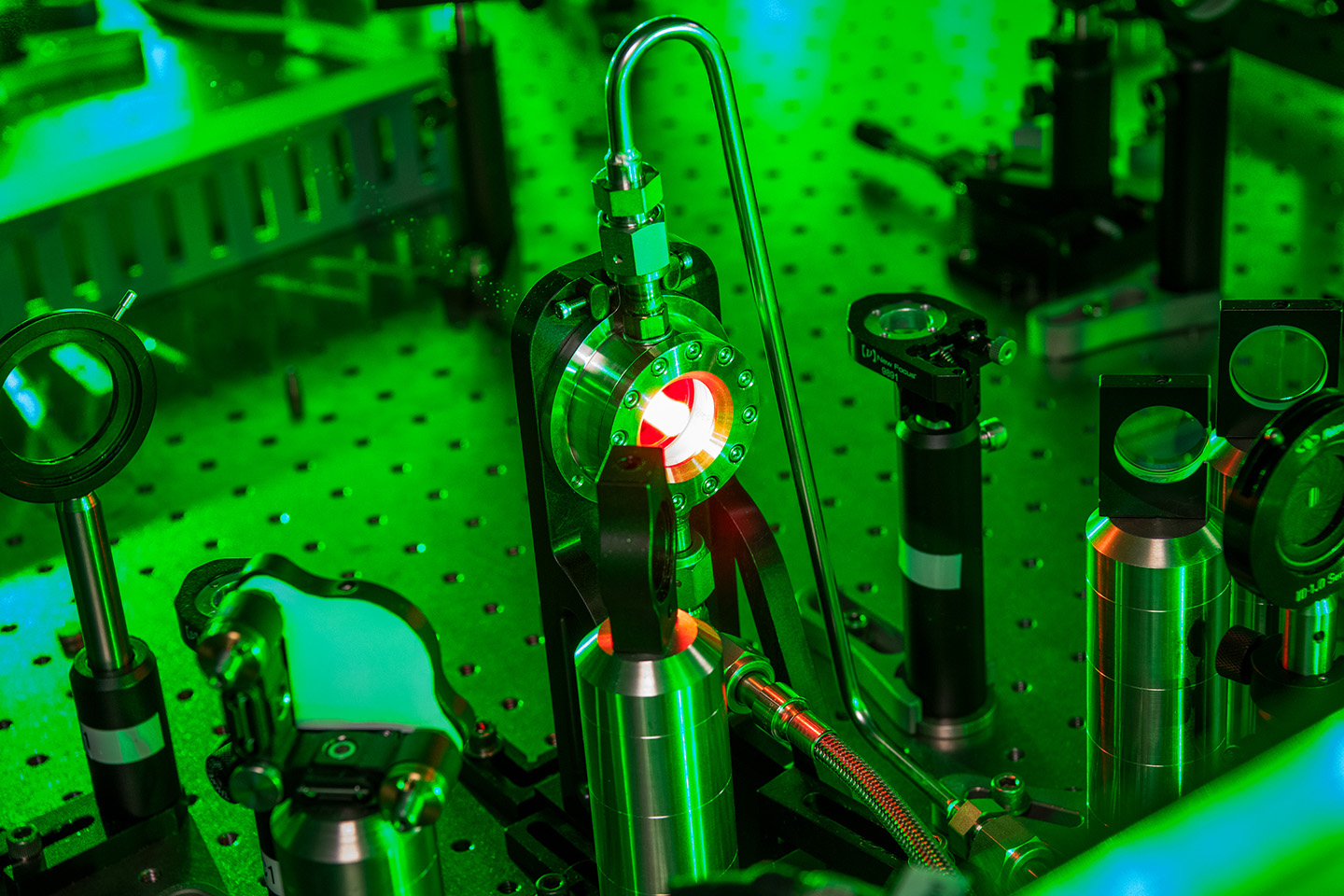
Researchers conducted the experiment at BELLA Center's 100-terawatt laser system, one of two beamlines open to outside scientists through the LaserNetUS program. It was the first user experiment performed on that beamline, and included experts from six institutions: Berkeley Lab, University of Michigan, SLAC, Lawrence Livermore National Laboratory, The University of Texas at Austin, and Imperial College London.
This research was funded by the U.S. Department of Energy's Office of Fusion Energy Sciences (FES) via the LaserNetUS program, Office of High Energy Physics, and National Nuclear Security Administration.