
A new Columbia University School of Nursing AI-assisted audit reveals nearly 3,000 peer-reviewed medical papers have fake citations that do not exist in scientific databases. The results highlight an alarming trend in academic publishing as the use of AI grows. The peer-reviewed research letter, "Fabricated citations: an audit across 2·5 million biomedical papers," was published in The Lancet on May 7, 2026.
To conduct their analysis, the research team developed an automated verification system using AI that scanned 2.5 million papers published from January 1, 2023, to February 18, 2026, in PubMed Central's Open Access. Among 97.1 million verified references, they identified 4,046 fake citations across 2,810 papers. The rate grew more than 12-fold since 2023, with the sharpest increase beginning mid-2024, coinciding with the rise of AI writing tools.
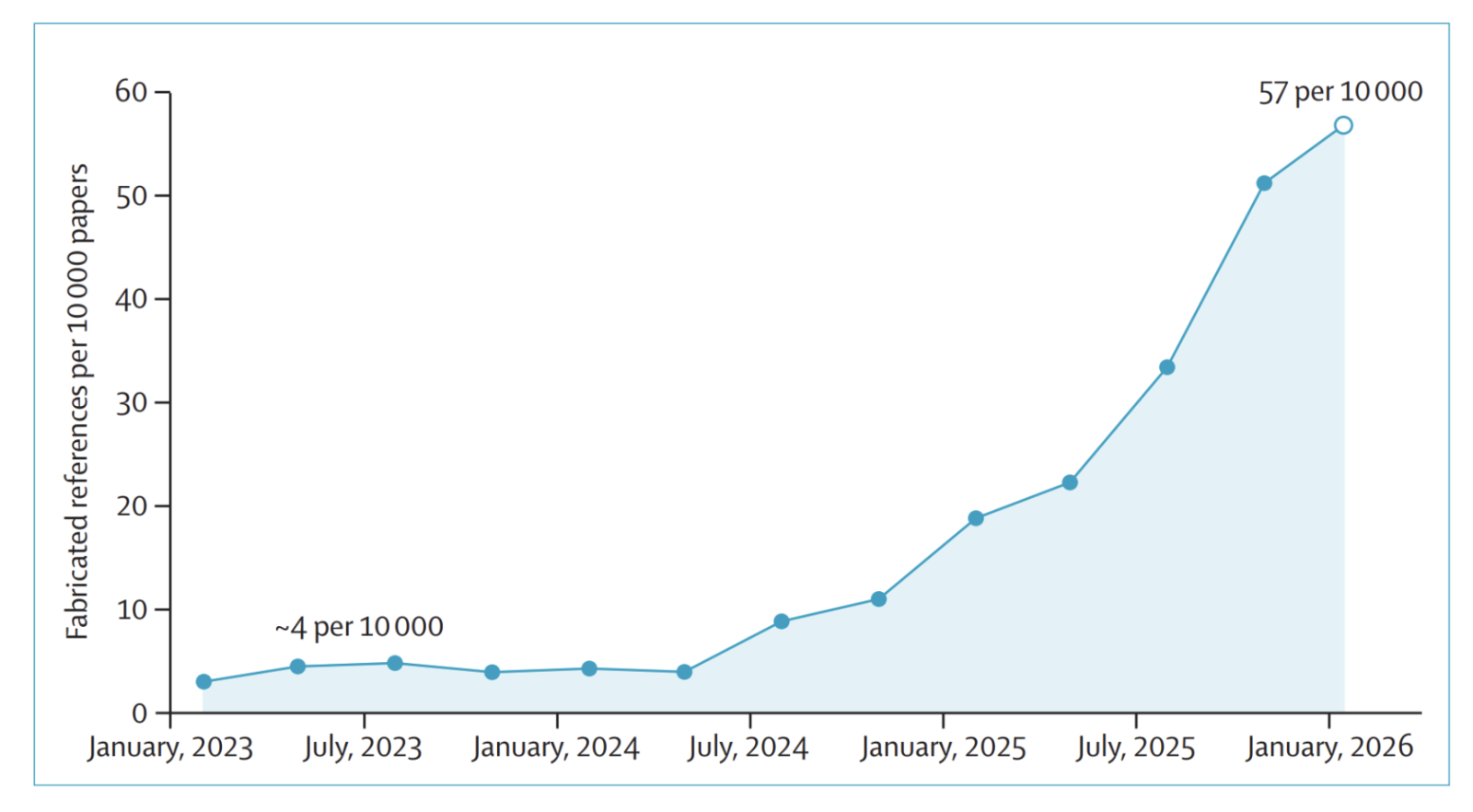
The image above demonstrates the monthly rate of fake citations per 10,000 papers in PubMed Central, January 2023 to February 2026. The fabrication rate remained stable at approximately 4 citations per 10,000 papers throughout 2023. Beginning in mid-2024, the rate rose sharply, reaching approximately 57 per 10,000 by early 2026. Each data point represents one calendar month. The open symbol indicates the final data point (January 1 to February 18, 2026), which represents an incomplete observation period.
This discovery directly impacts patients as medical professionals make treatment decisions based on clinical guidelines," says Maxim Topaz, PhD, associate professor at Columbia University's School of Nursing and Data Science Institute, who led the study.
"A medical professional or clinical guideline developer has no way of knowing that the evidence they are relying on does not exist. For example, one paper we reviewed had 18 out of 30 fake references. Some of those citations are already being cited by other papers and appear in systematic reviews that inform clinical care."
Based on their findings, the authors recommend publishers verify references with each paper submission. They also recommend that indexing services add metadata to records so that users can assess the accuracy of references. Lastly, the research team urges major research integrity databases to establish a dedicated category for fake references to enable systematic tracking and accountability. They call on publishers to retroactively screen existing publications and issue corrections or retractions where fake references compromise a paper's conclusions. Notably, at the time of the audit, 98.4% of affected papers had not received any publisher action.
In accompanying commentary, Howard Bauchner, MD, Boston University Chobanian and Avedisian School of Medicine, and Frederick P. Rivara, MD, University of Washington, say the study sheds light on a very disturbing issue and underscores the need to maintain and improve research integrity:
"Given that public trust in science appears to be waning in countries around the world, renewed efforts are needed to enhance research integrity. Authors must take responsibility and be held accountable for the entire content of a manuscript, including the references."
Other study authors include Nir Roguin, MD, Tel Aviv Sourasky Medical Center and Faculty of Health Sciences, Ben-Gurion University of the Negev; Pallavi Gupta, PhD, and Zhihong Zhang, PhD, Columbia University School of Nursing; and Laura-Maria Peltonen, PhD, Department of Health and Social Management, University of Eastern Finland; Wellbeing Services County of North Savo; Wellbeing Services County of Southwest Finland; and Department of Nursing Science, University of Turku.
An interactive website featuring the findings can be found here.


