
A crepe cake.
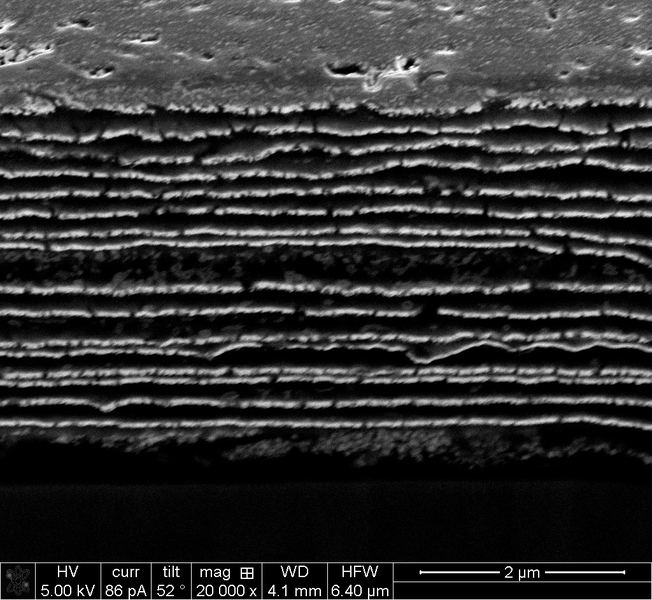
That's how Camille Cunin describes the polymer-metal "sandwiches" that became a highlight of her doctoral thesis at MIT's Department of Materials Science and Engineering (DMSE). Over close to five years, these composites were a key component of her research on bioelectronics - devices designed to interface with the human body.
Cunin completed her PhD in February - she'll attend commencement in May - but traces her interest in bioelectronics to a formative summer internship at Massachusetts General Hospital (MGH) in Boston in 2019. There, she saw a patient with Parkinson's disease struggle to swallow a tethered "capsule" intended to function as an exploratory gut probe. The device failed, and the gap between lab-based design and real life became all too apparent.
The incident validated the career path Cunin had already begun to pursue: to make usable products that have a positive impact on people's lives. It's a purpose that hasn't gone unnoticed. "Some might be happy with a sketch of a concept and no actual demonstration, but Camille has a remarkable ability in that she wants to do materials science that can translate to real-world applications," says her advisor, Aristide Gumyusenge.
Building blocks
The daughter of a psychologist and an engineer, Cunin grew up in Paris, encouraged by her parents to be curious about the world around her. LEGO blocks featured prominently in her childhood. When her father found some old lights in a box in the attic, 9-year-old Camille strung them to decorate her LEGO castle by creating a circuit, complete with a fuse.
Strong grades earned her a spot in France's elite post-secondary preparatory classes for admission to the country's prestigious grandes écoles. The intensive and competitive prep classes, however, left Cunin with a sour aftertaste - "for a while I hated science, because the environment was too competitive for me," she says - and a bit rudderless in engineering school.
It was the research internship thousands of miles from home, at MGH - part of her master's in engineering at École Centrale de Marseille in France - that rebooted her love of science. The open-ended nature of research appealed to her curiosity and helped her regain confidence in solving problems. She was delighted to be accepted at MIT DMSE for her doctoral studies. "In Boston, I thrived in collaborative environments, and it felt like anything was possible," she says.
Stretching possibilities
Before starting at MIT, Cunin had a wealth of interdisciplinary experience, from internships and her graduate studies. Unsure about how to slot it all together, she was looking for an advisor at a time when Gumyusenge, Henry L. Doherty Career Development Professor in Ocean Utilization and assistant professor of materials science and engineering, was himself just establishing his lab at DMSE.
When Gumyusenge shared plans to work on projects to turn biological signals into electronic data, Cunin was excited to build on her prior research in biomedical devices. "Here was a chance to fine-tune the materials and to optimize the performance of bioelectronic devices. I really felt I could leverage my strengths in Aristide's lab," she remembers.
Gumyusenge proved a great fit, supporting Cunin's broad research ambitions while helping her shape and integrate them into a coherent doctoral project. She tackled everything from developing and characterizing new materials to fabricating transistors and learning surgery to test the devices in animal models. The final dissertation focused on organic transistors, which boost body signals for easier detection in soft electronics.
Biological signals, like those from nerves in the body, are weak, and transistors amplify them so they can be measured. The challenge with developing bioelectronic devices is that traditional components are hard and rigid, while the human body is not. Devices must perform as needed and be soft and flexible to avoid irritating human tissue.
Another complication: Biological processes involve charged ions moving through fluids, while electronics rely on electrons moving through materials. Before transistors can amplify signals, they first have to convert biological signals into electronic ones for circuits to pick up.

Cunin's transistor design needed to solve two major challenges: first, to facilitate the movement of electrons and ions in the "channel," the hub of all signal activity, in soft, hydrated environments; and second, to be pliable enough to conform to the human body.
It was no easy task.
Elegant simplicity
Gumyusenge's lab typically uses chemistry to modify material behavior, but Cunin took a different tack. Since polymers are soft, and metals are good conductors, she looked to the classic French pastry mille-feuille, which inspired the layered design: thin metal sheets sandwiched between layers of porous elastomer. The metal stretches with the elastomer and forms microcracks. Charges get trapped in the cracks but can still flow through the stack, while the elastomer's strong adhesion keeps the layers together.
Previous item Next item
Her approach won Cunin high marks from her advisor. "Camille was working on a complex problem, but she found a way to simplify it with a straightforward approach," Gumyusenge says.
Of course, even an elegant solution needs test drives. "The more crystalline the polymers are, the better the charges percolate and travel in the material," Cunin points out, referring to how ordered the semiconducting polymers in the transistor channel are. But if they're packed too tightly, ions don't move freely, and the transistor channel can't switch properly. The arrangement of the spaghetti-like polymer chains controls this balance, so Cunin studied the composites' structure to optimize both ionic and electronic performance.
Professor Polina Anikeeva, who co-advised Cunin with Gumyusenge and calls her "unstoppable," says her innovation in the lab was remarkable - but not surprising.
"She didn't have to be pushed into trying something new," says Anikeeva, head of DMSE. "I would have higher and higher expectations, and she would consistently meet those higher and higher expectations."
That drive continues in industry. Cunin now works at the Cambridge-based neurotechnology startup Axoft - just minutes from her former lab at MIT - researching soft electrodes that can be implanted in the brain. The electrodes detect electrical signals that can shed light on the brain's many functions. "By understanding the brain better, we can eventually develop therapies and treatments that improve patient outcomes," Cunin says.
Creative outlets
During her time at MIT, Cunin also made time for activities outside the lab, driven by the same curiosity that fueled her research. Committed to sharing her love of materials science and engineering, she was a leading member of the Polymer Graduate Student Association and organized several editions of MIT Polymer Day, a one-day symposium connecting students, faculty, and industry to showcase cutting-edge polymer research.
She also pursued creative outlets. After learning to use 3D graphics software Blender, Cunin illustrated some of the journal covers featuring her work.
She is also a diehard salsa fan and teaches the dance style a couple of times a week. Salsa's social and collaborative forms appeal to Cunin, who enjoys sharing her passion, experimenting with choreography, and helping fellow dancers improve. "Salsa is fast - I love the mental challenge it brings. I also like that it exposes you to different aspects of the community; it pushes you out of your bubble," she says.
Gumyusenge appreciates that Cunin made time for other pursuits throughout the grueling demands of a doctoral degree. "She'd work 14 hours a day in the lab, but also go do some hiking and take a break. I love that - it's something that other PhD students seem to forget sometimes," he says.
That balance reflects her determination and resolve. "Camille has never been shy about facing challenging research problems," he says. "She had a research vision and was dedicated to learning the lessons she needed to get it all done. I learned to not get in her way because when Camille told you she would learn how to do something, she would."


