
The new approach combines MRI scans and AI tools to measure fluid flow linked to diseases such as Alzheimer's.
When a person goes into deep sleep, water-like fluid circulates around the brain, washing away metabolic waste linked to diseases such as Alzheimer's. This process, known as the glymphatic system, was first described in 2012 by Maiken Nedergaard-a pioneering neuroscientist and codirector of the University of Rochester's Center for Translational Neuromedicine.
But questions remain about the system's mechanics-notably, how quickly the fluid circulates. Studying the circulation within a living brain is difficult without causing irreparable harm to a subject.
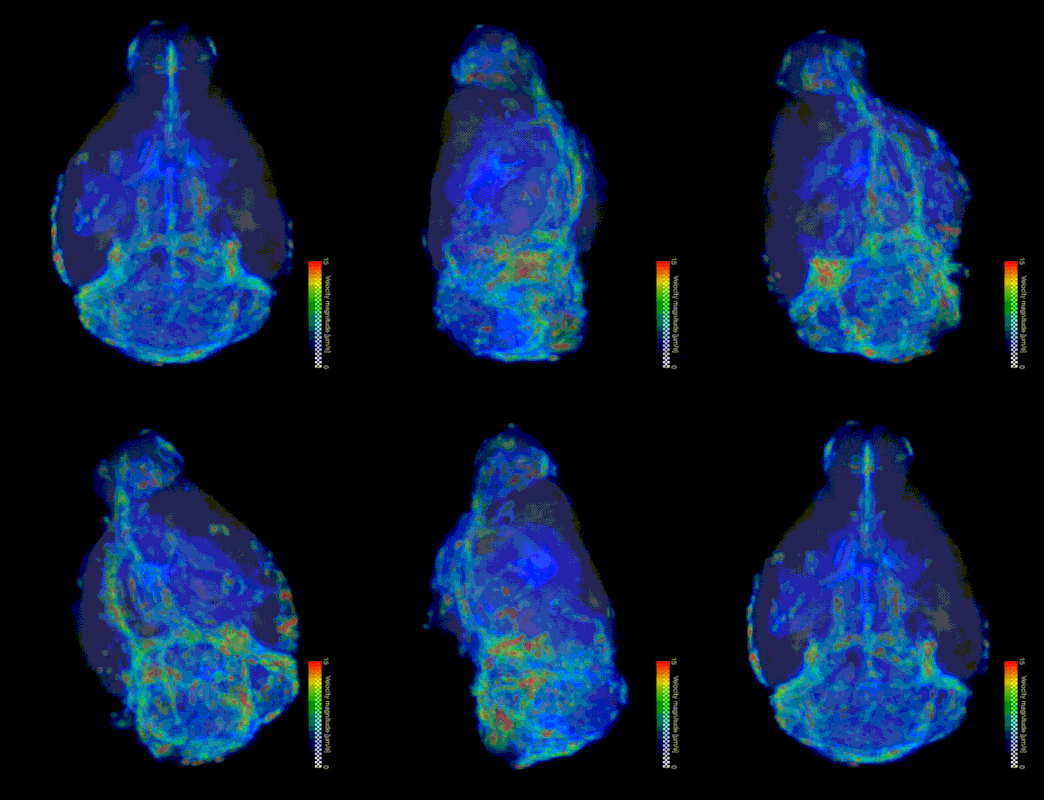
"You can put a microscope on a small patch of the brain and watch what's happening there with a lot of detail, and we've worked with that type of data in the past, but it's only a tiny view of the overall process," says Professor Douglas Kelley from URochester's Department of Mechanical Engineering. "If you want to image whole brains, an MRI is a great approach because it gives you a three-dimensional view. But an MRI has serious limitations, too, the biggest of which is that it does not capture the fluid flow velocity, at least not for flows this slow."
Kelley and his colleagues from URochester, Brown University, and the University of Copenhagen turned to artificial intelligence for help. In a new study published in Science Advances, they outline how they used physics-informed AI to determine fluid flow velocities from magnetic resonance imaging (MRI) data. Using videos of dye spreading across brain tissue over time, the neural networks the researchers built were able to deduce how fast the fluid flows and how permeable the brain tissue is.
The results showed that there are two main ways that the glymphatic system washes away particles in the brain such as the amyloid beta proteins linked to Alzheimer's disease-and one of these ways is much faster than the other. The fast flow of the glymphatic system's waterlike fluid moves at a few microns per second around the brain's open regions such as the surface between the skull and the brain, while the slower flow of the waterlike fluid trickles through the brain's deep tissue at a rate about 50 times slower.
So far, the researchers have been working to get baseline measurements of fluid flow in the brains of animals such as mice to inform the AI tools. In the future, they hope to be able to compare the fluid flow in healthy and sick brains as well as young and old brains, with aspirations to eventually study circulation in humans.
"We're working hard toward being able to measure the flow of waterlike fluids in and around human brains because then the clinical applications get a lot more important and exciting," says Kelley. "We hope to someday be able to see whether an Alzheimer's patient has poor circulation in their brain or even screen for poor circulation earlier in life to try to stave off Alzheimer's. Or we could check when somebody has been concussed to see whether the fluid circulation in their brain is disrupted. This study gets us a step closer."
Kelley's collaborators on the study include Brown University PhD student Juan Diego Toscano, URochester computational scientist Yisen Guo, Brown University PhD student Zhibo Wang, URochester PhD student Mohammad Vaezi, University of Copenhagen Associate Professor Yuki Mori, Brown University Professor George Karniadakis, and URochester Assistant Professor Kimberly Boster.
The NIH National Center for Complementary and Integrative Health and the NIH BRAIN Initiative supported this research.


