
A team of scientists from Berlin analysed water and sediment samples from six water bodies in Berlin and the adjacent federal states of Brandenburg and Mecklenburg-Western Pomerania, as well as the inflow and outflow of a wastewater treatment plant in Berlin.
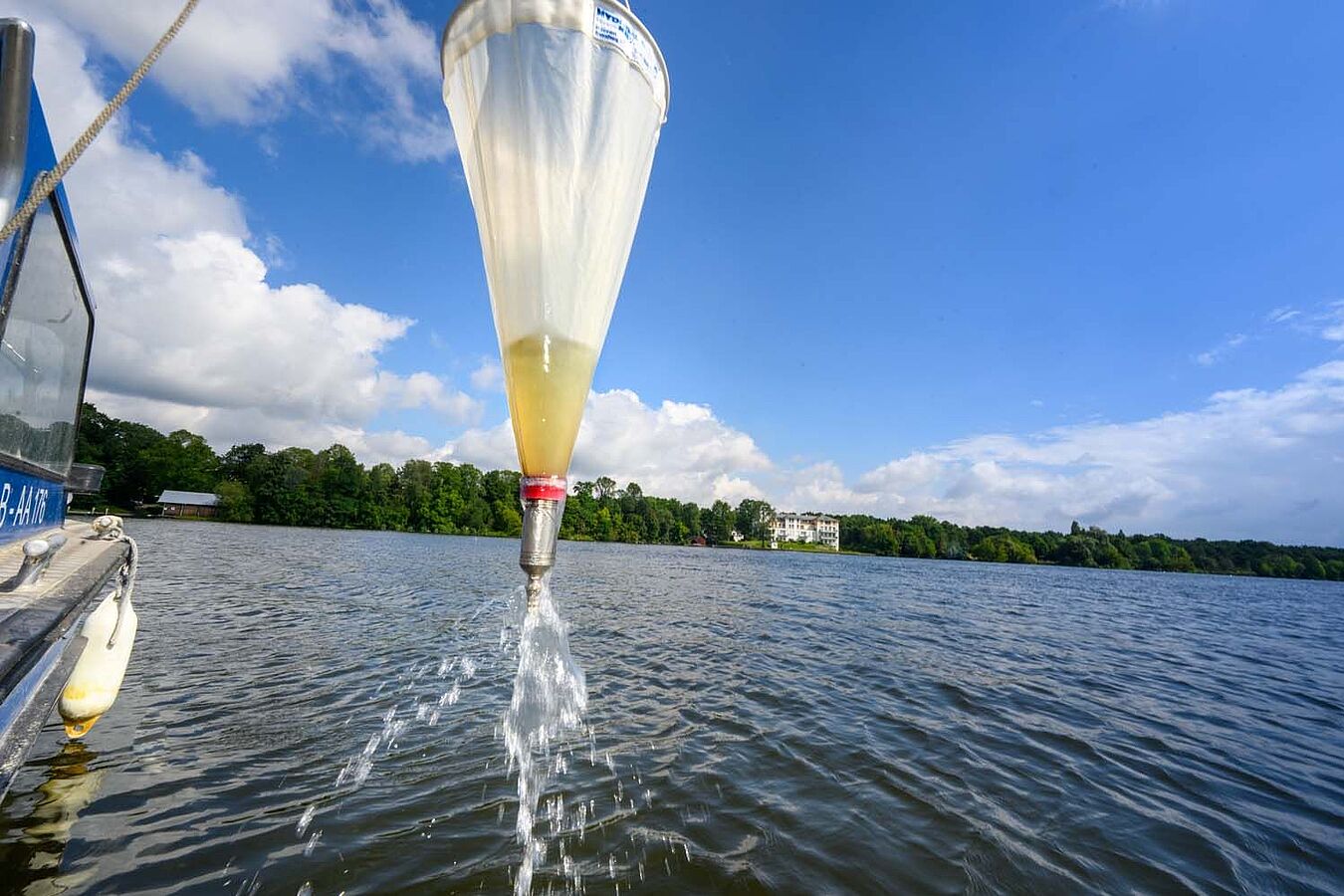
Water sampling in Lake Müggelsee | Photo: David Ausserhofer
The scientists analysed bacteria found in these samples and detected a higher diversity and load of antibiotic resistance genes in urban samples. The inflow and effluent from the treatment plant were the most heavily contaminated, but resistant bacteria were also found in rural lakes far from urban areas. The study is published in the journal "iScience".
A team from the Leibniz Institute for Zoo and Wildlife Research (Leibniz-IZW) and the Leibniz Institute of Freshwater Ecology and Inland Fisheries (IGB), in collaboration with colleagues from Potsdam (Germany) and Vienna (Austria), analysed water and sediment samples from the Weißer See and the Müggelsee in Berlin, the Stechlinsee and the Dagowsee in Brandenburg, the Haussee in Mecklenburg-Western Pomerania, a farm pond in Brandenburg and the inflow and effluent of a wastewater treatment plant in Berlin. The samples were genetically analysed and bacterial antimicrobial resistance genes classified. To do this, they employed different bioinformatic methods and genetic databases. "This broad methodological approach enabled us to identify specific genes in the genomes of the bacterial species prevalent in the samples that are responsible for antibiotic resistance," explains Pau de Yebra Rodó, lead author of the study and doctoral student at the Leibniz-IZW and the Leibniz-IGB. "We were able to identify a total of 18 classes of 'antibiotic resistance genes' (ARGs) - varying in diversity and load at the different sites."
Traces of antibiotic resistance genes are all too clear - even after water treatment
All 18 of the resistance gene classes identified were present in the inflow to the wastewater treatment plant, and 16 of these were also found in the effluent, albeit at slightly lower concentrations. The treatment process was evidently only able to remove or sufficiently dilute the bacteria resistant to glycopeptide antibiotics and nitroimidazoles; all other ARG classes remained present in the treated water. In second place in the ranking are urban waters: nine classes of antibiotic-resistant genes were detected in the surface water of Müggelsee, and a further nine were found in the sediment of Weißer See, the soil layers through which surface and groundwater flows and is filtered. In contrast, the surface water of Haussee, Stechlinsee and Dagowsee was free of detectable ARGs.
"What is interesting and worrying, however, is the detection of resistance genes in sediment samples from rural lakes," says Prof. Alex Greenwood, head of the Department of Wildlife Diseases at the Leibniz-IZW and senior author of the study. "Soil layers close to the water's surface appear to store antibiotic-resistant bacteria and retain them in the environment, even when the surface water no longer shows any detectable contamination." In particular, the class of genes responsible for resistance to aminoglycoside antibiotics was present in higher total loads in sediments than in water.
Farm ponds in rural areas are also notably contaminated
Fewer different resistance gene classes (six) were detected in the water samples from the farm pond situated amidst fields in western Brandenburg than in the water of Lake Müggelsee and in the inflows and outflows of the treatment plant, but more than in the water of Stechlinsee, Haussee or Dagowsee. The ARG classes found in the pond bacteria largely corresponded to those detected in urban water bodies: aminoglycosides, phenicols and tetracyclines. These substances are used as antibiotics in both humans and livestock and are released into the environment through anthropogenic as well as agricultural wastewater.
In the case of urban water bodies, it is not only the immediate proximity to human settlements that is decisive for the introduction of antibiotic-resistant bacteria (in this respect, Müggelsee, Weißer See and Haussee are relatively similar), but also the intensity of use, reports Prof. Hans-Peter Grossart, co-head of the Department of Plankton and Microbial Ecology at the IGB. "Significantly more ARG classes were detected in the waters of Lake Müggelsee than in the other two urban lakes, which is likely explained by the many bathing spots, fishing and boat traffic on Lake Müggelsee. In this respect, it is used far more intensively than the two comparably urbanised lakes."
Further studies on bacteria in water sporting antibiotic resistance are needed
Antibiotic resistance is regarded as a major global health challenge by experts. "With our research we try to improve our understanding of how antibiotic resistance spreads, persists and evolves in the environment," summarises de Yebra Rodó. "The introduction of resistant bacteria through human activities is the main source of ARGs in the environment, particularly via wastewater from hospitals, farms, and private households."
In their study, the scientists faced notable methodological challenges. For instance, they were able to achieve varying levels of sequencing depth (a quality grade for genome analyses) when comparing water samples, sediment samples and samples from the treatment plant. However, the differences found in the diversity and abundance levels of resistance genes in the bacterial genomes were substantial enough to allow for reliable conclusions. Further studies are needed, however, covering a broader range of water bodies, a larger number of samples and a longer timeframe, in order to be able to characterise differences in antibiotic resistance profiles between urban and rural freshwater ecosystems more precisely.
De Yebra P, Zoccarato L, Galdindo JA, Numberger D, Abdulkadir N, Grossart HP, Greenwood AD (2026):
Diversity of antibiotic resistance genes increases in urbanized lakes: a multi-tool screening. iScience 115892.


