
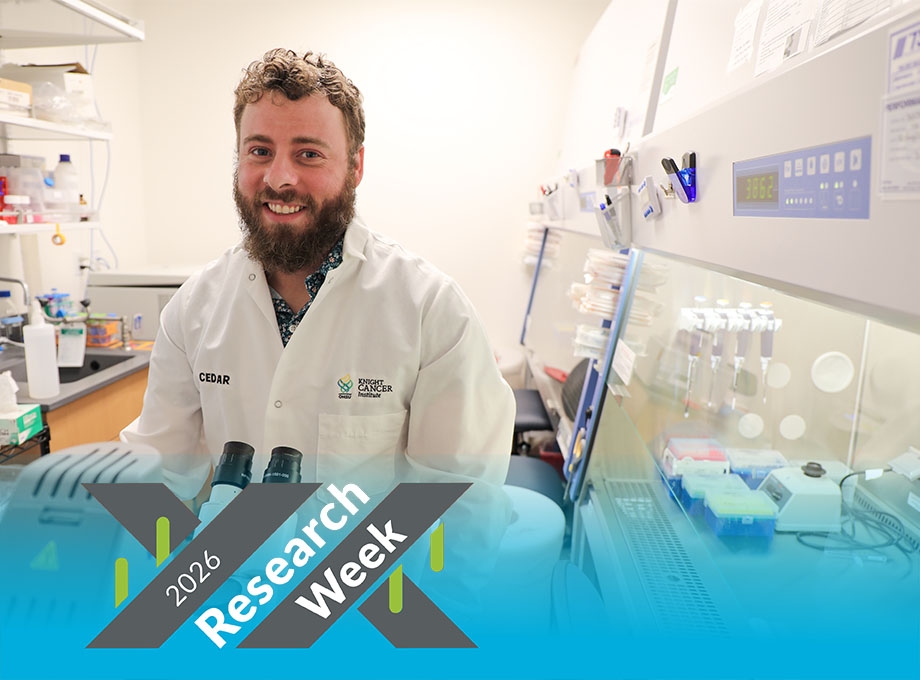
Creativity and curiosity have always been central to the work of Joshua Moreau, Ph.D., an immunologist whose work at Oregon Health & Science University sits at the intersection of harnessing the immune system; delving into tissue biology; and, most recently, discovering a potentially powerful defense against the invasion of cancer cells.
Recruited to OHSU in fall 2022, Moreau, assistant professor in OHSU's Division of Oncological Sciences, the Department of Dermatology, and the Department of Cell, Developmental & Cancer Biology, has spent the last four years leading an immunology lab on the fourth floor of the OHSU Knight Cancer Research Building. His chief area of focus has been understanding exactly how a specific type of white blood cells, called B cells, operate in inflammation.
Through experiments in mouse models, the team has been able to demonstrate that if B cells perceive a threat, they will gather in that specific location, taking up "residence" in, for example, the skin or the lungs. Once there, these so-called resident B cells act as hyper-vigilant maintenance workers — noticing if something isn't right and getting to work immediately to fix it.
"Until very recently, people didn't even think B cells could form residency, and so they've sort of been ignored in the context of tissue biology, tissue immunity and especially in tumor biology and cancer immunology," Moreau said.
Indeed, for the last decade, another type of white blood cells — T cells — have taken center stage in immunotherapy treatments. The most common immunotherapy drugs, called checkpoint inhibitors, leverage T cells to recognize and attack cancer cells more effectively.
Meanwhile, B cells have been quietly circulating, on the lookout for problems. Moreau wondered, what if you could provoke a B cell response to shrink or even eliminate a cancerous tumor? Could it work?
Vaccination method
Initial data suggest that yes, it can. In a "teach first, challenge later" approach, Moreau's team introduced cancer-associated proteins, or antigens, into mice so their immune systems would learn to recognize them. Then, the team used a laser-assisted skin vaccination approach to inject melanoma, or skin cancer, cells that expressed those same proteins.
What happened next was exactly what Moreau was hoping for: B cells gathered in that area of the skin and neutralized the cancer cells. Next, Moreau and team tried it in the lungs, this time using a nasal spray vaccine method. They waited, then injected the mice with lung cancer tumor cells. Again, the B cells gathered, attacked and neutralized the cancer cells.
Perhaps even more interesting, the B cells in each instance stayed at the scene of the fight. Months later, B cells remained clustered in the skin and in the lung, ready and waiting, should another threat occur.
"The fact that these B cells don't recirculate and they're sort of exquisitely tuned to that particular environment is notable," Moreau said. "So, if it's the skin, these memory resident cells are better able to work in that environment and regulate the biology of that tissue. And then if a disease comes along, whether that's a pathogen or cancer, they're best able to actually tackle that challenge."
Another benefit of this vaccination method is the ability to provide protection only where it's needed.
"More traditional cancer treatments, like chemotherapy, can cause toxicities and side effects that are difficult to deal with, but with this method, it's concentrated, not systemic. It's working where it needs to work and not anywhere else," he said.
Moreau and his team are putting the finishing touches on a paper to submit for scientific journal publication about this research. While initial data and results have been positive, Moreau cautions that his team is still a long way off from a proven cancer therapy. What works in mice doesn't always work in humans, and the road from bench to bedside can be long.
But in science, every step matters. Small discoveries can add up to a big breakthrough, Moreau said.
A personal struggle
He recalled his own childhood struggle with severe eczema, a common skin condition that can cause a rash, dry skin, itching, redness and blisters. He suffered with this condition until his post-doctoral years, when he began taking a newly approved biologic therapy that uses the patient's immune system to suppress the auto-immune disease. It has brought him immense relief.
The fact that some of Moreau's research has direct ties to dermatology and could lead to better skin disease treatments is not lost on him. In February 2024, Moreau was senior author of a journal publication describing how B cells organize, mature and adapt in cases of Hidradenitis suppurativa, a long-lasting skin disease that causes painful skin lesions.
"It's incredibly rewarding to think that work I'm doing could one day help people with skin conditions or skin cancer," he said. "It's why I like to focus on the basic biology of what we've been working on. The drug that has helped me so much stems from fundamental immunology — from how immune responses are regulated. And that is basically what we're trying to do with B cells."
While his lab's recent research is illuminating, Moreau said it's important to continue to work on fundamental discoveries that promote our general understanding of biological function.
"It's tempting to think about what this could be, but to me, that's getting ahead of ourselves," he said. "Could this, down the road, be a situation where a patient has a tumor, and you can deliver this localized vaccination method to eliminate it? Maybe.
"But more broadly, we're contributing to the understanding of the players involved in a localized tumor or tissue disease and how they interact with each other. How can we use that knowledge to unlock the full capability of the immune system to target the cancer?"
Moreau earned his Ph.D. from University of Toronto and did his post-doctoral fellowship at University of California, San Francisco, supported by a Human Frontier Science Program Fellow grant. His work at OHSU has been supported by funding from a Melanoma Research Alliance Young Investigator Grant, The LEO Foundation, The Elsa U. Pardee Foundation and generous startup funds from the Knight Cancer Institute.
Moreau said he's grateful for his journey so far and to be working at an academic health center, where collaboration, tissue samples and clinical support are easy to come by.
"I started our lab with an idea, and then to see that idea come to something has been really gratifying," he said. "We have this body of work now that shows that these B cells actually are important in the cancer journey. Not only are they present, but we can generate them. And that wasn't necessarily obvious when I started.
"It's very exciting to see that progress and know that we're on the right track. I think there's many new chapters ahead."


