
Professor Honey Meconi's scholarship on Saint Hildegard of Bingen advised the Vatican's exhibit featuring FKA Twigs, Brian Eno, Patti Smith, and others.
When the international art extravaganza Venice Biennale opens on May 9, visitors to the pavilion sponsored by the Vatican will find a fusion of past and present in the music of the 12th-century German Saint Hildegard of Bingen being interpreted by some of today's most innovative artists.
Helping bring the exhibit to life is Honey Meconi, a professor of musicology at the University of Rochester, whose extensive research into Hildegard has shaped how the world understands and performs her music.
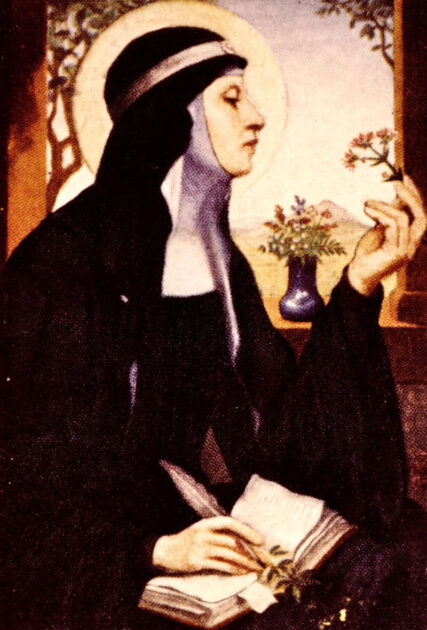
Meconi was among the consultants to the creative team behind the Holy See's pavilion, titled "The Ear Is the Eye of the Soul," which The New York Times highlighted as one of "eight pavilions that have the Venice Biennale buzzing." The life and work of Hildegard inspired the exhibition and, according to the Holy See, centers on themes of "slowing down, listening, contemplating, and caring" and features performances by 24 artists, including stars like FKA Twigs, Brian Eno, Dev Hynes, and Patti Smith.
"One of the things I've always loved about Hildegard is how inspiring her music is to artists of all kinds," says Meconi, whose book Hildegard of Bingen (University of Illinois Press, 2018) remains the first and only English-language text devoted to Hildegard's work as a composer.
"Her music consists of a single melodic line that modern musicians use as a tabula rasa, bringing their own ideas and interpretations to it while still engaging with something authentically medieval," Meconi says.
The Venice Biennale was founded in 1895 and is held every two years. Often described as the "Olympics of the art world" for its pavilions hosted by countries, the festival brings together artists, architects, and musicians and is a major stage for new ideas and cultural exchanges.
Part of the Vatican's pavilion is located in The Mystical Garden in Venice, where visitors can listen to commissioned re-compositions of Hildegard's music through headphones as they wander the secluded garden's plots of vegetables and flowers.
The pieces were curated by Hans Ulrich Obrist and Ben Vickers in collaboration with Soundwalk Collective, an experimental sound art organization based in Berlin and New York City.
URochester scholarship shapes a global stage
Meconi's involvement began last fall when Soundwalk Collective contacted her seeking guidance on Hildegard's music.
"They knew they wanted modern performers to interpret her work, so I provided editions and translations and answered questions about pronunciation, tuning, and so on," Meconi says. "I was also able to suggest pieces that might be appropriate for specific artists."
As part of her role, she was recorded singing Hildegard's music at Electric Lady Studios, the legendary space founded by Jimi Hendrix in New York City.
"That was surreal," Meconi says. "But it is also surreal for someone who specializes in music before 1600 to see Brian Eno's name in an email subject heading and to do a translation specifically for him."
Another highlight for Meconi, as she tells it, was learning that Pope Leo XIV had translated one of Hildegard's song texts into Portuguese for the famous fado singer Carminho. The song was one for which Meconi had provided the edition.
"Technically speaking," she says, "the pope and I are now collaborators."
Who is Hildegard, and why is her work so hot right now?
"She was the Boss Lady of the 12th century."
Hildegard of Bingen was a German Benedictine nun and polymath of epic proportions. In addition to founding a convent, writing theological treatises on her heavenly visions, inventing a new language and alphabet, corresponding with everyone who was anyone in the 12th century, and authoring books on the natural world and healing, she was a prolific musician. She penned 77 songs and a musical drama before her death at 81 in 1179.
"She was the Boss Lady of the 12th century," Meconi says.
The Holy See says its pavilion responds to the broad theme of the Biennale, titled "In Minor Keys." The festival's curator, Koyo Kough, died last year, but wrote of the exhibition in her original curatorial statement: "In refusing the spectacle of horror, the time has come to listen to the minor keys, to tune in sotto voce to the whispers, to the lower frequencies; to find the oases, the islands, where the dignity of all living beings is safeguarded."
The Biennale runs from May 9 to November 22.


