
Since their discovery in the 1950s, metallocenes - chemical compounds where a metal atom sits 'sandwiched' between two carbon rings - have been at the heart of organometallic chemistry research, finding applications in catalysis, materials design, energy, sensing, drug delivery and more. Yet knowledge of their formation has been limited, due to the transient nature of their unstable intermediates.
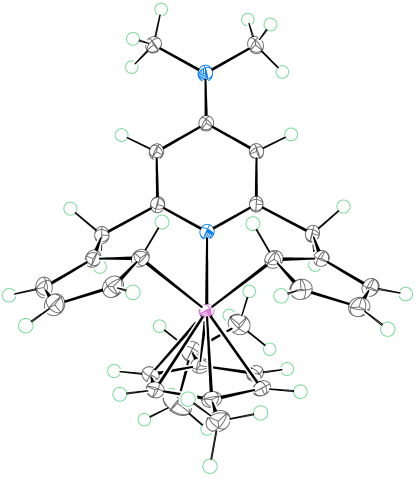
Published in the Journal of the American Chemical Society (JACS), researchers from the Okinawa Institute of Science and Technology (OIST) have reported the first full structural characterization of a doubly ring-slipped reaction intermediate in the formation of a metallocene. With its unusual structure, the characterization provides new evidence of how metallocenes may form, break and react, presenting design opportunities for stimuli-responsive, metallocene-based materials for a wide variety of potential applications.
Disturbed sandwiches lead to the discovery of stable intermediates
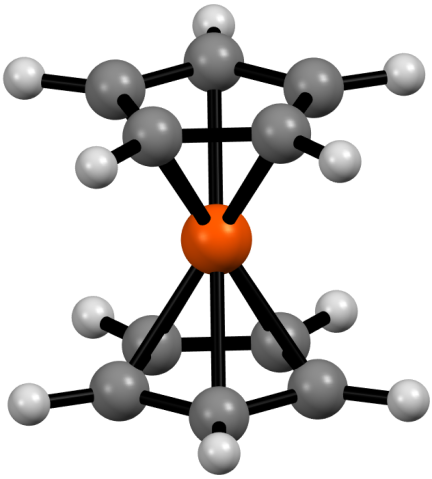
Ferrocene is perhaps the best known metallocene, earning its discoverers the Nobel Prize in Chemistry in 1973. Formed from iron sandwiched between two 5-carbon rings, it exemplifies the traditional organometallic chemistry rule that stable transition metal complexes usually have 18 electrons in their outermost shell, according to the formal electron counting method.
The Organometallic Chemistry Group at OIST, led by Dr. Satoshi Takebayashi, is researching how to go beyond 18 electrons to form unusual sandwich complexes, such as last year's report of 20-electron ferrocene derivatives. In that paper, they also attempted to create similar 20-electron complexes with ruthenium, but found the reactions resulted in 18-electron products instead. It was this research that sparked the group's present study.
"We were able to isolate an intermediate structure from our ruthenium complex formation reaction and characterize this with single-crystal X-ray diffraction. Surprisingly, we found the structure to be doubly ring-slipped," says Takebayashi.
Ring-slippage occurs when there's a reduction in the number of atoms involved in bonding a molecular ring structure to a metal; in this case, from 5 carbons to just 1 per ring. The study presents the first ever molecular characterization of a double ring-slipped sandwich intermediate and enables a leap forward in understanding for the formation of metallocene complexes.
The researchers used a variety of additional analytical methods such as NMR and mass spectrometry to fully characterize their ruthenocene derivative. They also investigated the formation pathway with both computational and experimental methods, identifying an unstable single ring-slipped intermediate which formed from the double ring-slipped complex.
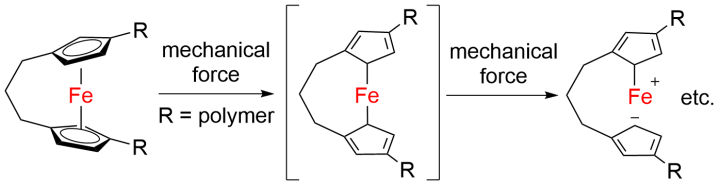
Takebayashi adds, "There is a recent renewed interest in incorporating metallocenes into materials to access different properties. By understanding how they can react and deform, we can design tunable polymer structures for use in drug delivery systems, catalysts, sensors and other settings."


