
How come our universe is full of disorder, when all elementary particles appear to follow strictly ordered laws of physics? And are there organizing principles behind disorder and apparent chaos?
One avenue of studying these fundamental questions is through an assembly of spins: the quantum property that makes electrons behave like tiny bar magnets, with a preferred orientation of either up or down. Neighboring spins align either in parallel (up-up) or antiparallel (up-down-up-down), as in ferromagnets and antiferromagnets, respectively. This simple ruleset makes spin systems very attractive for studying the emergence of order.
However, while the theory of spin is well-established, creating the material conditions for observing spin disorder has proven notoriously elusive. While physicists have been able to create exotic materials that exhibit spin disorder, tracing the evolution from order to disorder within materials has been challenged by the lack of a clean starting point.
In a new study published today in Matter, researchers from the Electronic and Quantum Magnetism Unit at the Okinawa Institute of Science and Technology (OIST) have successfully monitored the evolution of spin organization in a well-ordered antiferromagnetic crystal as chemical disorder is gradually introduced. The team has not only raised the bar for studying exotic magnetism but also offered an experimentally verified definition of so-called spin glass, which previously represented a foundational disconnect between theoretical physics and materials science.
"Physicists have approached spin disorder like blind men to an elephant for more than fifty years," says senior author Professor Yejun Feng. "We raised the elephant from birth and followed its life history. It took us seven years, but we believe that our methodology will pave the way for future discoveries in both classical and quantum physics."
Frustrated magnetism, chemical disorder, and frozen spin
In magnets, order describes the degree to which spins correlate in space. Long-range order, which characterizes regular ferromagnets and antiferromagnets, is characterized by alignment of spin interactions across the material. The absence of long-range order doesn't imply total randomness; short-range order can persist where local correlations are present but decay before reaching longer scales. Additional fascinating magnetic states have been shown to exist, including classical and quantum spin liquids. These exotic materials have long been studied to further our understanding of the universe.
Disordered states can arise from either chemical impurity or magnetic frustration, the latter referring to situations in which competing ferromagnetic and antiferromagnetic interactions cannot be simultaneously satisfied. In quantum spin liquids, this frustration keeps spins in continuous fluctuation even at near-zero temperatures, sustaining coherently fluctuating short-range order without freezing into one specific configuration. This quality makes them potential candidates for quantum computing applications, with information stored in a quantum state until retrieval.
Traditionally, spin glasses have been conceptualized as a correlated but also frustrated phase, where, below a critical temperature, spins lock into a disordered state, essentially freezing the fluctuating chaos of classical spin liquids. This has made them particularly interesting for studying the arrangement of spin disorder more generally.
Spin glasses arise from independent spins
While the theoretical nature of spin glasses is well established, and the underlying mathematics has guided advances in disciplines ranging from protein folding to neural networks, their experimental realization has remained opaque due to questions about their entity, structure, material properties, and degrees of spin disorder.
To set the record straight, the team chose zinc ferrite, which, while widely studied, has been characterized as both a spin liquid and a spin glass. Over years of refinement, the team grew a clean zinc ferrite crystal with an unprecedentedly low level of disorder - but that's only where the exploration started.
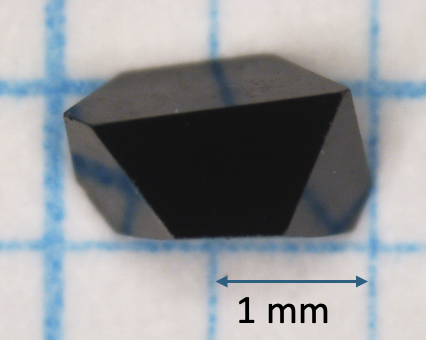
"Zinc ferrite presented many contradictions in the past. It shows signatures of exotic magnetism seen in both spin liquids and glasses, characteristic of short-range order. But after cleaning, it behaved as a simple antiferromagnet with long-range order," recounts Dr. Margarita Dronova, whose five-year PhD project at OIST culminated in the present work. "In other words, spin organization appeared to change with chemical purity. That suggested to us that we could control the level of spin organization."
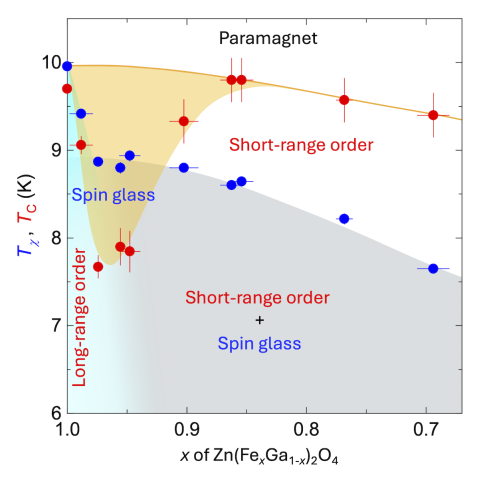
Over the next few years, the team carefully doped the crystals with increasing amounts of gallium ions, as a form of chemical disorder introduced only at iron sites. The resulting spin organization was captured by measuring neutron magnetic diffuse scattering, magnetic susceptibility, and heat capacity. By contrasting cross-referenced measurements across different levels of impurity, the researchers were able to plot the evolution of spin disorder - and, as it turns out, clarify the definition of spin glass from the experimental perspective. Feng continues:
"With the antiferromagnetic state as a reference, we could monitor how long-range order competed with short-range order as we doped the crystals. But we could also see that, contrary to the previous definitions, spin-glass behavior appeared independently of short-range order. Before the formation of clusters of correlated spins, spin glass arose from singular, uncorrelated spins."
This reclassification provides the necessary context for interpreting empirical studies of spin glasses. More broadly, the methodology provides a more robust approach to quantum spin liquids. "To truly understand exotic phases of matter, we need a deep sense of the baseline," concludes Dronova. "With this study, we built a strong foundation in a widely studied material, which has allowed us to confidently update the definition of spin glasses. I hope that this helps bridge the gap between theory and experiment and guides future studies of other fascinating materials."


