Off the coast of Cape Cod, something unexpected lurks beneath the seafloor: Fresh water.
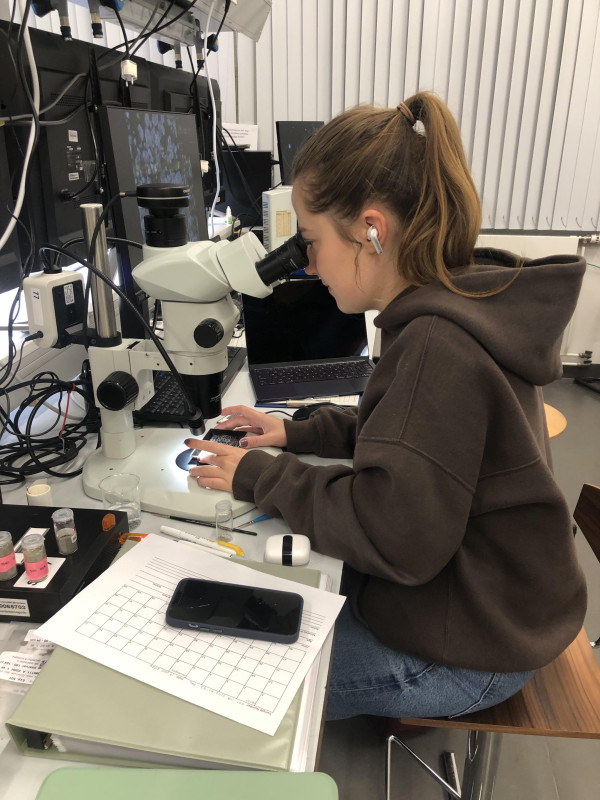
This year, Earth Sciences doctoral student Gretl King participated in an expedition through the National Science Foundation and International Ocean Drilling Program (IODP3) to investigate the phenomenon. Sediment cores from the seafloor were drilled in the summer of 2025 on the ocean shelf off the coast of New England; in January, King joined a team of scientists at the Bremen Core Repository in Germany to analyze them.
Originally from Charlottesville, Virginia, King completed her bachelor's degree at James Madison University, the same alma mater as her mentor, Assistant Professor Adriane Lam, a paleoceanographer. On Expedition 501, King served as the expedition's planktic foraminiferal biostratigrapher, using tiny fossils to assign age to sediments captured in the core sample - the same type of research that she does in Lam's lab.
Until recently, IODP science teams headed to sea; that ended in 2024 with the retirement of the Joint Oceanographic Institutions for Deep Earth Sampling (JOIDES) Resolution, a drill-ship first commissioned in 1985.
These days, scientists conduct the bulk of their research on land. But conditions in Germany mimicked shipboard life, albeit without the pitch and sway: King worked 12-hour days six days a week during the month she was there, she said.
Fossilized marine plankton have proven useful for dating layers of sediment. But in Germany, King confronted an interesting problem: Around 90% of the samples contained only quartz sand and not a speck of fossilized marine life. In the other 10%, she discovered microfossils older than expected.
"It's a lesson in real-world conditions," she reflected. "When we're working on our research in a lab, we get pristine samples that we know will have a lot of microfossils. When you go out into the real world and see these cores for the first time, you have no idea what you're going to get - and sometimes what you get is mostly nothing."
But absence can also offer clues. One hypothesis is that the freshwater dates to a time when the area wasn't ocean. Around 12,000 years ago, glaciers covered part of North America, which may have shaped a coastline different from today, she said.
The swathe of time captured by the cores is vast, extending all the way back to the Cretaceous period, 90 million years ago. While geochemists and hydrologists are working out the age of the freshwater itself, scientists didn't expect the sediment in the region to date back so far.
"That was a bit of a surprise for us," King said.
In April, the expedition took her to the British Geological Survey offices in Edinburgh, Scotland, where she and approximately 20 other scientists spent a week editing and compiling the data they collected in Germany. Instead of long hours behind a microscope, she spent them at a computer screen.
In addition to the expedition's research goal, King and other scientists were allowed to collect their own samples in Germany to further their individual interests.
"For me, that looks like going in with more detail into those intervals where there were microfossils to narrow the time period," she said. "That will help reconstruct the Cape Cod coastline during that time."
Overall, she is grateful for the opportunity to participate in Expedition 501, during which she worked alongside scientists with diverse backgrounds and specializations.
"I loved seeing how science works in real time," she said. "These are all people at the top of their field doing this work, and this is how my little piece fits into the puzzle we're working on."