
A study led by a UAB research team of Biological Anthropoly has analysed the genome of 54 newborns with the aim of tracking the genetic history of their culture since it developed in the Early Iron Age until the start of the Roman period, some 2,700 to 2,100 years ago.
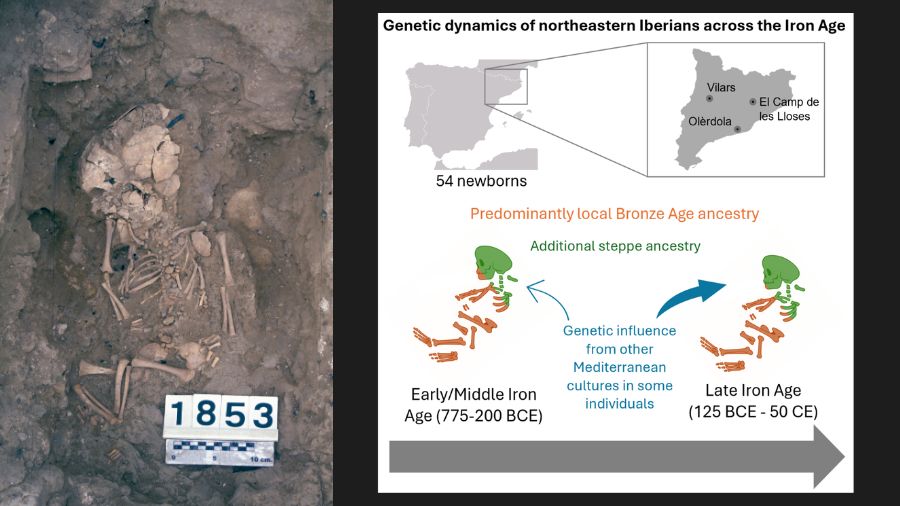
Despite being in contact with other Mediterranean cultures, the genetic identity of the Iberian people from the northeast of the Iberian Peninsula existing in the Iron Age remained largely stable throughout six centuries. Emerging from local Bronze Age populations, they evolved gradually without any major migratory movements bringing substantial changes to their DNA. It was not until the arrival of the Romans that they integrated new genetic influences that shaped a more diverse population, in parallel with the political and social transformations that took place.
This is the conclusion reached in a study led by researchers from the Universitat Autònoma de Barcelona (UAB). Published in the journal iScience, the study has obtained the most complete and precise image to date of the genetic history and evolution of the Iberian peoples inhabiting the northeast of the Iberian Peninsula from the beginning of the Iron Age until the Roman conquest, between 2,700 and 2,100 years ago.
The study provides a global view of the genetic ancestry, admixture, and demographic dynamics of the region, based on the analysis of the genome of 54 newborns buried in the houses and productive areas of three sites: Els Vilars (Arbeca, Lleida), from the Ilergeta people, which allowed researchers to see the transition from Bronze to Iron Age; Sant Miquel d'Olèrdola (Olèrdola, Penedès) belonging to the Coseta people, to analyse the Middle Iron Age; and El Camp de les Lloses (Tona, Barcelona), from the Ausetans group, for the final stage and beginning of the Roman era.
The researchers expected to find a greater external genetic influence, but the results surprised them: "We see that there is a great genetic continuity, that the population changes much less than we had imagined from the archaeological evidence of Mediterranean cultures found in these peoples, such as those of the Phoenicians, Greeks and Carthaginians. These influences did occur, but very gradually," explains Cristina Santos, researcher in Biological Anthropology at the UAB who led the study.
No massive migration to explain the Iberian culture
The results rule out that Iberian culture arose from a mass migration and confirm the indications noted in previous studies: Iberian groups emerged from the pre-existing local population. All the individuals studied had the genetic profile established by the prehistoric people of the Iberian Peninsula of the Neolithic and Bronze Age: Western Hunter-Gatherers (WHG), Anatolian Neolithic, and Steppe or Yamnaya Bronze Age ancestries.
This would corroborate the theory that the change in social organisation towards a more hierarchical one, characteristic of Iberian culture, would not have been the result of a major migration. "Archaeologically it is clear that there must have been a very important cultural change, but we see that the genetic substrate is maintained. Our study suggests that this change would not have been associated with a major genetic change," says Assumpció Malgosa, director of the Biological Anthropology Research Group (GREAB) at the UAB and co-author of the study.
The mark of other cultures
The study detects occasional contacts with other Mediterranean cultures, with individuals from Els Vilars and Olèrdola who may have had ancestors from the eastern Mediterranean and/or North Africa. These genomic-scale contacts are also visible in the material recovered in archaeological excavations of these sites, which have brought to light amphorae and other objects characteristic of Phoenician, Greek, Punic and Italic cultures.
Already in the Iron Age, the Iberians may have incorporated a higher proportion of the Yamnaya ancestor than Bronze Age populations, in addition to influences from other Mediterranean sources. "This apparent steppe increase may be the result of the still limited number of Bronze Age samples available, especially from the northeast of the peninsula, but it could also be linked to migrations from eastern Europe. We are now working with more Bronze Age samples and from this period to clarify it," explains Santos.
A gradual cultural and genetic transformation occurred in the Roman era, visible in the constructions and materials recovered in the Camp de Les Lloses. This Roman influence contributed to a greater introduction of Mediterranean and North African ancestors. The latter could also have come from the Punic culture, in the south of the Iberian Peninsula, or from the Balearic Islands. In any case, all these influences shaped a more diverse Ibero-Roman population, although it continued to retain a strong genetic signature of the previous local Iberians.
A network of active contacts between Iberian groups
The analysis of mitochondrial DNA, inherited through the mother, confirms the results of a previous study by the same research group with samples from the sites of this study and other Iberian settlements. "Despite not detecting significant differences between the different Iberian groups, we did identify subtle differences in the lineages, some of which are more frequent in certain groups," says Daniel Ruiz de la Cuesta Aguirre, first author in this study and in the previous one. "This makes us think that, although the groups interacted with each other, they had a certain level of autonomy. And we also corroborated that most of these lineages were already present in the Iberian Peninsula before the Bronze Age. This makes us think that perhaps the women were local, but there are some lineages that had never been detected in the peninsula, which would imply some female mobility," he adds.
The research has revealed no degree of kinship among the individuals studied at Els Vilars. At Olèrdola, it was ruled out that two infants buried in the same grave were twins or related, whereas at Les Lloses a pair of sisters and two second-degree relatives were identified.
As for the Y chromosome, linked to male sex, it detects the arrival of the steppe component that largely replaced the previous paternal lineages in the Iberian Peninsula during the Bronze Age. However, some Neolithic lineages persist, demonstrating continuity with earlier populations.
"Our study reveals the complex and lasting genetic legacy of Iberian communities, one of the main pre-Roman civilisations of the Iberian Peninsula," Cristina Santos highlights. "It connects genetics and archaeology: it shows that cultural exchanges also leave a biological mark and, at the same time, that history is often not made up of sudden changes, but of gradual processes with human and cultural contacts," concludes the UAB researcher.
Iberian newborns, highly valuable study material
Iberian newborns are very valuable when studying Iberian culture, given the scarcity of remains of individuals from this culture, whose main funerary rite was cremation. In 22 of the 54 newborns studied, the research team was able to recover more than 20,000 genetic variants (SNPs) from the entire genome (from the variant panel used in ancient DNA studies), in addition to the almost complete mitochondrial genome, and in nine more newborns, the mitochondrial genome was recovered.
The genetic analyses of the 54 newborns were conducted at the Ancient DNA Lab located at the Faculty of Biosciences of the UAB.
Researchers from the universities of Granada, Lleida, Coimbra (Portugal) and Copenhagen (Denmark), and Brown University (USA), as well as the Museum of Archaeology of Catalonia and of the site, the El Camp de les Lloses Museum, and the Australian Centre for Ancient DNA of the University of Adelaide (Australia) also participated in the research.
Original article: Daniel R. Cuesta-Aguirre et al. The genetic landscape of northeastern Iberian communities from the early to late Iron Age. iScience Volume 29, Issue 6116186 June 19, 2026. DOI: 10.1016/j.isci.2026.116186


