
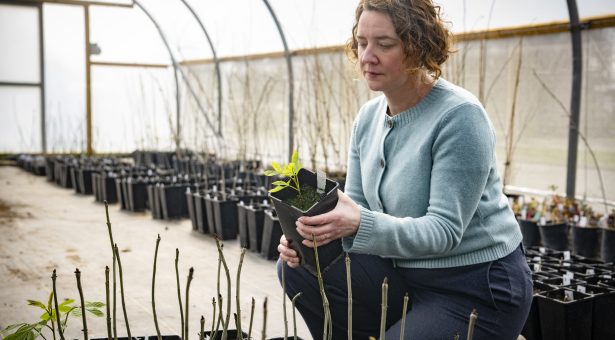
A fast-track method of breeding disease-resistant ash trees has been developed by researchers leading efforts to conserve the species.
Researchers at the John Innes Centre, who have adapted the embryo extraction method, found that it rapidly speeds up the germination of European ash seeds. A process that can take up to six years in nature now takes around one week in the lab.
The rapid seed germination method has already produced more than 2,000 seedlings for trials and research. It has been welcomed by the international research community, and, with adaptations, could be adopted by landowners, conservation volunteers, and enthusiast gardeners.
The method, outlined in a recent study, offers hope for those trying to preserve the threatened species by establishing populations of ash families propagated from mother trees that show resistance to ash dieback.
The technique involves carefully extracting the embryo from the seed coat using a knife and tweezers and placing it on an agar nutrient jelly to give this slow starter a helping hand.
Dr Elizabeth Orton, a John Innes Centre researcher and first author of the study, said: "Ash seed usually takes two to three years to germinate in the wild, and we have reduced this to about a week in the lab. We have produced hundreds of seedlings rapidly for experimentation, for our seed orchard or for planting in the wild."
"We've had so much interest from both other researchers and from stakeholders keen to help restore ash populations. One of our next steps is to develop a kitchen method so that people can do this at home, using substances that you can purchase online such as household bleach and agar to treat the seed as part of the process."
The ash dieback epidemic spreading across Europe has created an urgent need to propagate new populations from ash trees with resistance to the disease.
This is needed to restore ash in the landscape and to advance research methods which probe the genetics and mechanisms by which trees can resist pests and pathogens.
Research efforts have so far looked at finding trees which show visible resistance to the fungal pathogen that causes dieback. Approaches include cloning resistant trees, grafting healthy cuttings on rootstock or using air layering, a method used to clone desirable traits in difficult to root species.
But propagation from seed remains the most effective way to preserve the high genetic diversity of ash. This offers best protection against a range of pests and pathogens and allows populations to adapt to new climate conditions.
A problem has been that the distinctive winged seeds of ash have a long dormant period in nature. Seeds are protected in a hard case and require a stratification period (a warm summer period followed by a chilly winter, sometimes repeated) before they germinate, usually in the second spring after formation.
This rapid seed germination protocol developed by the John Innes Centre team is based on earlier research It involves carefully removing the embryo, and therefore bypassing seed dormancy. Embryos, after being cultured on agar media, are ready to transplant as seedlings into compost within 14 days in the lab. The process is likely to take a little longer (two to three weeks) in non-specialist settings.
After a period of 10 months in a glasshouse, the ash seedlings are ready for planting outside.
Using this accelerated method, researchers now have a way of germinating ash seeds which can be reliably used to produce orchards of thousands of trees. It has been used to create a seed orchard at the Wendling Beck, nature recovery project, near Dereham, Norfolk. These trees selected because they show resistance to ash dieback, will breed, set seed and, hopefully, produce a new generation of resistant trees.
This study and its next steps offer a cause for hope, says Dr Orton: "This propagation method is a big step forward and the interest I have had has been very positive. People from all over the international research community are working on restoring ash populations together and our contribution has added to the atmosphere of hope that we can speed up natural selection and transform the fortunes of ash trees."
"With the modifications we are making the technique could be adopted by conservation volunteers and other non-specialists to support local efforts in growing diverse ash populations for restoration projects."
Ash dieback, caused by the fungal pathogen (Hymenoscyphus fraxineus) was first detected in the wild in the UK by John Innes Centre researcher Dr Anne Edwards in 2012, in Ashwellthorpe Woods, Norfolk. It is believed to have been in the UK much longer via a combination of wind-blown spores from the continent, plus movement of horticultural stock carrying the fungus.
Between 5-10% of ash show good resistance to the fungus, and conservation volunteers and researchers have been scouring woodlands for examples of healthier trees from which to propagate new populations. Even so, many hundreds of thousands of ash have succumbed to the disease, and more will follow, a threat not only to the keystone species but also to the many species that associate with it.
The Emerald Ash Borer, a beetle which has already devastated ash populations in the United States, is a further threat to this beloved and versatile species. Research by the John Innes Centre and partners is looking into the possibility that trees that show resistance to ash dieback fungus also show resistance to the beetle.
Dr Orton said: "Climate change means that pests and pathogens can become established in previously unfavourable locations and the movement of infected timber and horticultural material means that we are in a race to protect keystone species such as ash. With this model we can restore natural resistance much quicker, not only in species such as ash but others such as elm."
Rapid germination of seeds of European ash (Fraxinus excelsior) to restore populations in the face of ash dieback, appears in the Scandinavian Journal of Forest Research.
Image Credit – Phil Robinson


