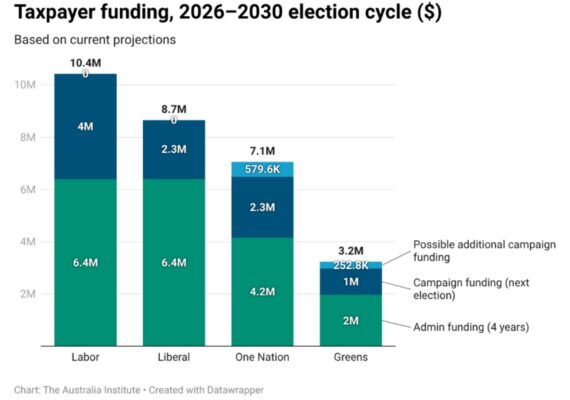
The public funding will deliver around $10 million to Labor, $9 million to the Liberals, $6 million to One Nation and $3 million to the Greens over the four-year electoral cycle.
The record payments are a consequence of the Malinauskas Government's "political donation ban", but they will be far larger than the large political donations they supposedly replace.
Key findings:
- Under the new laws, introduced to compensate for a ban on most private political donations, political parties and sitting MPs receive generous taxpayer funding.
- Political parties and sitting MPs will receive $20 million in administrative funding over the four-year electoral cycle and $10 million in campaign funding.
- One Nation will be able to spend up to ten times more at the 2030 election than it did this year, and will have millions more to spend on expanding its party operation in the state.
- In April 2026, the High Court voided Victoria's entire political finance regime because it included an unfair "nominated entities" loophole.
- South Australia's new laws also include a loophole for so-called nominated entities (the parties' investment/asset-holding arms), putting its laws at risk of a challenge.
"South Australia's new laws are generous towards sitting MPs and established parties, but miserly towards independent candidates and new entrants," said Bill Browne, Director of the Australia Institute's Democracy & Accountability Program.
"There is a real possibility that if South Australia's laws face constitutional challenge, the entire political finance regime will be struck out. That would leave South Australians with fewer protections than they had before SA Labor's donation ban and raise questions about why taxpayers are spending $30 million on sitting MPs, parties and candidates.
"Far from reducing money in politics, the Malinauskas Government's generous taxpayer funding for parties and candidates sets the 2030 election campaign up to be the biggest yet."