
The University of California, Davis, celebrated the grand opening of the Resnick Center for Agricultural Innovation, a state-of-the-art facility designed to transform agricultural research, teaching and outreach while accelerating solutions to the world's most pressing challenges in food systems and sustainability.
Made possible by philanthropic support, including a lead transformative gift from Lynda and Stewart Resnick, through their foundation in 2022, the new center is housed within the UC Davis College of Agricultural and Environmental Sciences - ranked No. 1 in the nation and No. 2 in the world in agriculture and forestry. The center builds on the university's longstanding global leadership in agriculture with a focus on translating research into real-world impact.
"This center represents the best of UC Davis, uniting our strengths in agriculture, engineering and environmental sciences to address challenges facing communities across California and around the world," said Chancellor Gary S. May. "We are deeply grateful to Lynda and Stewart for their partnership and support, which expand research opportunities and drive solutions that will shape the future of agriculture."
Students, faculty, staff, donors and industry partners joined university leaders May 19 to celebrate the opening with a ribbon-cutting ceremony, open house and tours. Named after the Resnicks, co-owners of The Wonderful Company, home to beloved brands including Wonderful Pistachios, POM Wonderful and FIJI Water, the center reflects a shared commitment to advancing sustainable agriculture, innovation and food security. The Resnicks are among the world's most impactful philanthropists, having committed more than $2.5 billion across health and wellness, education, community development and more. This includes extensive support for sustainability research to increase access to nutritious food worldwide and to protect the planet for future generations.
"Lynda and I have always believed that growing more food with fewer resources is one of the most important things we can do," said Stewart Resnick, chairman of The Wonderful Company. "UC Davis is the leading ag university in the country, and we all have a stake in giving them everything they need to continue leading on this important work. This center will train the next generation, drive practical solutions, and get this urgently needed progress to growers and communities around the world."
The Resnick Center reflects a broader commitment from the couple and their foundation, whose $50 million gift to UC Davis in 2022 included $40 million for the facility and $10 million to establish the Resnick Agricultural Innovation Research Fund, advancing research into sustainable uses for agricultural byproducts. Stewart Resnick also serves on the Chancellor's Board of Advisors, underscoring the Resnicks' longstanding commitment to the university and its mission.
Where innovation meets application
The 34,000-square-foot facility revolutionizes hands-on learning in an innovative and immersive environment that connects education to research and discovery.
Experts across disciplines will work in labs equipped with robotics, sensors, data science and artificial intelligence - technologies transforming how agriculture is managed and scaled. Research efforts will focus on making agricultural systems more resilient, developing advanced technologies, maximizing sustainability through water and energy efficiencies, and expanding access to nutritious food.
"The new Resnick Center strengthens our ability to integrate research, teaching and extension in ways that directly serve California and beyond," said Ashley M. Stokes, dean of the College of Agricultural and Environmental Sciences. "It creates a dynamic environment where discovery, learning and community engagement come together - accelerating innovation, deepening partnerships with industry, and translating knowledge into real-world solutions. The design and flexibility of the space allow us to reimagine ideas and respond with agility to the evolving needs of our communities."
The center will incorporate specialized labs and equipment that bolster efforts to transform agricultural byproducts into high-value materials. This work is supported by the annual competitive research grants funded by the Resnicks, through their foundation.

Over the past three years, UC Davis researchers have explored how agricultural waste - including discarded hulls and shells from California's iconic specialty crops like almonds, pistachios and pomegranates - can be repurposed as soil amendments, sustainable food products and low-cost industrial materials. The new facility will allow for widespread exploration of even more agricultural crops and potential uses.
Preparing the next generation
For students, the Resnick Center offers a direct pathway from classroom learning to real-world application. Through hands-on experiences, interdisciplinary training and collaboration with industry partners, students will engage with emerging technologies and active research projects, gaining experience that prepares them as leaders in the workforce.
In addition to experiential learning opportunities, the facility houses The Wonderful Scholar Center, a student success hub that offers academic and career advising for more than 50 students who are attending UC Davis on a Wonderful Scholarship. With a commitment to supporting first-generation students, the Resnicks, their foundations and The Wonderful Company have awarded over 3,500 scholarships of up to $40,000, providing mentorship and tutoring support with dedicated coaches, and equipping students with the tools to succeed in college and beyond.
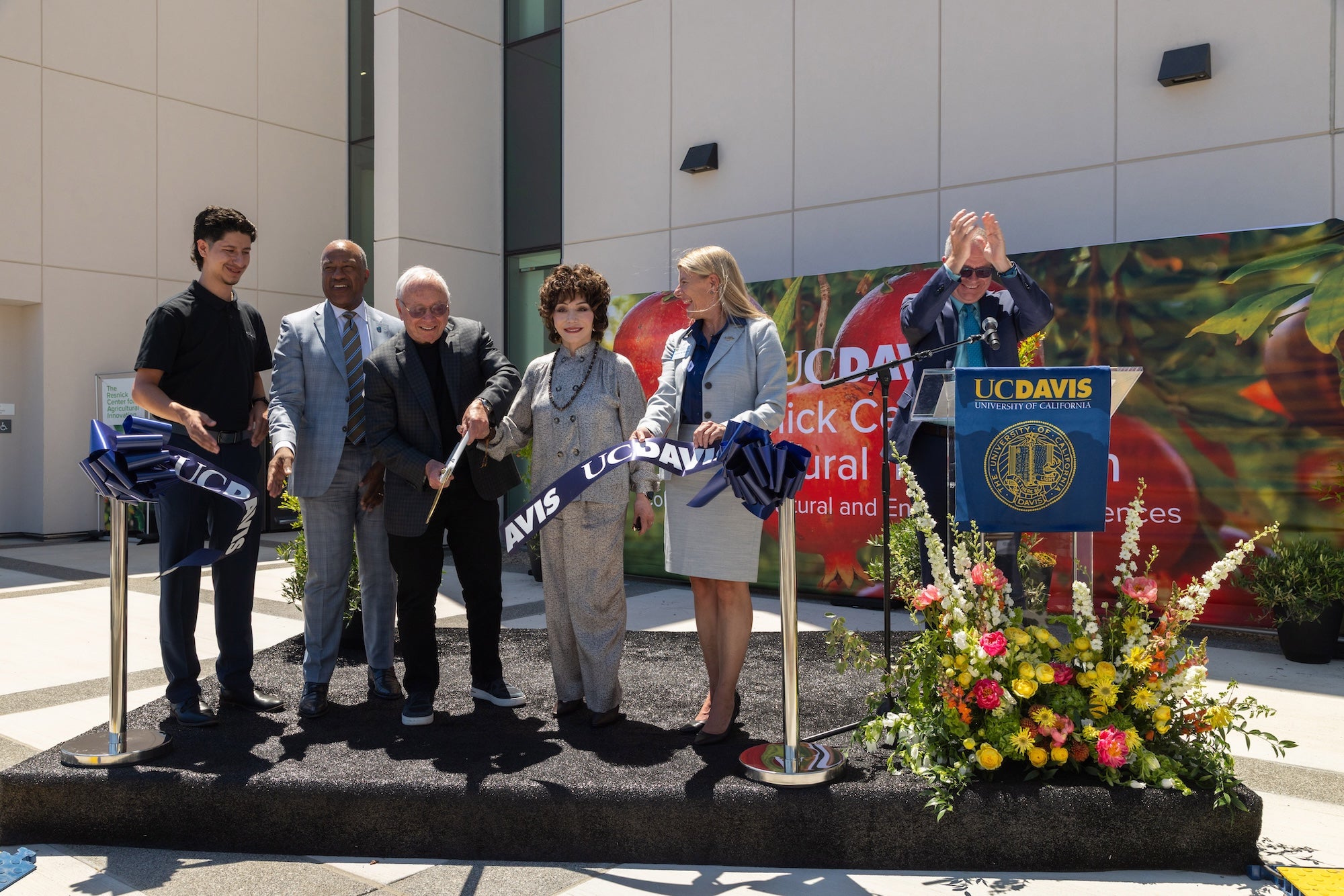
"As a first-generation college student who grew up around agriculture, I came to UC Davis with a deep appreciation of what farming families are up against. The Wonderful Scholarship brought me here, and this center has shown me how research, innovation, and policy all have to work together to change the future of agriculture," said Jose Gomez, Wonderful Scholar and second-year political science major. "What the Resnicks have built isn't just a building. It's a bridge across disciplines - driving research, innovation, and people forward. I intend to spend my life serving others and advancing solutions that strengthen our communities."
"Today marks the beginning of a new era," Chancellor May said. "The discoveries made inside this building will extend into farms, fields, and communities around the globe, shaping a more resilient and sustainable future for agriculture."


