
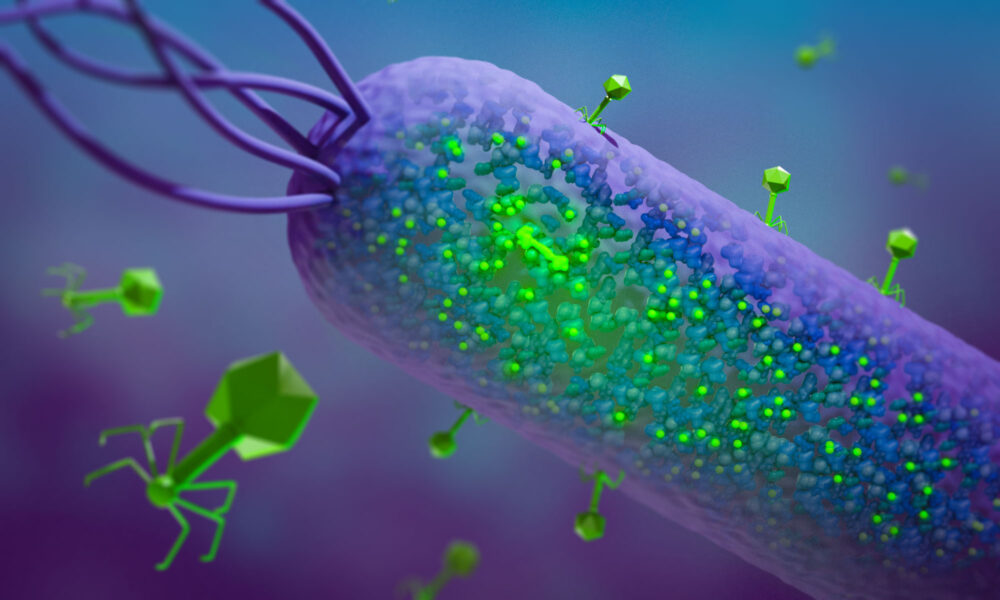
Scientists have found how phages, viruses that infect bacteria, orchestrate an explosion of protein modifications inside host cells that helps them evade the bacteria's immune systems
Summary
- Phages are viruses that attack bacteria, and the two exist in a perpetual evolutionary arms race.
- New research from EMBL sheds light on a creative strategy that one such phage - T7 - deploys to overcome bacterial defence pathways.
- The strategy relies on T7 kinase, a viral enzyme that modifies bacterial proteins and specifically targets DNA-binding proteins that form a core part of bacterial immune mechanisms.
- The study provides novel insights into bacteria-virus interactions and opens up new possibilities for bioengineering phage therapy.
As antimicrobial resistance grows around the world, novel therapies to counter it become increasingly more important. Phages - viruses that infect bacteria - are an exciting avenue of research in this regard, providing a means to kill pathogenic bacteria selectively, even ones resistant to traditional antibiotics.
However, to utilise phages effectively, understanding the biology of how they interact with their host bacteria is important. EMBL scientists and collaborators have discovered a new paradigm by which phages can shut down bacterial defence systems. They found that certain phages can use a 'loose cannon' enzyme to set off an explosion of protein modifications inside infected bacteria.
Inside an evolutionary arms race
Like all viruses, phages exist in a perpetual molecular arms race with their hosts. For the nearly 4 billion years of their co-existence, bacteria have been evolving mechanisms to defend against infecting phages, while phages have been evolving anti-defence systems to shut down or evade these immune mechanisms. The new study demonstrates, for the first time, how a single phage protein can shut down multiple bacterial defences with different mechanisms of action.
These findings resulted from a long-standing collaboration between two research groups at EMBL Heidelberg - the Typas Group , which specialises in systematic studies of bacterial interactions, and the Savitski Team , who are experts in cutting-edge proteomics technologies.
"Phage research has led to a lot of exciting developments, the CRISPR-Cas9 gene-editing system among them," said Mikhail Savitski, Senior Scientist, Team Leader, and Head of Proteomics Core Facility at EMBL Heidelberg. "Using the sensitive technologies we had available in the lab, we wanted to understand in an unbiased way how phages affect bacterial proteins during infection."
For this, they decided to use a well-known model system - E. coli, a rod-shaped bacterium that lives in our guts, and T7 phage, a prototypical virus, studied since the dawn of molecular biology, that infects E. coli. During infection, T7 uses the bacterium's own molecular machinery to create thousands of copies of itself, finally bursting out from the host cell, killing it in the process. The whole process typically takes 15 minutes.
Given the speed of this infection process, the researchers decided to look more closely at protein post-translational modifications in infected bacteria.
What are post-translational modifications?
These chemical modifications can be rapidly added or removed from proteins and change their function, e.g. by activating or inactivating them. One of the most common modifications is phosphorylation, where an enzyme called 'kinase' adds a phosphate-containing chemical group to proteins. This can both activate and inactivate proteins depending on which location within the protein gets modified. Kinases target specific amino acids in proteins, recognising the area surrounding them (protein motif). Typically, for each protein they target, they modify a fraction of that protein's pool in the cell.
Surprisingly, the scientists found that phage infection resulted in almost every single bacterial protein getting phosphorylated within minutes - at least for part of the protein pool in the cell. The likely culprit was T7 kinase, a phage enzyme first discovered in the 1970s. However, the scale and manner of phosphorylation was unlike anything previously observed. In fact, the list of phosphorylation targets for the T7 kinase surpassed what's known so far for any kinase in nature, leading the researchers to dub it a 'loose cannon' in their paper describing these findings, published recently in the journal Nature.
"We realised that we were seeing a quite unprecedented molecular event: a catastrophic phosphorylation across the entire proteome in a completely nonspecific manner," said Savitski. "This had never been seen before, and it was fascinating that there was also no pattern to it."
Shutting down bacterial defences
However, this discovery posed a new question. Previous studies had shown that deleting T7 kinase from the phage's DNA doesn't really affect the infection process. "As puzzles go, it leaves you a bit flabbergasted," said Savitski. "You have a kinase with apparently no phenotype that seems to phosphorylate the entire host proteome."
"And then if you uncontrollably phosphorylate every host protein to some degree, how does that even benefit the phage, which still depends on host cellular machines, such as the ribosome, to complete its infection cycle?" added Nassos Typas, Senior Scientist and Head of Molecular Systems Biology Unit at EMBL.
The first clue came from the protein's activity. The T7 kinase is short-lived, and it deactivates itself 5-6 minutes post-infection, as was previously reported and immediately evident by the team's proteomics experiments. The researchers then decided to examine the kinase structure. This held another important clue: one section of the protein, called the shutoff domain, far from the kinase enzyme domain, was rich in chemical features that might help it bind DNA. This led the team to hypothesise that this domain might help the kinase attach to DNA and subsequently come close to other DNA-binding proteins. This could trigger uncontrolled phosphorylation of the entire pool of such proteins, thereby inactivating them.
"Methodologically, it is not easy to test such things, but we designed an elegant experiment that could measure exactly how much of a protein population is phosphorylated inside a cell," said Tara Bartolec, postdoc at EMBL Heidelberg and one of the paper's first authors, together with Karin Mitosch and Clement Potel, former postdocs in the Typas and Savitski labs. Using this quantitative phosphoproteomics technique, the researchers found that the T7 kinase preferentially targeted DNA-binding bacterial proteins, with the entire population of such proteins sometimes being phosphorylated. This would be predicted to deactivate most such proteins.
DNA-binding proteins are often the bedrock of bacterial defence systems, helping them detect and destroy phage DNA inside the cell. This suggested that the T7 kinase might play a role in hampering these defence systems. And indeed, the researchers found that the kinase could help the virus infect strains of bacteria that had such defence systems by inactivating them. In such natural E. coli strains, the kinase was vital for T7 to infect. This also solved the original riddle - explaining why the kinase wasn't needed to infect the model lab E. coli strain, which has relatively few defence systems.
By also comparing kinases across different types of phages, the researchers believe they may have hit upon an evolutionarily conserved mechanism that certain phages use to deactivate bacterial immune systems. "As phages have multiple post-translational modification enzymes, the question becomes whether this is a general strategy of phages, and whether this is the ancestral role of such modifications," said Typas.
A unique EMBL project
According to the scientists, these new insights became possible only due to technological advances and the collaboration between labs with complementary expertise. While past studies had looked at the T7 kinase and its targets, the methods were not yet sensitive enough to detect phosphorylation signatures on less-abundant proteins. Similarly, past studies had mainly looked at lab-adapted strains of E. coli, which lack robust defence systems. Using a collection of bacterial defence systems and E. coli strains isolated from the wild played a central role in the team's investigations into the T7 kinase's activity against diverse bacterial defence mechanisms.
"To me, this epitomises the perfect EMBL project, where you leverage the unique expertise of different groups and technologies to the maximum," said Savitski. "It relies on the unique way we interact and collaborate at EMBL, so I think it is a testament to that."
Bartolec, who was an EIPOD Fellow working across both the Savitski and Typas groups, agrees: "I come from a proteomics background, and this project was a crash course in phage biology for me. But I think it demonstrates that you do need people working at this intersection. It worked well because of expertise embedded around me: Clément developed a bacterial phosphoproteomics approach sensitive enough to detect the phenotype in the first place, and Karin designed a high-throughput screen that showed us the kinase's function in cells. I had to learn a lot of microbiology to work across both, and the interpretation really came out of the team talking and learning from each other."
In the future, the researchers plan to look at other protein modifications and the role they might play in phage infections. The study also opens up the possibility of novel bioengineering approaches that use these new insights into phage biology to design or predict the effectiveness of phage therapies to treat drug-resistant bacterial infections.
"To be effective for therapy, phages should be capable of infecting diverse versions (strains) of the same pathogen," said Typas. "Interestingly, pathogenic strains are exquisitely diverse in their immune repertoire, and can always pick up new systems. So engineering phages with broad anti-defence systems, such as the T7 kinase, might be key in this quest for effective phage therapies. We identified the first one here, but we are sure there are many more out there."


