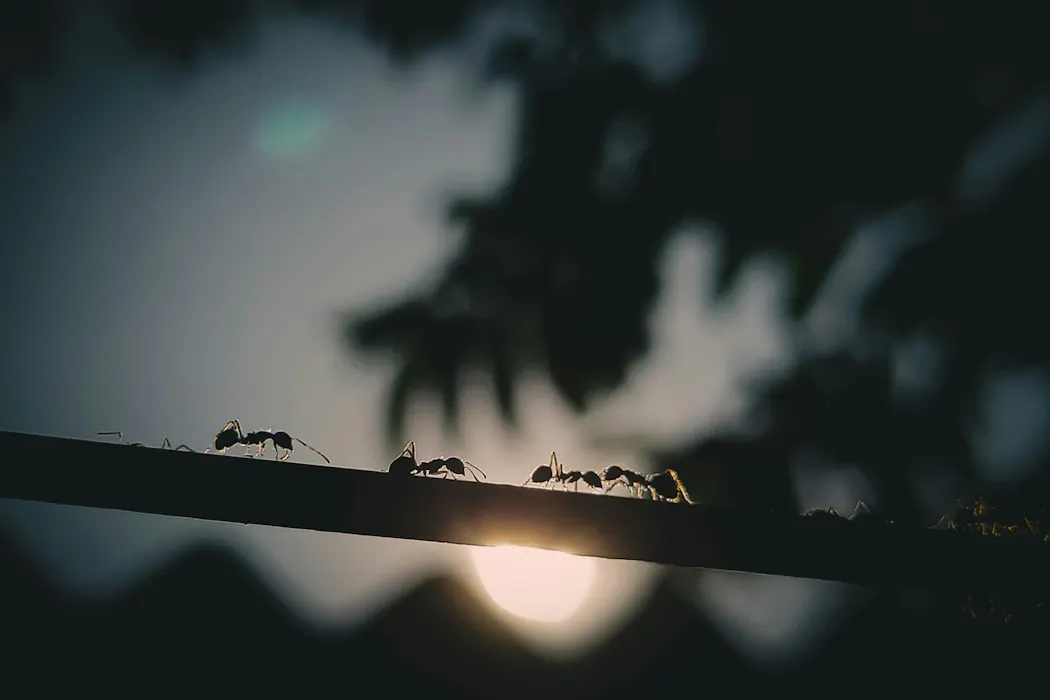
Imagine trying to build a house without a blueprint, find a shortcut through an unfamiliar city without a map, or govern a large organisation with no leaders and no meetings.
It sounds impossible. Yet tiny-brained ants, working without leaders or blueprints, have been solving problems like these for millions of years - and no, the queen isn't the boss telling them what to do.
By almost any measure, ants are a wildly successful group of animals - there's an estimated 20 quadrillion of them on Earth and they thrive on every continent but Antarctica.
How have these minuscule animals managed to take over the world (and our kitchens)? The answer is teamwork.
Bustling colonies
Ants are social animals that live in colonies ranging from a few individuals to vast continent-spanning supercolonies containing billions of ants .
Bustling ant colonies display many of the features we associate with human societies, including:
- transportation networks
- collective care of the young
- food systems (including agriculture in some species)
- health care for injured nestmates.
In humans, this level of social complexity usually involves clear governance hierarchies, with leaders and middle managers directing our activities.
But ants don't work that way. So who is in charge in an ant colony?
The answer is simple: no one.
The queen isn't in charge
Ant colonies are a classic example of a self-organised system , where complex behaviour emerges from the combined actions of many ants. Each follow relatively simple rules while communicating and interacting with each other.
The human brain works in a similar way: individual neurons have simple behaviours and cannot think on their own, but together they give rise to the full range of human thought and behaviour.
The queen, whom many people assume is in charge, has little involvement in decision-making or leadership.
Instead, her role is to maintain the colony's workforce by producing new ants.
In some ant species, workers will even kill their queens under particular conditions, such as declining productivity!
By working together, ant colonies are capable of complex behaviours and problem-solving skills far exceeding the abilities of an individual ant.
For example, some ant species run sophisticated transportation networks linking their colony to many food sources.
When a foraging worker finds a good source of food, such as some crumbs in your kitchen, she lays down drops of attractive chemicals called " pheromones " as she walks home.
Other ants in the colony are attracted to the trail, reinforcing it with more pheromones as they go. As a result, the colony can rapidly deploy large numbers of workers to quickly collect food.
While an individual ant is only aware of the foods she herself has visited, the trail network allows the colony as a whole to be "aware" of many foods.
Should a food source disappear or decline in quality, the colony can quickly refocus its efforts.
Ants can also optimise their trail networks by finding shortcuts .
Since pheromone trails evaporate over time, shorter paths that are traversed more quickly get reinforced more often. Longer paths, by contrast, receive less traffic and get reinforced less often, which in turn causes the pheromone trail to fade and become less attractive.
This simple feedback loop allows the colony to "discover" shorter routes that take less time to traverse while eliminating longer routes.
The resulting transportation network can be remarkably efficient .
Remarkable architects
Nest construction is another impressive example of the power of self-organisation.
Ant nests can be vast and intricately structured , with chambers for raising the young, food storage, and waste.
Yet no ant has a blueprint for the final nest design, nor is a boss ant in charge of directing construction activities.
Instead, ants use simple rules to create their remarkable nest architecture.
For example, in the black garden ant Lasius niger, nest building ants excavate soil and form it into small pellets .
These pellets carry chemical cues making other ants more likely to deposit their own pellets nearby.
Over time, this leads to the formation of structures such as pillars, walls, and eventually roofs, without any ant understanding the overall design.
This process, where individuals respond to cues left behind by other individuals, is called "stigmergy" and it underpins the construction of other insect-built structures such as termite mounds and honeycomb .
More humans, more problems - but not so for ants
The use of simple behavioural rules enables ants to coordinate remarkably effectively as a group.
In a study where groups were tasked with moving a T-shaped object through a tight space, human performance did not improve with group size.
When participants were instructed not to speak, performance actually declined as groups got bigger.
Similarly, it has long been known that as human group size increases, the performance of individual team members tends to decrease, a phenomenon known as the Ringelmann effect .
Ants, by contrast, showed the opposite pattern: as group size increased, their performance actually improved.
So next time you see a line of ants marching around your house, resist the urge to spray or whack them away.
Instead, take a moment to appreciate these tiny masters of teamwork.

Tanya Latty co-founded and volunteers for conservation organisation Invertebrates Australia, is former president of the Australasian Society for the Study of Animal Behaviour and is on the Education committee for the Australian Entomological Society. She receives funding from the Australian Research Council, NSW Saving our Species, and Agrifutures Australia.