
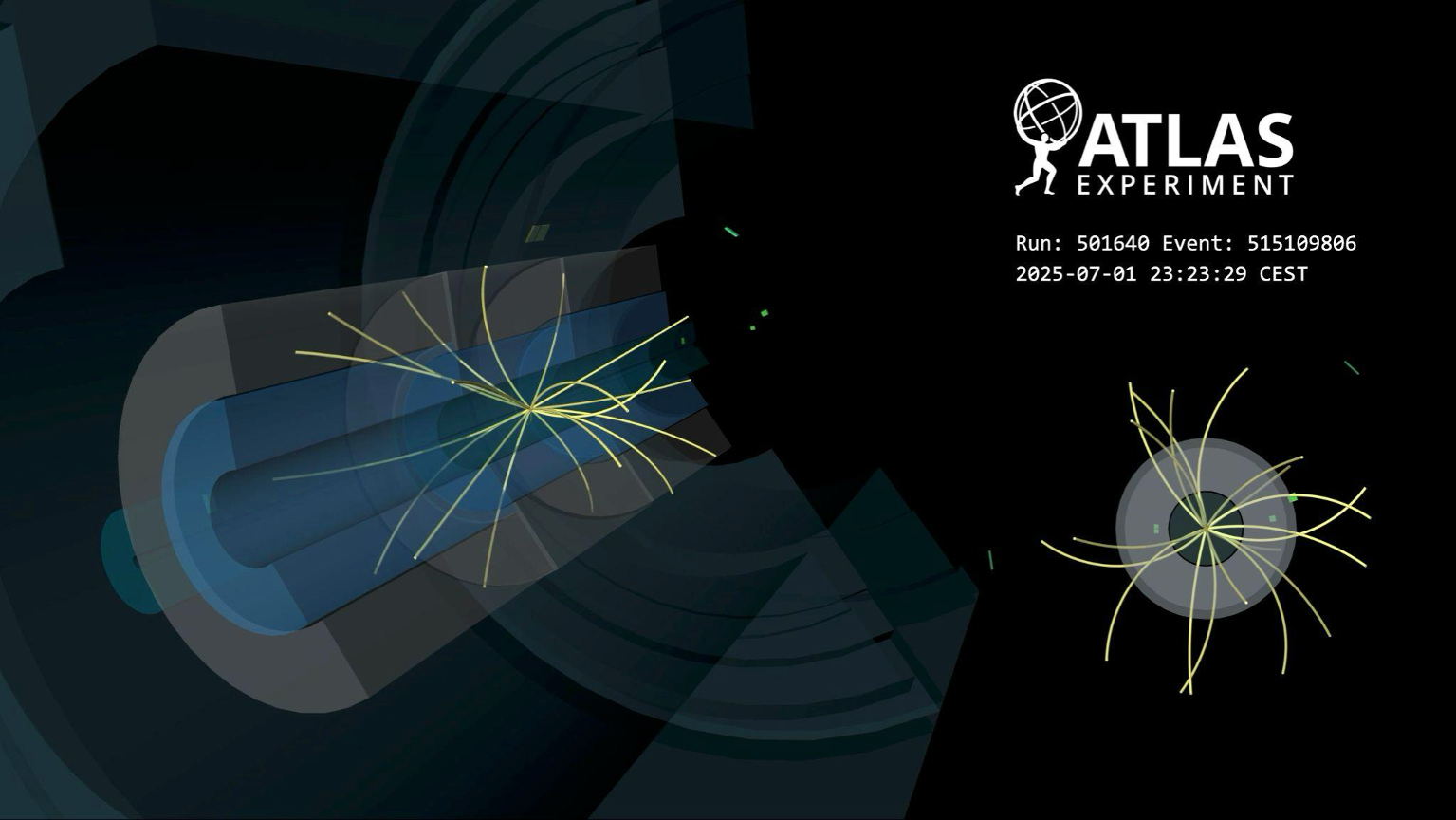
Tens of kilometres above Earth's surface, high-energy particles from outer space constantly strike the atmosphere, creating showers of energetic secondary particles that rain down from the sky. Approximately one of these particles passes through your head every second, but the "cosmic rays" that produce them are still not fully understood. In a recent paper, the ATLAS Collaboration describes how its first measurement of proton-oxygen collisions at the LHC could help us learn more about them.
Cosmic rays were discovered over a century ago by physicist Victor Hess in experiments conducted aboard hot-air balloons. Today, astrophysicists use detectors on the ground to image cosmic-ray showers and computer simulations of the showers to understand that data.
However, these simulations depend on properties of the strong force - one of the fundamental forces of the Universe - which is difficult to accurately model. Current simulations disagree with one another, making it difficult for astrophysicists to interpret their measurements of cosmic rays.
In part to help improve these simulations, the LHC was configured to collide protons with oxygen ions for the first time in July 2025. This meant physicists could study 'recreated' cosmic-ray collisions in more detail. The beam of protons acted as a cosmic ray, while the beam of oxygen ions played the role of Earth's atmosphere, which is composed primarily of nitrogen and oxygen.
The new paper describes how ATLAS physicists analysed these collisions by measuring the tracks left in the experiment from electrically charged particles. They measured key properties of the collision, including how often the particles were created, how many were created, and the energies and angles at which they flew out.
They then compared the measured distributions of charged particles with the numbers predicted by various simulations typically used to interpret data from cosmic-ray observatories. These simulations, which are tuned to reproduce data from previous collisions of protons with heavier nuclei, disagree with one another.
The new ATLAS measurements achieve a precision level of a few percent, significantly improving knowledge of proton-oxygen collisions. Theorists can now use this input to refine their models and help shed more light on the mysterious high-energy particles arriving from our cosmos.


