
Florida State University's Art in STEM event returns for its 12th annual exhibition showcasing the artwork of FSU students conducting research in science, technology, engineering and math disciplines.
The FSU community is invited to enjoy an opening reception from 10 a.m. to 4 p.m., Tuesday, April 21, at the Dirac Science Library, and vote in person or online for their favorite piece. The people's choice award winner will be announced the following day.
This year's edition of the annual exhibition, which can be viewed at the Dirac Library and accessed online in a digital gallery, is a collaboration among FSU's Graduate Women in STEM (GWIS) organization, Art in the Library, and the FSU College of Arts and Sciences. It features 30 artworks created by students representing environmental science, geology, microscopic biology, neuroscience, physical chemistry, astrophysics, ecology, chemical engineering and more.
"The Art in STEM exhibition shows another side of students whose interests or majors are in STEM fields," said Kaylie Green, 2025-2026 GWIS president and third-year biomathematics doctoral student. "We want viewers to connect with STEM topics through the artwork they see."
Artists drew inspiration for their creations from their work in the field, lab and classroom, using microscopes, cameras, watercolor and acrylic paints, screen printing and more to capture the artistic side of science and bring their research to life.
"This event demonstrates that art can be found everywhere - even in cells viewed under a microscope," Green said.
"This event demonstrates that art can be found everywhere - even in cells viewed under a microscope."
- Kaylie Green, 2025-2026 GWIS president and third-year biomathematics doctoral student
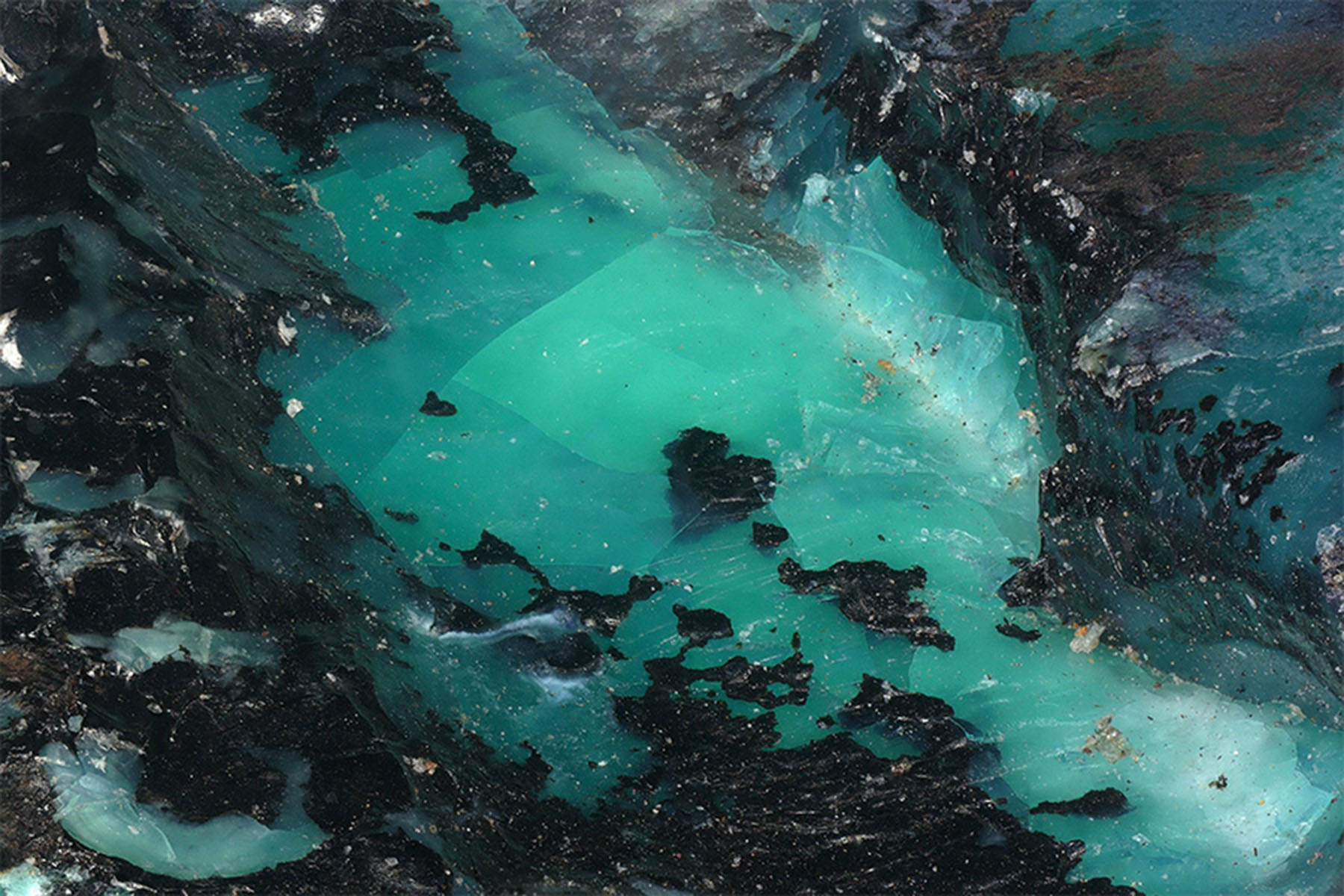
Jennifer Scheckowitz, an undergraduate majoring in physical science in the Department of Physics, is among this year's featured artists. Her piece, "Heart in Malachite," highlights the hidden beauty of geological microscopy - analyzing rock, mineral and soil samples to understand geological processes, environmental history and fluid interactions.
Using the depth composition feature on a Keyence VHX-7000 digital microscope, Scheckowitz captured multiple photos of the malachite crystal at different focal points and stitched the images together to produce one cohesive photograph, highlighting the shape of a heart appearing in the light-green stone.
"When I first got the opportunity to explore different forms of microscopy, I was immediately captivated by how rocks and minerals looked under a microscope," said Scheckowitz, who also participated in the Center for Undergraduate Research and Academic Engagement's Undergraduate Research Opportunity Program. "I spent a lot of time taking pictures of the microscopic surfaces of many different geological specimens, but the malachite was by far the most interesting to me."
Scheckowitz's research was conducted through the Microscopic BioArt research project under the Nanobio Materials and Robotics group led by Jamel Ali, associate professor of chemical and biomedical engineering at the FAMU-FSU College of Engineering, and based at the FSU-headquartered National High Magnetic Field Laboratory.
Beyond its artistic appeal, geological microscopy is an effective and valuable learning tool for students and amateur geologists, preparing Scheckowitz for future research in physical science and chemical engineering. Her additional artworks in the exhibit, "Biotite Schist under UV Light" and "Sodalite Crystal," showcase the range and beauty of photomicroscopy.
"While many geological subjects may look identical to the naked eye, employing a microscope reveals fascinating new structures and hidden differences between them," Scheckowitz said. "It highlights structural features that often go unnoticed, revealing a whole new world just on the surface of a rock."
Art in STEM encourages the FSU community to engage with various scientific topics, providing an aesthetic entry point for viewers to learn about the innovative research conducted by undergraduate and graduate students across programs.
"This exhibition seamlessly connects art and science," Scheckowitz said. "I believe that art fosters innovation - the two are intertwined. Artistic experimentation mirrors scientific development, and it's important to highlight the similarities between the two."


