
A study initiated as a Physics degree thesis at the UAB has led to the first complete analytical description of muon-based calibration of the double-mirror telescopes used in gamma-ray astronomy. The new formalism allows for the precise prediction of the amount of Cherenkov light reaching the camera, taking into account the complex geometry of these instruments. The results, published in The Astrophysical Journal Supplement Series, are directly applicable to the calibration of future telescopes at the Cherenkov Telescope Array Observatory (CTAO).
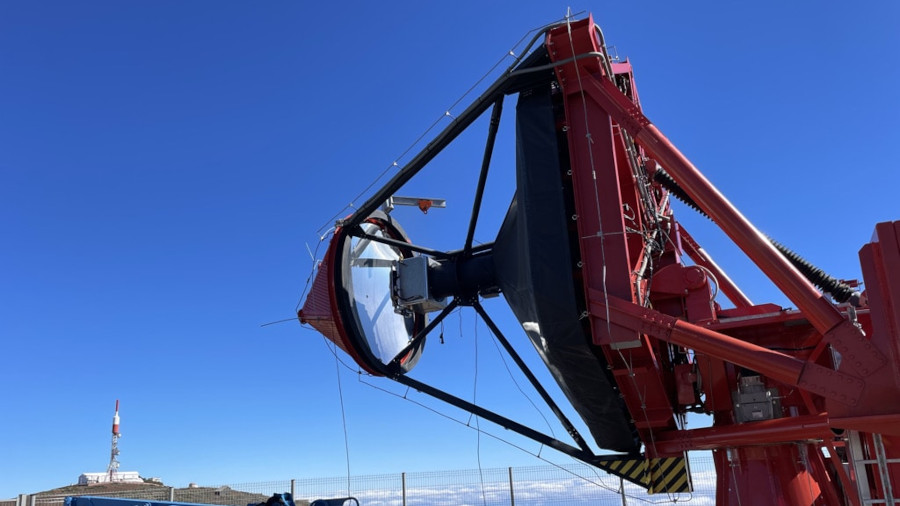
Research initiated as part of a bachelor's thesis in Physics at the Universitat Autònoma de Barcelona (UAB) has culminated in a new analytical description of the muon-based calibration of dual-mirror Cherenkov telescopes. The work solves a problem that had remained open for more than thirty years due to the geometric complexity of these optical systems: determining precisely how much Cherenkov light produced by a muon reaches the camera, taking into account the shadows cast by the secondary mirror and the camera itself.
The study is authored by Markus Gaug, lecturer in the Department of Physics at the UAB and researcher at the CERES-IEEC; Víctor Giráldez-Segalàs, graduate in Physics by the UAB; and PhD student Fiona Redmen.
Muons as a natural calibration source
Cherenkov telescopes detect the brief flashes of light produced in the atmosphere by particle cascades originating from gamma rays and cosmic rays. Among these particles are muons which, when travelling through the atmosphere at a speed exceeding the speed of light in air, emit Cherenkov radiation.
When a muon passes close to a telescope, this radiation produces a characteristic ring-shaped image on the camera. Since the amount of light emitted can be calculated with great precision, these rings constitute a natural calibration source continuously available during observations.
By comparing the expected light with the light actually detected by the camera, it is possible to determine the overall efficiency of the optical and detection system and track its evolution over time. This continuous calibration is particularly important because the large CTAO telescopes are not protected by domes —unlike conventional optical telescopes— but are instead exposed to the elements. Furthermore, precise calibration is essential for accurately reconstructing gamma-ray energy and controlling systematic uncertainties.
From a bachelor's thesis to a new analytical solution
The research originated in the bachelor's thesis conducted by Víctor Giráldez-Segalàs during his Physics degree at the UAB, under the supervision of Markus Gaug. The objective was to extend the analytical muon calibration methods developed for conventional single-mirror telescopes to the future dual-mirror telescopes of the CTAO.
In a double-mirror telescope, the geometry is considerably more complex: the secondary mirror, its supports and light deflectors, the camera and the central hole of the primary mirror can intercept part of the Cherenkov radiation. These shadows also depend on the muon's inclination and trajectory and vary along the observed ring. Having an analytical solution will save the CTAO from having to resort to continuous and costly simulations in terms of computing time.
Up to a 40% difference regarding simplified models
The new formalism allows for the explicit calculation of the fraction of Cherenkov light blocked by the various telescope components for each muon trajectory. The effects are particularly significant for inclined muons and for configurations featuring protective structures around the secondary mirror.
In these cases, the predicted amount of light can differ by up to 40 % from that obtained using previous approximations, which treated the secondary mirror's shadow in a simplified manner. This difference far exceeds CTAO requirements, which demand a calibration method precision better than 4%.
The study also provides two results for conventional single-mirror telescopes: a first-order correction for the maximum altitude from which a muon's Cherenkov light can reach the reflector, due to the curvature of the primary mirror, and an analytical description of the effect of coma aberration on muon rings in telescopes with parabolic reflectors.
Applicability to the Cherenkov Telescope Array Observatory
The CTAO will be the new generation terrestrial observatory dedicated to very high energy gamma ray astronomy. It will have two locations: CTAO-North, at the Roque de los Muchachos Observatory in La Palma, and CTAO-South, in the Atacama Desert, in Chile.
More than half of the planned telescopes will use dual-mirror optical systems inspired by the Schwarzschild-Couder design, including the Small-Sized Telescopes (SST). These designs provide wide fields of view and good image quality across the entire focal plane, while also allowing for the use of more compact cameras. The new formalism provides the necessary tools to precisely calibrate these systems using muon rings.
Original article:
M. Gaug, V. Giráldez-Segalàs i F. Redmen, Using Muon Rings for the Calibration of the Cherenkov Telescope Array: An Analytical Solution for the Dual-mirror Telescope Using Vector Geometry, The Astrophysical Journal Supplement Series, 285, 22 (2026). DOI: 10.3847/1538-4365/ae6da5.


