
When developing new technologies, engineers do their best to keep it simple. Adding layers of complication can lead to more things that could potentially go wrong.
As a researcher who develops microelectromechanical systems (MEMS), Binghamton University Professor Mohammad Younis fits tiny mechanical devices into spaces no bigger than a microchip, so simplicity also helps to keep it small.
Younis - a faculty member at the Thomas J. Watson College of Engineering and Applied Science's Department of Mechanical Engineering - recently received a $335,000 grant from the National Science Foundation to develop and test an ultrasensitive gas detection MEMS device with autonomous actuation.
The intention is to install the detector alongside lithium-ion batteries to pick up the faint traces of hydrogen or carbon dioxide that can be an early indicator of thermal runaway - a rare, uncontrolled, self-heating chain reaction where a rise in temperature increases the rate of heat generation, leading to extreme temperatures, fire, or explosion.
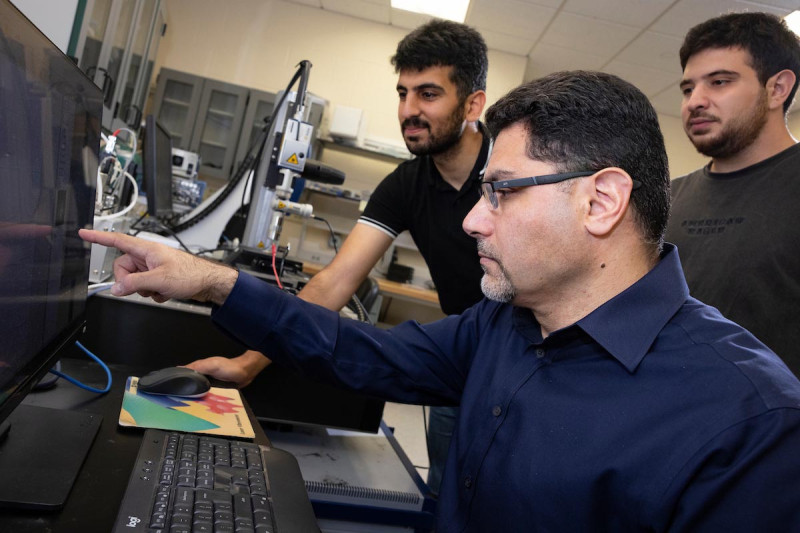
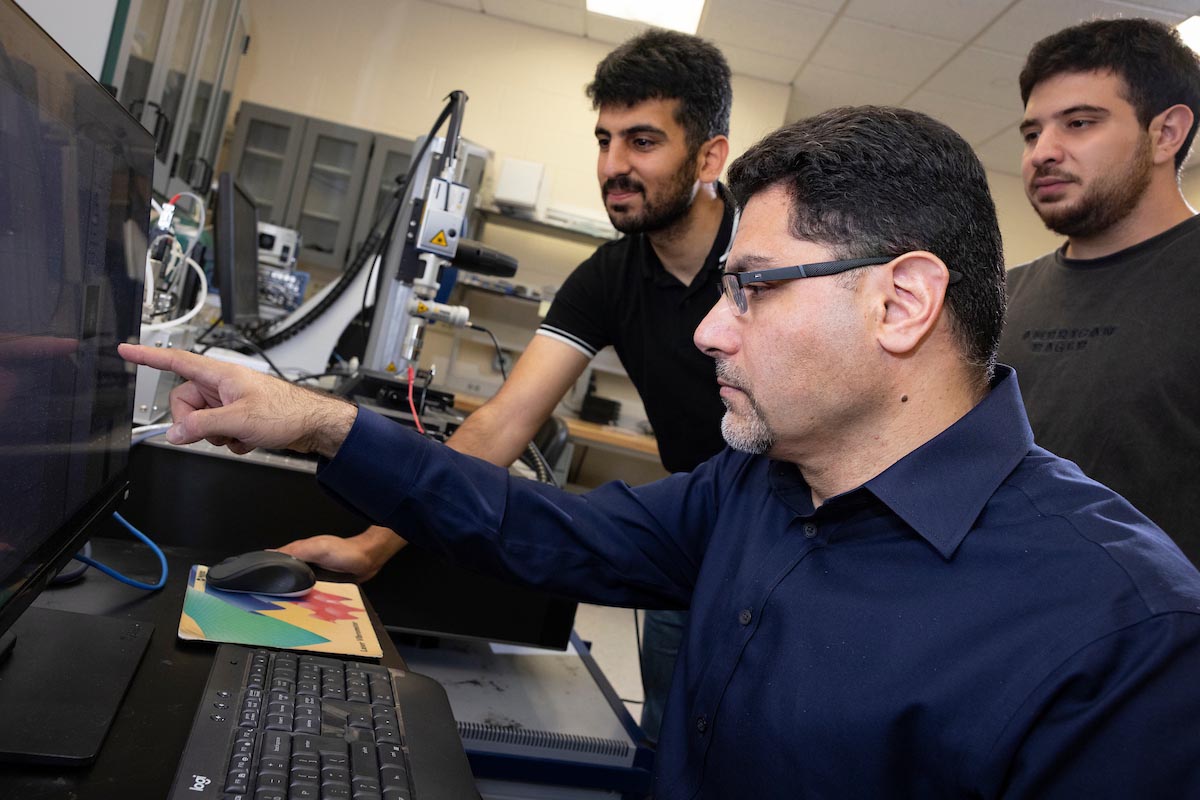
By improving the use of lithium-ion batteries, Younis will connect the research to wider Binghamton University initiatives such as the Upstate New York Energy Storage Engine, Battery-NY, the NorthEast Center for Chemical Energy Storage, and New Energy New York.
"I don't work on just sensors. I want the sensor to be part of a complete intelligent system," he said. "In this case, it would be a sensor, an actuator, and the ability to make a decision based on one input or two inputs - all in the same MEMS device. I'm always intrigued about this idea that I can replace a complicated system of sensors, actuators, controllers, and decision units."
Because the device is self-contained, it doesn't need to transmit data for processing and activation. As Younis points out, that solves two problems: no need to expend energy to send its findings somewhere else, and no concerns about possible cybersecurity risks.
"We are overwhelming the network and the cloud with too much data," he said. "Also, although sensors are cheap, it's not free when you transmit so much data from them, and processing the data is not free."
The hydrogen-detecting sensor that Younis has designed features a vibrating wire and works on the principle of thermal conductivity. When the gas is present, the wire cools and becomes stiffer, lowering the rate of vibration and triggering the alarm.
"The dynamical mechanism of this sensor is much more sensitive than a static mechanism, and I was among the first to do it using dynamics," he said. "Most researchers do thermal conductivity, with just passive electrical current. As a mechanical engineer, my passion is always on dynamics."
In addition, Younis is teaming up with Professor Roya Maboudian, the chair of the Chemical and Biomolecular Engineering Department at the University of California - Berkeley. Maboudian researches metal-organic frameworks, a class of polymers with porous structures that can be used for gas storage. By coating the MEMS device with MOFs, any increased mass when the polymers capture carbon dioxide can also trigger an alert.
When they applied for NSF funding for this sensor project two years ago, Younis and Maboudian both could claim "one degree of separation" from Nobel Prize winners - Distinguished Professor M. Stanley Whittingham at Binghamton (a pioneer in lithium-ion batteries) and Professor Omar Yaghi at Berkeley (a key developer of MOFs). Yaghi has since moved to Tsinghua University in China to lead an artificial intelligence laboratory for accelerating the discovery of new materials.
If this MEMS technology is developed successfully, it could be adapted for a wide variety of sensor needs.
"The application is not limited to gases. It can be magnetic, pressure, acceleration, or any other stimulus. I'm a mechanical engineer, so I don't have a loyal attachment to gases," Younis said.


