
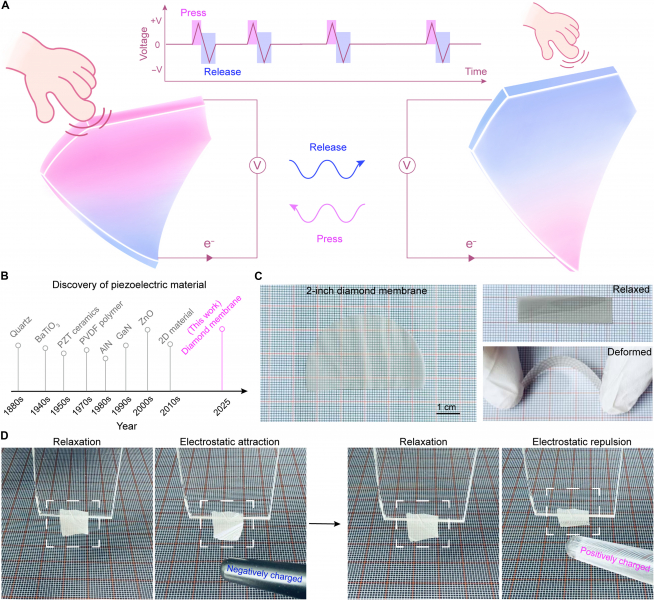
Ultrathin polycrystalline diamond membranes respond to charged objects
A research team led by Professor Zhiqin Chu, Associate Professor in the Department of Electrical and Computer Engineering, and Professor Yuan Lin, Professor in the Department of Mechanical Engineering, Faculty of Engineering at the University of Hong Kong (HKU), has reported a significant piezoelectric effect in ultrathin and ultra-flexible polycrystalline diamond membranes. This pioneering discovery challenges a century-long scientific dogma that diamonds are strictly non-piezoelectric.
Since the 1900s, diamonds have been classified globally as non-piezoelectric material. Consequently, despite being a strong, hard and inert material with exceptionally high acoustic velocity, thermal conductivity, dielectric breakdown strength and ultrawide bandgap, diamond has only been used as a mechanical substrate supporting other piezoelectric material layers in microelectromechanical systems (MEMS). Indeed, the very idea of "generating electricity from diamonds" was initially deemed impractical by many.
To overcome this limitation, the HKU research team utilised a recently developed edge-exfoliation method to fabricate an ultrathin, flexible polycrystalline diamond membrane, enabling this exceptionally hard natural material to undergo large deformations. Surprisingly, imposed bending deformation of the membrane was found to generate stable voltage signals.
Ensuring the utmost scientific rigour and ruling out potential environmental noise or triboelectric artefacts, the team conducted extensive mechanical cycling tests under various controlled conditions. The consistent and repeatable electrical outputs demonstrate the outstanding piezoelectric response of the diamond membrane.
Detailed first-principle calculations revealed that this piezoelectric effect is primarily attributed to the asymmetry of grain boundaries within the diamond membrane. Specifically, charge polarisation accumulates at the grain boundaries as the imposed deformation increases, which in turn creates a potential difference between the upper and lower surfaces of the membrane.
Given diamond's unparalleled biocompatibility, chemical stability, and non-toxicity, this finding demonstrates the huge potential of diamond in medical and energy applications. For example, piezoelectric diamond membranes could be used in future implantable medical devices to serve as self-generating power source or deformation sensors.
This research not only pioneers an entirely new avenue for the functionalization of diamond materials but also provides an innovative solution for the development of next-generation high-reliability micro-energy systems and self-powered sensing technologies.
For the article titled "Uncovering piezoelectric effect in polycrystalline diamond membranes" on Science Advances, please visit: https://www.science.org/doi/full/10.1126/sciadv.aea8318
About Professor Zhiqin Chu
Professor Zhiqin Chu received his B.S. and Ph.D. degrees in Physics from Northwest University (China) and The Chinese University of Hong Kong, in July 2008 and July 2012, respectively. After spending one year as a postdoctoral fellow in the same group, he conducted postdoctoral research at The University of Stuttgart in Germany from April 2014 to September 2016. Since November 2018, he has been an Assistant Professor in the Department of Electrical and Computer Engineering (with a joint appointment in the School of Biomedical Sciences) at HKU, and was promoted to tenured Associate Professor in November 2024. Since joining HKU, Professor Chu has published over 60 peer-reviewed articles in journals such as Nature, Nature Communications, and Science Advances, and has filed 14 patents related to diamond technology. Professor Chu has received multiple awards, including the Gold Medal at the 2023 International Invention Innovation Competition in Canada (iCAN), the Top 10 Best Invention Award at the 2023 iCAN, the Silver Medal at the 2022 Inventions Geneva Evaluation Days, and the Gold Medal at the 2024 International Exhibition of Inventions of Geneva.
About Professor Yuan Lin
Professor Yuan Lin earned his B.S. and M.S. in Engineering Mechanics from Tsinghua University, followed by another M.S. in Applied Mathematics and a PhD in Solid Mechanics from Brown University. He joined The University of Hong Kong in 2008 and is now a full Professor in the Department of Mechanical Engineering. His research on cell/tissue mechanics and mechanics of functional materials led to publications in top journals, including Nature, Nature Physics, PNAS, Nature Communications, Science Advances and PRL, as well as awards such as Gold Medals at 2026 International Exhibition of Inventions Geneva and 2023 International Invention Innovation Competition in Canada (iCAN). Professor Lin has served as Chair of the Gordon Research Conference on Nano-Mechanical Interfaces and keynote speaker in numerous international conferences. As the PI or Co-PI, he has secured more than 15 research grants.


