
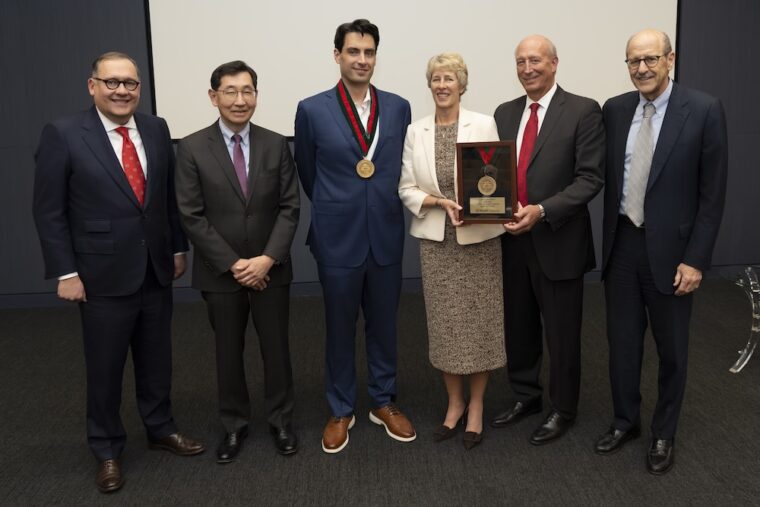
Nico U. Dosenbach, MD, PhD, a widely recognized pioneer in precision neuroimaging, has been installed as the inaugural David M. and Tracy S. Holtzman Professor of Neurology at WashU Medicine. The professorship was established by David M. Holtzman, MD, a world-renowned WashU Medicine expert in Alzheimer's disease, and his wife, Tracy S. Holtzman, to support translational neurology research. Holtzman is the Barbara Burton and Reuben M. Morriss III Distinguished Professor and former head of the Department of Neurology.
Dosenbach - who also holds appointments in radiology, pediatrics, biomedical engineering, psychological and brain sciences, and occupational therapy - was installed by Chancellor Andrew D. Martin and David H. Perlmutter, MD, executive vice chancellor for medical affairs, the Spencer T. and Ann W. Olin Distinguished Professor and the George and Carol Bauer Dean of the School of Medicine.
"I'm pleased to celebrate the extraordinary contributions of the Holtzmans and the pioneering work of Dr. Dosenbach with this professorship," Martin said. "David and Tracy Holtzman are longtime supporters of WashU, where David has dedicated his scientific career to the understanding, diagnosis and treatment of Alzheimer's disease, helping make WashU Medicine the world's foremost center for Alzheimer's research. Nico Dosenbach carries on this legacy of innovation and dedication to solving the most challenging neurological problems."
A pediatric neurologist by training, Dosenbach aims to refine functional brain mapping technologies - including resting-state functional connectivity MRI, functional MRI and diffusion tensor imaging - to achieve individual-level precision and support the development of improved therapies for conditions ranging from neurodegenerative diseases and chronic pain to treatment-resistant depression.
His research led to the discovery of the somato-cognitive action network (SCAN), which lies within the motor cortex - the part of the brain that controls body movements - and links cognition with movement. This discovery forced a revision of classical textbook models of the motor system. Recently, he and his colleagues have shown that this newly recognized network is altered in Parkinson's disease and that reversing SCAN hyperconnectivity improves Parkinson's symptoms. Neuromodulation of the SCAN and the closely related action-mode network have also shown promise in treating chronic pain.
"Dr. Dosenbach's research is expanding what we know about the human brain and ultimately what we can know about its inner workings," Perlmutter said. "His work in functional brain mapping reveals how structural connections shape behavior and cognition in ways that are unique to each person. This kind of translational research moves us closer to real-world solutions for the most devastating neurological diseases and reflects the spirit of innovation and impact that David Holtzman has advanced throughout his career."
As part of the new Allied Labs for Imaging Guided Neurotherapies Center at WashU Medicine, Dosenbach aims to develop more effective neuromodulatory treatments - those that stimulate nerves to change brain activity - through personalized precision imaging. This approach lends itself to studying naturally occurring brain plasticity and the effects of interventions, including medications. In addition to his discovery of the SCAN and its role in Parkinson's disease, Dosenbach's recent imaging studies have revealed the effects of psilocybin and stimulant ADHD medication on the human brain.
Dosenbach was elected to the American Society for Clinical Investigation in 2023. He holds several Small Business Innovation Research grants and patents, and he is the co-founder and director of Turing Medical, a WashU Medicine startup.
"Dr. Dosenbach has made groundbreaking contributions in the fields of advanced functional neuroimaging and mapping of the brain's global networks, combining technical innovation with cutting-edge brain network science to drive transformative advances," said Jin-Moo Lee, MD, PhD, the Andrew B. and Gretchen P. Jones Professor of Neurology and head of the WashU Medicine Department of Neurology. "He exemplifies the collaboration, curiosity and entrepreneurship that are hallmarks of David Holtzman's incredible and inspiring career. It is with great pride that the Department of Neurology celebrates their accomplishments."
Born and raised in Gültlingen, a small town at the foot of the Black Forest in southwest Germany, Dosenbach came to the U.S. to study biochemistry as an undergraduate at Columbia University. After completing his bachelor's degree in 2000, he earned his MD/PhD at WashU Medicine, followed by a neurology residency at Barnes-Jewish Hospital and a pediatric neurology fellowship at St. Louis Children's Hospital. He became an assistant professor in 2015 and was promoted to full professor in 2024.
About David M. and Tracy S. Holtzman
David M. Holtzman, MD, is a native St. Louisan who has dedicated his neurology and research career to Alzheimer's disease and is widely regarded as one of the world's leading experts in the disease. After attending the six-year undergraduate/medical school program at Northwestern University, he completed his neurology residency and research training at the University of California, San Francisco. He then moved to WashU Medicine in 1994 to establish his lab.
Over the 32 years since, he has identified effects and mechanisms underlying the most important genetic risk factor for Alzheimer's disease, portending new treatment strategies. In addition to running his research lab, he was chair of the Department of Neurology from 2003 to 2021 and is currently director of the Hope Center for Neurological Disorders and the Charles F. and Joanne Knight Alzheimer Disease Research Center at WashU Medicine. Eighteen years ago, he co-founded the company C2N, a WashU Medicine startup, which has since commercialized the first diagnostic blood test for Alzheimer's. The test was initially developed by Holtzman and his colleague Randall Bateman, MD, the Charles F. and Joanne Knight Distinguished Professor of Neurology at WashU Medicine.
Tracy S. Holtzman grew up in New York, attended Duke University and earned her master's degree in physical therapy from Columbia University. She began her career at the University of California, San Francisco, focusing on inpatient neurological, neurosurgical and pediatric patients. Upon moving to St. Louis, she saw adult patients with hemophilia at St. Louis University Hospital and worked for WashU Medicine at St. Louis Children's Hospital in pediatric rheumatology. The last 10 years of her career at WashU Medicine were focused solely on patients with pediatric rheumatologic diseases. Since retiring in 2010, she has been engaged in volunteer work, including multiple board positions for Sign of the Arrow, a nonprofit retail gift and needlepoint shop benefiting St. Louis charities.
The Holtzmans have been steadfast supporters of WashU Medicine. Both received scholarship support as they pursued advanced degrees, inspiring them to provide a gift to help fund medical school scholarships in honor of David Holtzman's parents. The Holtzmans have subsequently supported multiple Department of Neurology initiatives including the Tracy S. and David M. Holtzman Endowed Bishop Lecture, the Tracy S. and David M. Holtzman Endowed Dodge Lecture, neurology resident travel scholarships, the Center on Biological Rhythms and Sleep and the Knight Alzheimer Disease Research Center.


