
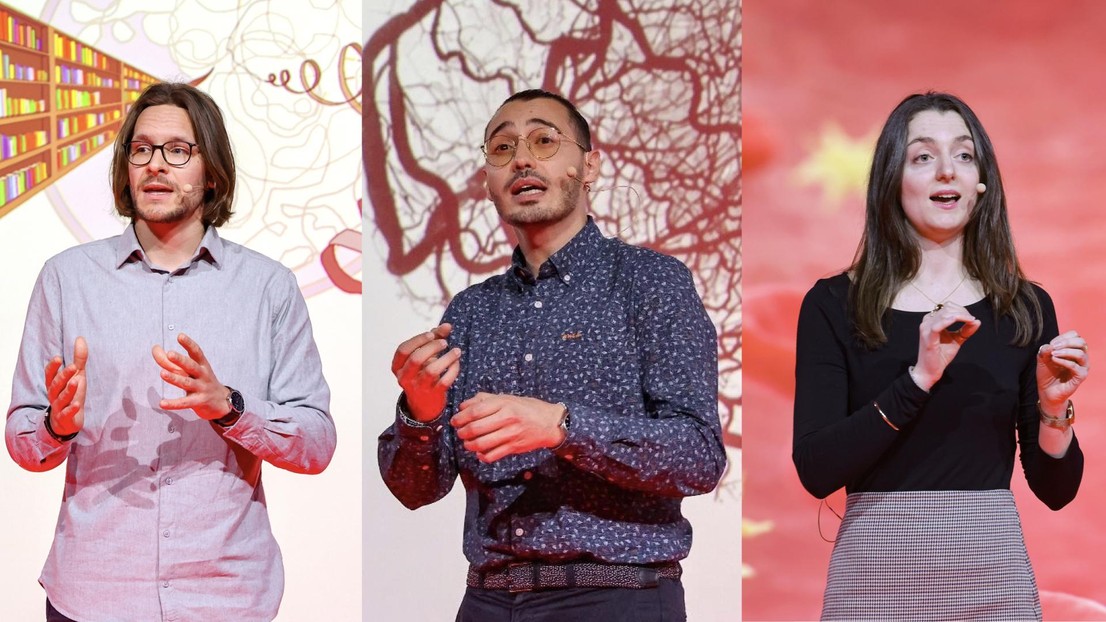
Three EPFL PhDs: Antoni Gralak, Mehdi Ali Gadiri and Camille Lambert, will take part in the swiss final © 2026 Alain Herzog/EPFL CC BY SA
The Swiss finals of the My Thesis in 180 Seconds competition, now in its 10th year, will be held at the Rolex Learning Center on 21 May. Fourteen PhD students will have exactly three minutes to explain their research to a broad audience. We spoke with the three finalists from EPFL about their experience.
The My Thesis in 180 Seconds finals always play to a full house. This year, attendees will get another opportunity to glimpse behind the scenes of research labs and learn about fascinating and often little-known aspects of various fields, including biology, political science, microengineering and literature. Fourteen PhD students from universities across Switzerland who won their local competitions will present their research and share their passion. By taking a step back from the excitement, we can appreciate the full extent of what the competition entails - distilling years of research into three captivating minutes without sacrificing technical rigor. The selection panel will pick the winner based on three main criteria: how clear the explanation is for non-experts, how well the PhD student is able to pique the audience's curiosity and the PhD student's public-speaking skills. Finalists use humor, storytelling and creativity to make the science understandable and demonstrate their flair for communications.
Over the past ten years, nearly 400 EPFL PhD students have been trained on public speaking by media professionals before taking part in the My Thesis in 180 Seconds competition - initially in qualifying rounds. When the competition was first introduced, some feared the format would make a mockery of the science, but the competition has since become a highly appreciated and much-awaited event. It also gives PhD students from different fields, whose paths might otherwise never have crossed, an opportunity to meet.
We spoke with the three finalists from EPFL about their experience, their expectations and the swaths of work they had to exclude from their presentations to meet the time requirement. Regardless of the outcome, one thing is sure - these researchers will have a ready reply when asked "what are you up to these days?"
Applying high-precision craftsmanship to healthcare
For Mehdi Ali Gadiri, a PhD student at EPFL's MicroBioRobotic Systems Laboratory, the competition goes well beyond stage performance and gets right to the fundamental issue of knowledge sharing. "Even the most promising scientific breakthroughs lose relevance if they're neither shared nor understood," he says. His thesis involved developing a tiny catheter with integrated pressure sensors that doctors can use to explore even the narrowest coronary arteries with unprecedented accuracy. The biggest challenge in his ambitious research project was achieving the extreme miniaturization: he had to incorporate several sensors into a guidewire that's less than a third of a millimeter in diameter without compromising the sensors' performance. This required precision engineering on par with that used for watchmaking, and much of it was done by hand. "The trickiest steps were the assembly and navigating the interface between microscopic and macroscopic," says Ali Gadiri. When it came time to prepare for the My Thesis in 180 Seconds competition, "I focused on the key message of how the system can be used in practice to measure blood flow and pressure. That really speaks to people because it relates to healthcare." Ali Gadiri has degrees in both medicine and engineering, which is "a useful combination because it lets me keep patients' concrete needs in mind as I develop technical solutions for clinical problems - and vice versa, in that I can make technical decisions based on what would be helpful and easy to understand for medical workers."
Ali Gadiri is unassuming yet confident as he looks ahead to the finals, boosted by the positive feedback he received during the EPFL competition. He's determined to use the same approach - and with the same drive to tell people about his research - as he proudly represents the School.
Watch Mehdi Ali Gadiri's presentation at the EPFL finals.
Pivoting from microfluidics to cancer cell analysis
Like all PhD students, Camille Lambert, a PhD student at EPFL's Laboratory of Systems Biology and Genetics, is accustomed to presenting her research in academic settings. But she has trouble explaining it clearly to her friends and family: she often finds herself giving overly lengthy or overly technical descriptions. Preparing for the My Thesis in 180 Seconds competition helped her strike the right balance between cutting to the chase and providing sufficient technical detail. She even found that the experience "influenced how I structure my reports, as it forced me to clarify my ideas and better understand my own research topic," she says.
Lambert has an engineering degree and began her thesis by working to design a microfluidic chip enabling the precise analysis of cells by photographing them one by one before encapsulating them in tiny droplets to characterize their contents. But she ended up switching to the analysis of biological data collected from circulating cancer cells. "That pivot wasn't easy because it pushed me out of my comfort zone and required me to work with complex datasets, and there were no off-the-shelf answers, no clear end point," she says. She therefore took classes on statistics, spoke with colleagues and learned by doing until she gradually built up her confidence. Today, this field is her area of expertise. Her research is underpinned by the long-term goal of helping scientists better understand the cancer cells that circulate in the bloodstream, identify cells with a high risk of propagation and, hopefully, improve cancer diagnosis and treatment. Applications for her research are still far off, but they could pave the way to earlier, faster and potentially cheaper therapeutic diagnostics approaches.
In the run-up to the finals, Lambert is "continuing to tweak my presentation by getting input on how to make my message clearer. I'm also working on my stage presence, as I know that holding an audience's attention is just as much about what you say as how you say it."
Watch Camille Lambert's presentation at the EPFL finals
"Completing a PhD takes stamina and resilience"
Antoni Gralak, also a PhD student at EPFL's Laboratory of Systems Biology and Genetics, is conducting research on how proteins interact with DNA and with each other. He entered the competition because he wanted to learn how to whittle years of research down into a clear, easy-to-understand narrative. The two things motivating him are the personal challenge and the opportunity to speak before a large audience. It's a demanding experience that he describes as stressful yet also invigorating. "I like explaining things and speaking in public," says Gralak. "Also, it's especially important for scientists today to be able to speak in layman's terms - not just to keep people informed, but also to build up their interest and restore their trust in science. This issue still isn't addressed enough in PhD programs, where students often find themselves communicating only with other experts."
Gralak found that the biggest hurdle in completing his thesis wasn't resolving the technical problems but rather making his way through the scientific method - a long, winding process marked by missteps, assumptions to be revisited and failed experiments. "Completing a PhD takes stamina and resilience because you take one small step at a time, and the occasional wins keep you motivated and focused on the goal." In preparing his three-minute speech, Gralak had to put aside a hefty chunk of his lab work, experiments and data analyses. "I'll also spare the audience some of the more tedious aspects of life as a researcher," he says.
For now, Gralak is focusing his efforts on one last, sizable hurdle before the final - getting ready to give his talk in French, a language he doesn't yet feel fully comfortable in. It won't be easy, but he's determined and has the support of his friends and family, and he remains driven by the goal of putting science within everyone's reach.


