
Micro-electromechanical systems (MEMS) are tiny devices used in technologies such as microphones, accelerometers, and biosensors. MEMS are highly useful, but prone to physical stress that affects their performance, stability, and reliability. Tracking this interference is important, but attaching a separate sensor to such a miniscule structure is no easy task.
Researchers at Tohoku University developed an approach that addresses this problem by making the sensing region part of the mechanical device itself. This innovative approach allows us to accurately detect when MEMS are under stress. This finding could support the future development of compact and highly integrated diamond quantum devices for next-generation technology.
To create the ideal sensor, they started by examining something a bit less than ideal: a defect. A nitrogen vacancy (NV) center is a defect in a diamond crystal lattice. It consists of a nitrogen atom replacing one carbon atom next to a vacant lattice site. Despite being a defect, the NV center has very useful quantum properties. When illuminated with green laser light, an NV center emits red fluorescence. Its electronic spin state can be manipulated using microwaves, and the fluorescence intensity changes when the microwave frequency matches the spin-resonance frequency. This technique is called optically detected magnetic resonance, or ODMR. How is this useful for detecting mechanical stress? ODMR resonance frequency is not just sensitive to magnetic fields, but temperature and mechanical stress too.
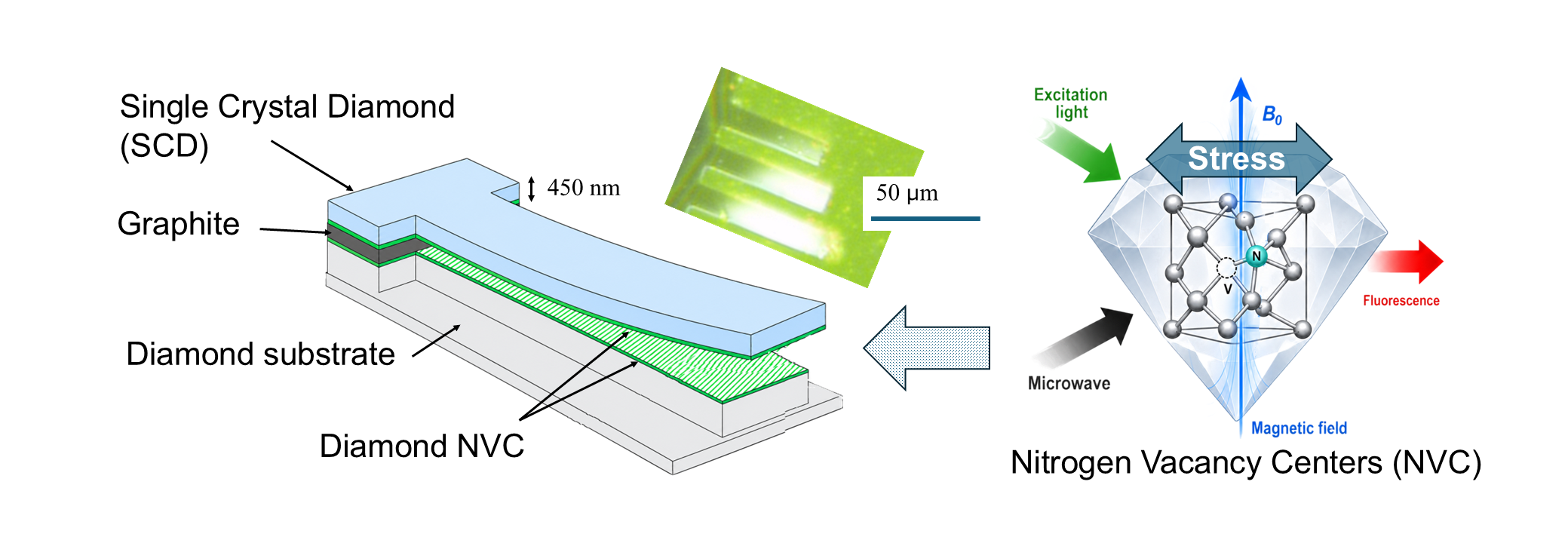
The research team looked at NV centers formed inside a single-crystal diamond MEMS cantilever. A cantilever is a structure that is supported by a base on one end, and unsupported on the other, like the hand of a clock. Therefore, when the MEMS undergoes mechanical stress, the unsupported end of the cantilever vibrates, and these movements travel through the whole system, triggering a shift in resonance of NV centers in opposite directions.
The study reports that the NV centers reacted to changes in cantilever vibrations as well, meaning that the NV centers were not simply responding to a static deformation, but could be used to probe the changing stress state of a vibrating MEMS structure. This is crucial, as we don't just want to detect the presence or absence of mechanical stress, but if that stress is changing and what kind of stress it is.
"The most exciting aspect of this work is that the quantum sensor is formed as part of the MEMS fabrication process itself," says Masaya Toda (Tohoku University). "We were able to show that this integrated NV-center region functions as an effective stress sensor, responding as expected to both tensile and compressive bending. In other words, the mechanical structure and the quantum-sensing function can be created together within a single diamond device."
The study provides a platform to create an all-in-one system in the same single-crystal diamond structure. This is useful not only for stress sensing but also for research on interactions between mechanical deformation and quantum spin states. From an engineering perspective, the work demonstrates a fabrication route for integrating a quantum-sensing region into a MEMS structure without attaching a separate sensing element. The team hopes to continue improving the accuracy of this system in future studies.
The findings were published in Functional Diamond on August 28, 2026.
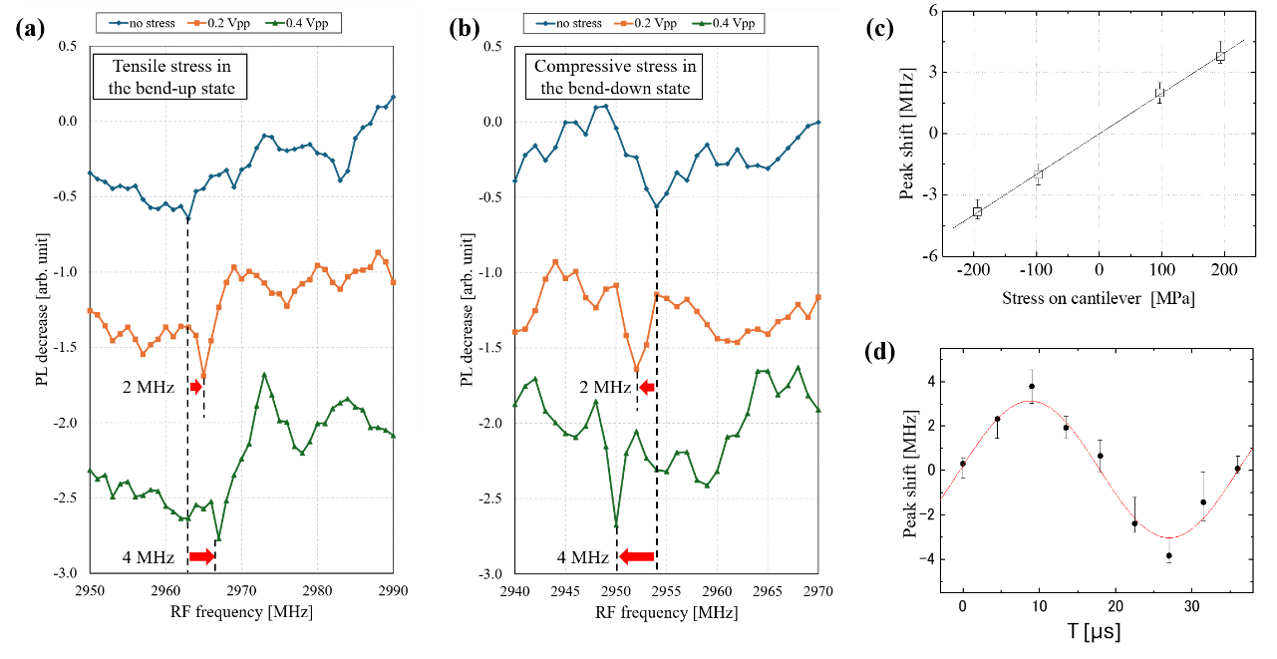
(b) resonance frequency shifts observed under compressive stress, (c) relationship between bending stress and ODMR frequency shift, and (d) periodic frequency shifts synchronized with the vibration phase. ©Yuta Ochiai et al.
- Publication Details:
Title: Dynamic Bending Stress Sensing Using NV Centers in a Single-Crystal Diamond MEMS Cantilever
Authors: Yuta Ochiai, Vu Xuan Tung Duong, Zilong Zhang, Takahito Ono, Meiyong Liao, Masaya Toda
Journal: Functional Diamond


