
Faint red auroras seen over Japan could be hiding space storms that are stronger than previously thought.
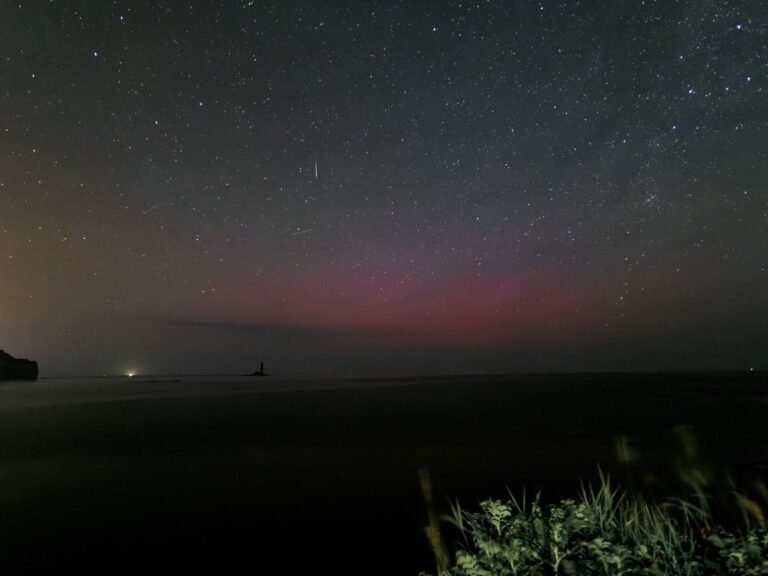
On a special night if you are lucky you might catch a faint red glow quietly lighting up Japan's sky, stretching low along the horizon and easy to miss if you are not looking carefully. Subtle and diffuse, it probably appears as a soft crimson haze. But behind this glowing beauty are countless charged particles traveling from the Sun toward Earth's magnetic field, which then collide with oxygen atoms high above our planet. At these great heights, where the air is extremely thin, the excited oxygen atoms then release their energy as dim red light, creating the auroras we see from the ground.
In a new study published in the Journal of Space Weather and Space Climate, researchers from Hokkaido University and the Okinawa Institute of Science and Technology observed red auroras over Japan that stretched to unexpectedly high altitudes, about 500 to 800 kilometers above Earth.
Every now and then, a magnetic storm occurs, during which charged particles from the Sun disturb Earth's magnetic field, producing auroras. Typically, such auroras appear during a strong geomagnetic storm. However, new findings show that auroras can also occur during a moderately intense storm, challenging our understanding of how they form and how we measure the strength of space storms.
Auroras are usually seen near the poles as bright, shimmering lights produced when charged particles from the Sun collide with Earth's atmosphere. When they appear further south, including in Japan, they are generally linked to strong geomagnetic storms and occur at lower altitudes of around 200 to 400 kilometers.
"We found that red auroras can extend to extremely high altitudes even during those storms that are measured as moderately intense. I was really surprised because I didn't expect such tall auroras to appear even during moderately intense storms," says Tomohiro M. Nakayama, lead author of the study. "This suggests that these storms may actually be stronger than conventional indices indicate."
The team analyzed five auroral events observed from Hokkaido between June 2024 and March 2025. During these events, bursts of charged particles from the Sun compressed Earth's magnetosphere-the invisible magnetic shield that surrounds the planet. Although the storms appeared moderate based on standard indices, this compression was unusually strong.
The researchers propose that such intense compression of Earth's magnetosphere, driven by dense streams of solar wind, would have heated the upper atmosphere and lifted the region where red auroras form to much higher altitudes than usual. At the same time, the outflow of charged particles could have masked the true strength of the storms, making them appear weaker than they actually were.
To study this further, the team combined satellite data with photographs taken by citizen scientists from across Japan. By analyzing the elevation angles of the auroras in these images and tracing them along Earth's magnetic field lines, they reconstructed how high the glowing structures extended into the sky.
Widespread participation from across Japan proved crucial here. With observers spread around the country recording the events, they could capture rare auroral occurrences from multiple locations, revealing details that traditional observation networks might miss.
These findings have important implications beyond the beauty of the night sky. When the upper atmosphere heats and expands, it increases atmospheric drag on satellites orbiting the Earth. This can alter their paths and, in some cases, cause them to lose altitude more quickly than expected.
"As the number of satellites in low Earth orbit continues to grow, understanding these effects is increasingly important," says Nakayama. "Our results could help improve space weather forecasting and support safer satellite operations."
Original article:
Tomohiro M. Nakayama and Ryuho Kataoka, Faint red auroras as seen from Japan associated with intense magnetospheric compression, Journal of Space Weather and Space Climate, May 19, 2026.
DOI: 10.1051/swsc/2026004
Funding:
This study was supported by Hokkaido University Astronomy Club, Japan Society for the Promotion of Science (JSPS) (KAKENHI 24H00277), Hoso Bunka Foundation, and NIJL DDH project.


