
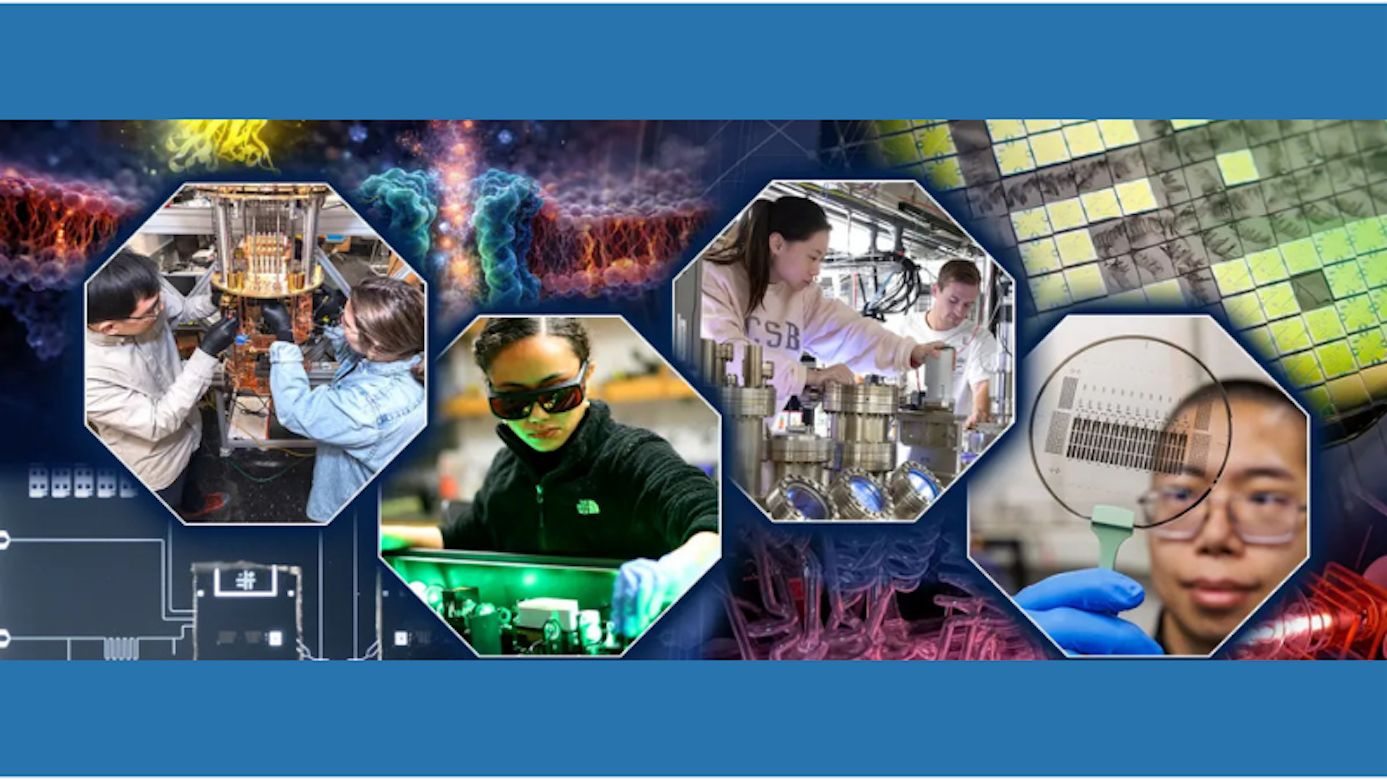
Courtesy of the National Science Foundation
The NSF's Quantum Leap Challenge Institutes are taking on some of the hardest scientific hurdles in the global race to create powerful quantum-based technologies.
Two UCLA computer scientists will help lead major national efforts to address some of quantum computing's biggest challenges, serving as co-principal investigators for separate research institutes backed by five-year, $37.5 million grants from the National Science Foundation.
The two institutes are among eight NSF Quantum Leap Challenge Institutes receiving more than $290 million in new funding to advance U.S. quantum science and accelerate the development of technologies with practical applications. UCLA Samueli School of Engineering professors Jason Cong and Jens Palsberg will each help lead one of the initiatives.
Cong is a co-principal investigator for the newly established Institute for Fault-Tolerant Quantum Systems, Architectures and Applications, led by Harvard University with UCLA Samueli and MIT as co-leads. Researchers will work to make quantum computers capable of performing useful calculations reliably despite the errors and noise that plague current systems. Cong will head UCLA efforts to develop software, algorithms and AI-based tools to improve their reliability and efficiency.
Palsberg, meanwhile, is co-principal investigator for the NSF Challenge Institute for Quantum Computation, a UC Berkeley–led research network that includes UCLA Samueli, UC Santa Barbara, Caltech and Stanford. Renewed with a five-year, $37.5 million grant, the institute will investigate the capabilities of quantum computation and develop new quantum technologies and applications. Palsberg, co-director of the Center for Quantum Science and Engineering at UCLA, and the UCLA team will focus on overcoming bottlenecks in current trapped-ion quantum computing systems and developing software that can compare different quantum technologies.
"Quantum computers have the potential to solve problems that are out of reach for today's computers, but we still have a lot of work to do to get there," Palsberg said.
The UCLA researchers hope their work will help identify where quantum computers can ultimately make the greatest difference.
Read the full story on the UCLA Samueli website.


