

© 2026 EPFL
LéXPLORE is the most advanced research platform ever built on a lake. It's equipped with cutting-edge instruments that collect high-resolution data for use in an array of fields.
The LéXPLORE platform and its circle of yellow buoys have been an integral part of the Lake Geneva waterscape near Pully for the past seven years - yet many of the nearby residents have no idea what goes on there. Nor are they aware that LéXPLORE is the most advanced research platform that exists on a lake. No fewer than 25 projects are currently being carried out on its 100 m2 surface, and 40 projects have already been completed there.
The floating research lab is decked out with high-tech instruments that scientists use to collect high-frequency data in a range of fields: chemistry, physics, ecology, microbiology, hydrology, technology development and even astrophysics. Around 20 EPFL research groups are involved in the program along with several units from Eawag - one of the world's leading water-research institutes - the University of Lausanne (Unil), the University of Geneva (UNIGE), CARRTEL (INRAE-USMB) in France and close to a dozen other research centers.
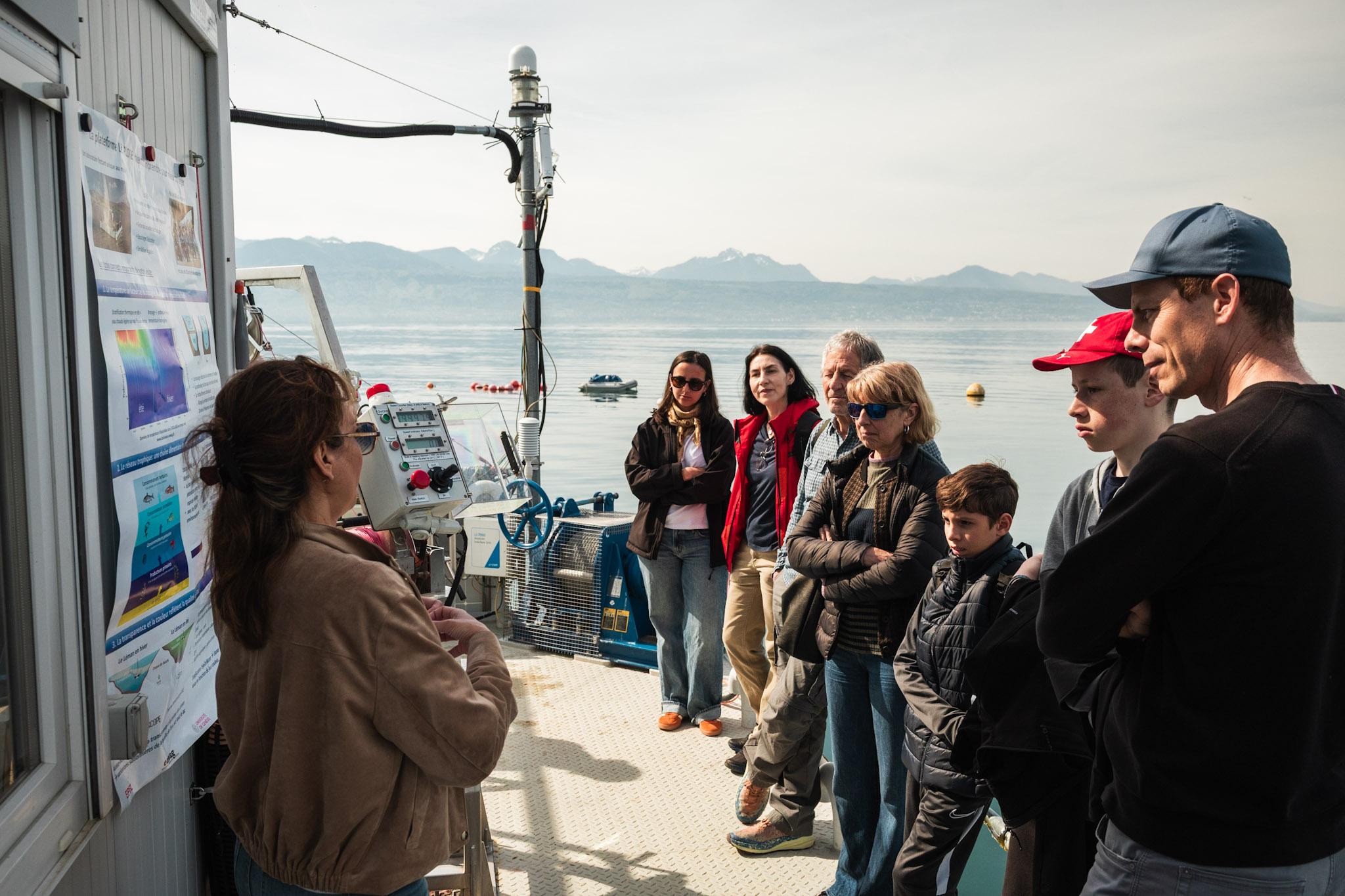
Not only does LéXPLORE bring together researchers from many different disciplines and organizations, but it also gives members of the general public an opportunity to learn more about science. One example is the guided tours held in the summer; another is the Lémanscope citizen-science initiative involving EPFL, Eawag, Unil and the Association pour la Sauvegarde du Léman (a Lake Geneva conservation association). Under Lémanscope, which ran for over two years, hundreds of citizens took measurements of water transparency and color all over the surface of the lake. These measurements were combined with the platform's high-frequency data and satellite images to give researchers unique insight into seasonal and spatial variations in lake water quality.
A complex ecosystem
By enabling continuous, real-time measurements and data collection, including at night, LéXPLORE provides rare and valuable information for studying many aspects of lake ecosystems. These include their complex biochemical processes, the dynamics of water mixing and circulation, and their biodiversity, not to mention their role in the carbon cycle, in the flow of greenhouse gases and, more broadly, in the changes occurring in the regional and global climate.
One thing that visitors to LéXPLORE are often curious about is the quagga mussels now found here. Several research groups are studying this extremely invasive species, which first appeared in Lake Geneva around ten years ago and has since settled in and colonized the entire lake. They have altered the lake's ecosystem, clog up pipes - including those used for EPFL's cooling system - and weigh down boats.
Visitors are also particularly interested in plankton, which they can observe on the platform with a microscope. Research is being carried out on these organisms to better understand their role in the environment and in lake biogeochemistry, their vertical migration patterns, the conditions causing them to occasionally proliferate, and how rising water temperatures are affecting the plankton population and the flow of carbon into sediment.
Plastic and flashing cosmic particles
LéXPLORE is a useful tool for pollution detection and analysis. From the platform, scientists can observe the effects of microplastics, for example - how they accumulate, become distributed in the water column and change in concentration over time. Some researchers are looking specifically at how microplastics interact with the lake environment and indigenous microorganisms depending on the season, temperature and other variables. Another study is examining contamination by synthetic chemicals from pesticides, fertilizer, drugs and more.
For engineers, the platform is ideal for developing and testing new technology under real-world conditions. The latest equipment includes smart sensors, probes, drones, underwater robots for collecting deep-water samples and inspecting critical structures, a holographic microscope camera for observing microorganisms and particles, and rain gauges for measuring and characterizing rainfall in a given area.
There are also some unexpected uses for LéXPLORE, such as in astrophysics. The platform's roof has sensors enclosed in light-tight compartments that can detect cosmic ray particles from the Milky Way. These particles sometimes hit the lake surface and generate high-energy flashes of light.
Information and registration here.


