
Easy-to-use adaptive immersive technologies incorporating augmented reality (AR) can motivate learning, social engagement and cognitive development in early childhood, according to new research.
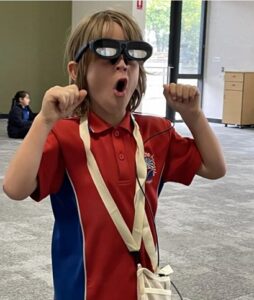
The Flinders University study found that innovative artificial intelligence-driven AR smart glasses - combined with group work, iPad exercises and other classroom activities - resulted in high levels of engagement and cohesive classroom behaviour when used to teach a science topic in an Australian junior primary school.
The study put cutting-edge AR 'Immersive Visual Learning Environment' (AR-IVLE) technology on trial with 84 Year 1 and 2 students and five teachers in a Victorian primary school, enabling researchers to assess how effectively young children engaged in their learning experience.
Education experts at Flinders University, the Australian Catholic University (ACU) and Zhejiang Normal University in China were excited by the results of this multi-modal learning.
"Unlike traditional touchscreen devices or even bulky 3D glasses, these AR glasses deliver real-time, adaptive feedback aligned with individual learning preferences," says Flinders University Professor Gretchen Geng, lead author in a new article published in the Journal of Science Education and Technology.

"With wider application of the AR-IVLE, future research will be conducted to investigate and identity challenges and opportunities to assist children's science learning in this highly engaging and seamless learning environment," she says.
The AR glasses were synchronised with iPads and Apple TVs, enabling shared viewing of digital content to foster collaboration between pupils and teachers. The rich sensory input and kinaesthetic experiences during play-based learning revealed enhanced engagement, increased interaction with virtual objects, and improved academic outcomes.
The virtual world brought to life lessons about ants and their nest-building communities, which researchers say can prove complex and difficult for young children to learn in traditional classroom settings.
During the trial, the teachers asked the students to sit in front of the classroom as a whole group first.
Under the teachers' supervision, each student took turns using the AR smart glasses for approximately 5 to 7 minutes, while the remaining group members observed the experience on the iPad. This approach meant the students who were not wearing the glasses remained actively engaged by following and observing the AR-IVLE in real time through the iPad display.

Students who wore AR smart glasses could walk around the room and observe the ants and ant nest from different angles. They used various gestures and were able to zoom in and out to interact with the virtual learning objects. Meanwhile, the group members were seen communicating with each other verbally, giving directions such as locating the queen ant, worker ants, male ants and the chambers.
Some of the observations from whole-class feedback and follow-up assessment, included:
- Students using AR smart glasses in immersive virtual learning environments showed dramatically higher engagement than those using traditional iPad or tablets. Stronger focus, higher energy levels, more creativity and more active participation were observed during learning activities.
- Learning outcomes were also enhanced, with students demonstrating deeper understanding, richer ideas and stronger problem-solving skills through their work and reflections.
- When AR smart classes were paired with iPads or classroom TV for group activities, social engagement increased significantly, encouraging greater collaboration through shared exploration, discussion and teamwork.
Researchers say future multisite studies across diverse early childhood settings and socio-economic contexts could be conducted to validate and extend these findings.
Longer-term studies with reduced researcher involvement are needed to better distinguish novelty effects from sustained engagement, they say.

The latest article, Engaging Young Minds: How Smart Augmented Reality Glasses Transform Learning Experiences in AR smart glasses Immersive Virtual Learning Environments (AR smart glasses IVLE) 2026 by Gretchen Geng, Kathy Green, Amanda Telford (both ACU) and Yue Zhu (College of Teacher Education, Zhejiang Normal University, China), have been published in the Journal of Science Education and Technology (Springer Nature Link) DOI: 10.1007/s10956-026-10299-4.
Also see, 'AI-powered augmented reality glasses enhance interactive immersive learning for young children' (2025) by Gretchen Geng, Amanda Telford (ACU), Yue Zhu (Zhejiang Normal University, China) and Kathy Green (ACU) has been published in Interactive Learning Environments (Taylor & Unwin). Received 05 Apr 2025, Accepted 05 Nov 2025, Published online: 10 Dec 2025 https://doi.org/10.1080/10494820.2025.2590602
Acknowledgements: This research has obtained full ethical clearance (Ethics application: 2023-3299H) from the Ethics Committee in Australian Catholic University. All participants, including children and their parents, were asked for their informed consent.
The AR Pioneer technology company (ROKID) loaned six pairs of AR smart glasses and developed the smart AR teaching resources for the research project.


