
As climate change and human activities continually ramp up, fish are forced to find ways to adapt. As fish move around to find more suitable habitats as ocean conditions shift, regional fish distributions change - which can have huge downstream effects on local ecosystems. To predict future shifts in fish distributions, researchers looked at ecological niches, which are the basic conditions a fish needs to be able to live in a certain habitat. However, just like humans, not all fish have the same needs.
Detecting essential ecological niches over a broad spatial scale remains highly challenging. This is because some factors determining what these niches are can be "hidden" from human observation due to a lack of existing knowledge or ecosystem complexities. As long as these important clues remain hidden, it becomes harder to predict how fish distributions shift.
To unveil these hidden factors, a research team including Yutaka Osada, an associate professor from the Advanced Institute for Marine Ecosystem Change (WPI-AIMEC), conducted a large-scale survey using environmental DNA (eDNA). Instead of directly collecting DNA samples from each individual fish in the area, DNA is collected non-invasively from samples of seawater to get a broad picture of regional biodiversity. The water is full of shed skin, scales, and tissue from living things - all of which are full of genetic information useful to scientists.
Over a three-month period during the summer, the research team collected seawater samples at 528 coastal sites across Japan. By applying advanced data analysis to the resulting big data on fish distributions, the team utilized an approach to back-calculate hidden factors - which could not be directly measured - from the overall characteristics of the dataset.
The findings were published in Scientific Reports on February 17, 2026.
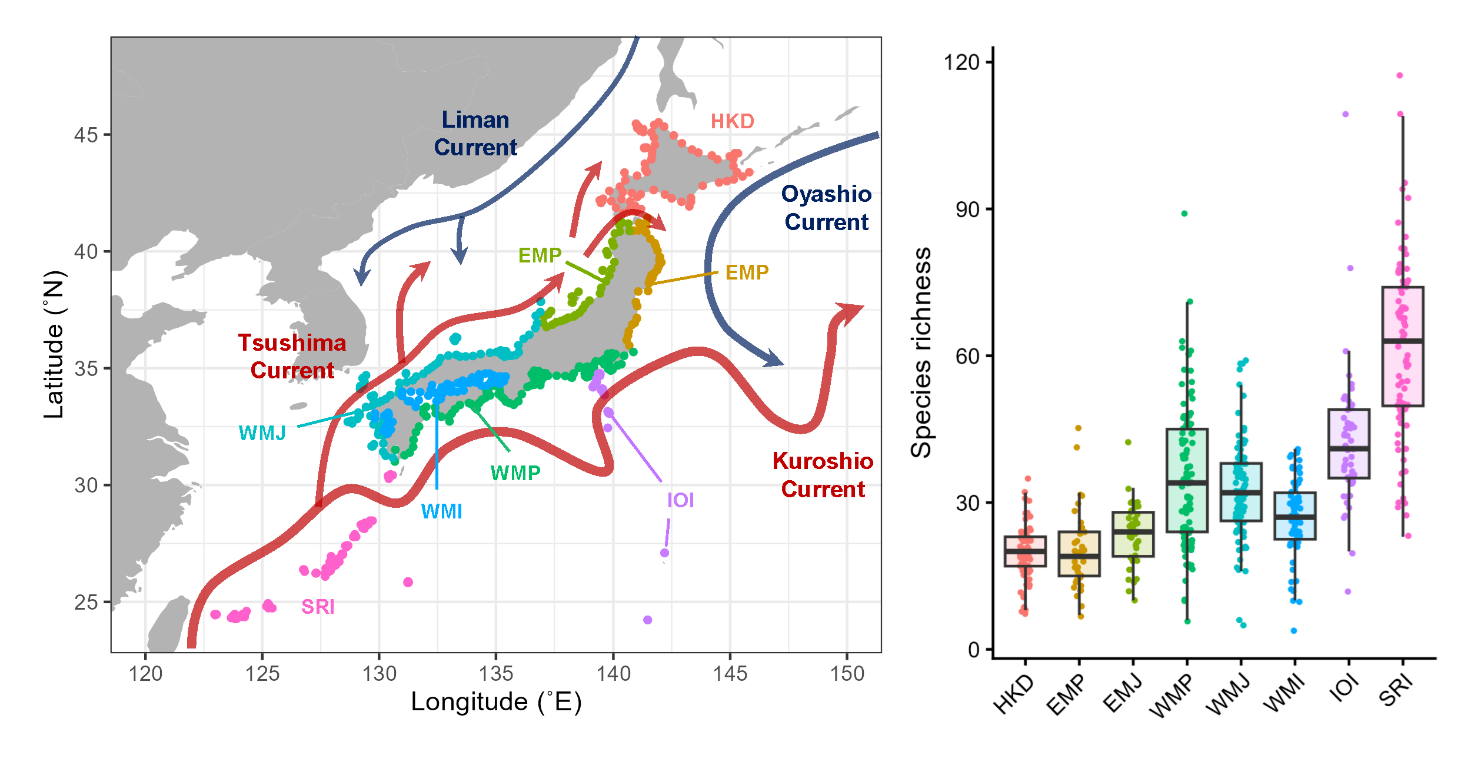
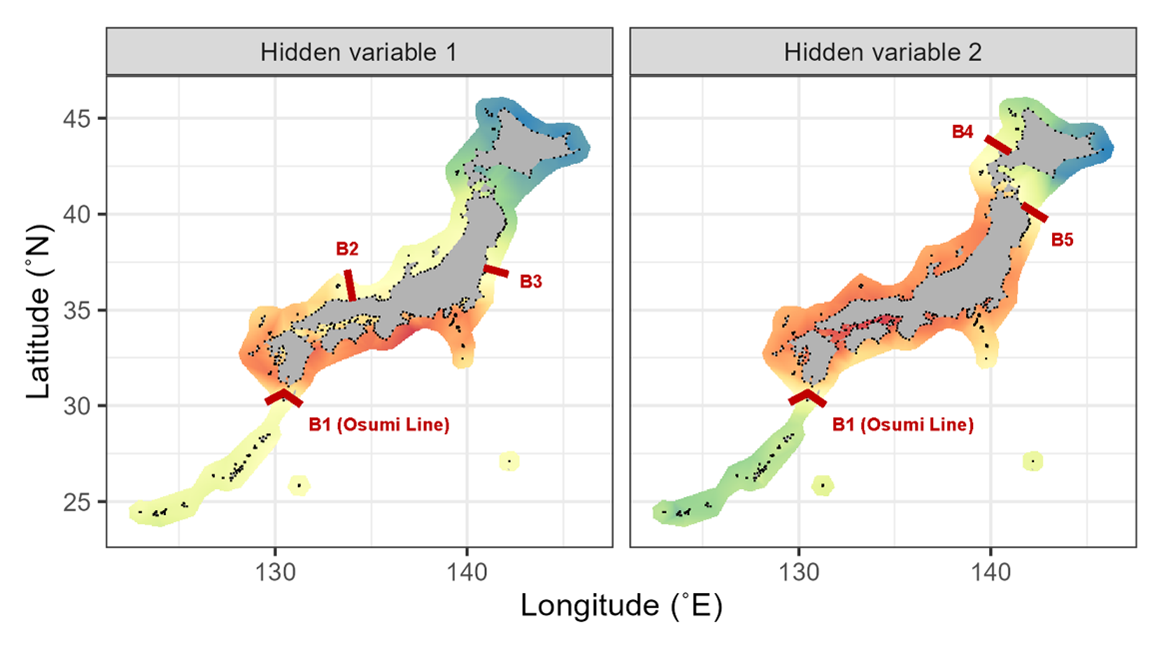
As a result of the survey, the team successfully detected a total of 1,220 coastal fish species (approximately 44% of all currently reported coastal fish species in Japan). Furthermore, data analysis revealed the existence of five "biogeographic boundaries" along the Japanese coast, where fish composition changes significantly. For example, at the boundary drawn near Yakushima Island (the Osumi Line), closely related species are distributed separately because they cannot cross the broad and fast-flowing Kuroshio Current. Overall, the findings indicate that ocean currents around Japan govern the distribution of diverse coastal fishes in many ways.
"Coastal areas serve as essential ecosystems that provide the majority of the marine fisheries resources supporting our daily diets - so it is crucial to track changes to how fish are distributed and how this can change in the future," says Osada.
Global warming may have severe impacts on coastal ecosystems not only by directly increasing seawater temperatures but also by altering the dynamics of ocean currents. Uncovering the complex processes of ocean currents that shape fish distributions is expected not only to deepen our understanding of current rich biodiversity but also to significantly improve the accuracy of predictions regarding how fish distributions will shift under future climate change scenarios.
Currently, the international community has established a "Nature Positive" goal aimed at halting and reversing biodiversity loss, making it an urgent priority to put ecosystems on a trajectory of recovery. It is anticipated that efficient observation networks based on eDNA technology such as the survey in this study alongside the novel analytical framework presented in this study, will serve as a powerful driving force to halt biodiversity loss not only in Japan but globally, ensuring that rich ecosystem services are passed down to the next generation.
- Publication Details:
Title: Large-scale environmental DNA survey reveals niche axes of a regional coastal fish community
Authors: Yutaka Osada, Masaki Miya, Hitoshi Araki, Hideyuki Doi, Akihide Kasai, Reiji Masuda, Toshifumi Minamoto, Satoquo Seino, Teruhiko Takahara, Satoshi Yamamoto, Hiroki Yamanaka, Mitsuhiro Aizu-Hirano, Keiichi Fukaya, Takehiko Fukuchi, Ryo O. Gotoh, Masakazu Hori, Midori Iida, Tomohito Imaizumi, Tadashi Kajita, Takashi Kanbe, Tanaka Kenta, Yumi Kobayashi, Tomohiko Matsuura, Hiroki Mizumoto, Hiroyuki Motomura, Hiroaki Murakami, Kenji Nohara, Shin-ichiro Oka, Tetsuya Sado, Hiroshi Senou, Koichi Shibukawa, Tomoki Sunobe, Hiroshi Takahashi, Koji Takayama, Katsuhiko Tanaka, Hisashi Yamakawa, Satoru Yokoyama, Seokjin Yoon, Michio Kondoh
Journal: Scientific Reports


