
Key takeaways
- Wearable sensors that use microneedles to painlessly take samples at skin level could help personalize health care and enable precision drug dosing in real time, but many have been limited by weak signals and damage caused by friction in tissue.
- A UCLA-led team developed a microneedle platform that operated continuously for six days in rats while improving signal quality and resistance to abrasion.
- In preclinical studies, the technology not only tracked drug levels but also revealed impaired kidney and liver function based on how quickly drugs cleared from the animals' systems — including identifying early kidney injury before conventional blood tests indicated a problem.
Wearable technologies are starting to reshape how people manage health. Continuous glucose monitors that measure blood sugar levels in diabetes patients have already shown the power of tracking an important molecule in real time. The next leap is to track other medically important molecules. However, doing so is far more difficult because most of those molecules are present at much lower concentrations than glucose.
One area such wearable technologies could transform is drug therapy. Many powerful medications are still managed through blood tests that offer only occasional snapshots of how a patient's body is processing treatment. For drugs that must be dosed precisely to avoid harm, clinicians can miss the point at which dosing becomes ineffective or begins to threaten the organs responsible for processing the drug.
A UCLA-led research team has now developed a microneedle sensor platform designed to address that problem through continuous, minimally invasive monitoring in skin. In a study published in Science Translational Medicine, the researchers showed in rats that the sensors could operate continuously for six days, track drug concentrations over time and provide insight into kidney and liver function by measuring how quickly the body cleared those drugs.
The advance could support a future in which doctors are better able to personalize dosing in real time and intervene earlier when organ function begins to decline. Beyond drug monitoring, the technology could also help bring continuous molecular monitoring to a wider range of conditions where changes over time carry important information about health and treatment response.
"We show that measurements taken just a millimeter beneath the skin can reveal clinically actionable information about organs deep inside the body," said corresponding author Sam Emaminejad, an associate professor of electrical and computer engineering at the UCLA Samueli School of Engineering and a member of the California NanoSystems Institute at UCLA or CNSI. "By continuously monitoring certain drugs and how the kidneys or liver process them, we can detect organ dysfunction earlier and guide treatment with greater precision."
Designed for signal quality and durability
Typically, a microneedle sensor works by carrying sensing molecules on its surface that are designed to recognize a specific target. When a target chemical binds to one of those sensing molecules, it changes the electrical signal generated at the needle.
The researchers' reimagined sensor design protects those sensing molecules while also greatly increasing the microneedle's sensitivity.
It does so through a strongly adhered gold coating with nanoscale cavities — tiny surface features visible only at the scale of billionths of a meter. When sensing molecules are attached, many of them settle inside those cavities, where they are better protected from abrasion by the skin and from buildup of proteins and other biological material that can interfere with sensing.
That protection helped extend sensor operation in freely moving rats from only hours to six days. The textured surface also dramatically expands the active area available for detection.
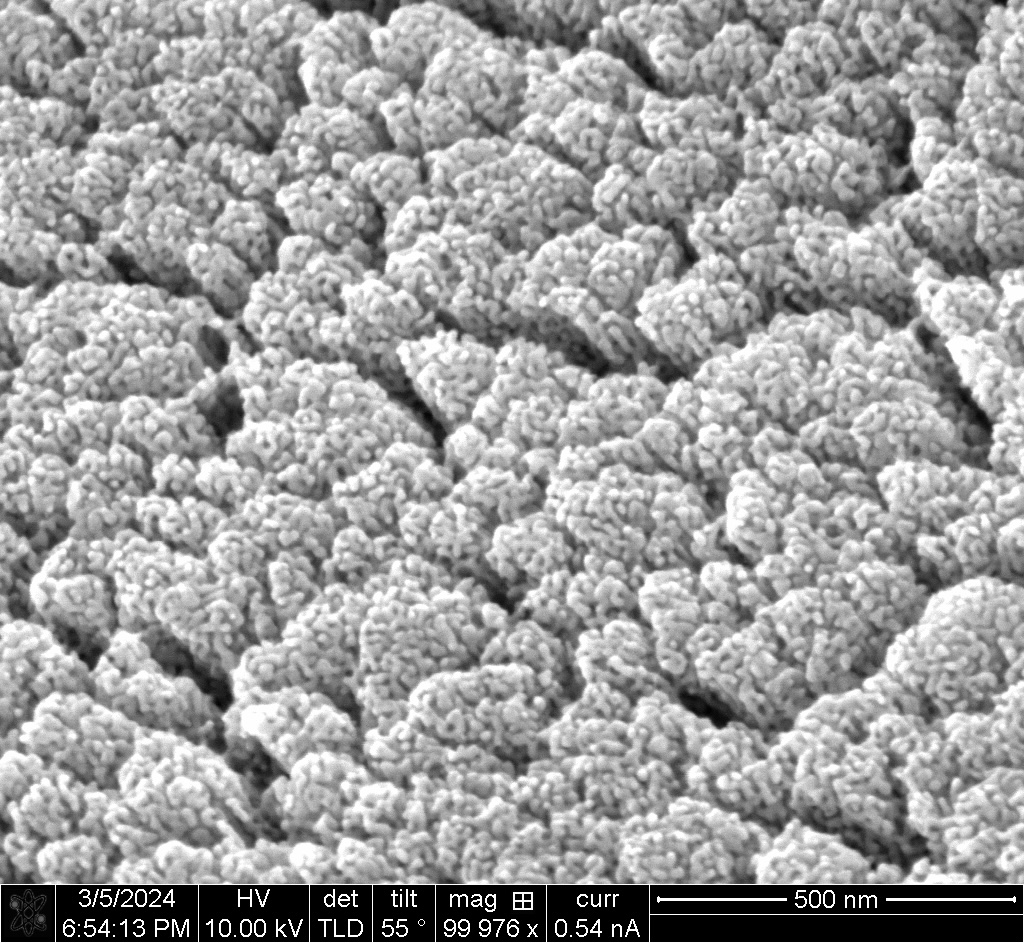
"By increasing the effective surface area to nearly a hundred times that of a smooth microneedle, we created much more room for sensing molecules while also helping protect them during use in tissue — increasing signal while reducing noise," said Jialun Zhu, the study's first author and a former member of Emaminejad's Interconnected and Integrated Bioelectronics Lab who graduated from UCLA in 2025.
Because the researchers' technology is highly sensitive, a single microneedle was sufficient for monitoring a single molecular target. That creates room for a broader sensing strategy: Future versions could use different needles within the same patch to track multiple molecules at once. The researchers also showed that the platform could support more than one type of sensing chemistry, working with approaches based in DNA and in engineered antibodies.
With future manufacturing in mind, the team designed the fabrication process to be scalable. The microneedles currently cost about $1.50 apiece to make in batch production.
Monitoring drug clearance and detecting organ damage earlier
In the study's preclinical experiments, the researchers used the microneedles to track two drugs: a chemotherapy processed by the liver and an antibiotic cleared by the kidneys.
"These are drugs where, if dosing is a little too low, they may not work as intended," Emaminejad said. "If dosing is too high, they can harm the same organs that are trying to clear them."
By continuously tracking how drug levels rose and fell, the researchers were able to infer how well those organs were functioning. Rats with liver injury showed delayed clearance of the chemotherapy drug, while rats with kidney damage showed delayed clearance of the antibiotic.
In one experiment, the team followed animals through two weeks of worsening kidney dysfunction and then two weeks of treatment intended to stimulate recovery. The microneedle data captured a corresponding decrease in drug clearance followed by improvement during recovery.
The researchers also found that during the first week of kidney injury, the microneedle measurements already indicated impaired drug clearance. At that point, blood creatinine — the conventional biomarker commonly used to assess kidney function — remained below thresholds signaling injury. That result suggests the platform may be able to detect clinically relevant changes earlier than standard testing in some settings.
The researchers next aim to move the technology toward human studies.
"We want to determine whether this kind of monitoring can help prevent damage from antibiotics and chemotherapies," Emaminejad said. "There is a real opportunity to better protect patients from the side effects of powerful therapies by recognizing trouble earlier and adjusting treatment sooner. More broadly, this approach could expand continuous molecular monitoring to many other targets, with the potential to guide care and reveal health problems earlier."
Study funding
The study — which involved researchers from UCLA, MIT, Northwestern University, Duke University and Stanford University — received funding from the National Institutes of Health, the Elisabeth K. Harris Foundation Trust, the Cystic Fibrosis Foundation, the Allan Smidt Charitable Fund, the Ralph Block Family Foundation, the Kleeman Fund, the Factor Family Foundation, the Chan Zuckerberg Biohub Chicago, CNSI's Elman Family Foundation Innovation Fund, the UCLA Vice Chancellor for Research and Creative Activities, a UCLA Graduate Dean's Scholar Award and a UCLA Electrical and Computer Engineering Department Fellowship.


